

Your favorite leather work boots might look rugged, but they often lack the structural integrity required to prevent a crush injury during a simple low-speed tip. In a global market now valued at over $14.5 billion, the engineering behind motorcycle riding boots has evolved far beyond basic leather. Choosing the wrong footwear usually leads to avoidable frustrations like foot fatigue on long tours or the discomfort of wet feet after an unexpected rain shower.
It's a common challenge to find gear that performs under pressure without looking out of place when you step off the bike. You need a reliable solution that balances certified safety with everyday aesthetics. This guide helps you master the technical details of modern footwear to find the perfect mix of crush protection and weatherproofing. We will decode the EN 13634:2017 safety ratings, explain impact protection levels, and help you choose a pair that provides all-day comfort for your specific riding style.
Key Takeaways
- Understand why lateral rigidity and reinforced heel cups are critical to preventing crush injuries during a slide or tip.
- Learn how to select the right motorcycle riding boots based on your discipline, from waterproof touring options to casual urban riding shoes.
- Identify essential safety features like dual-sided malleolus protectors and the current CE certification standards for 2026.
- Discover how to achieve the perfect fit across different brands and what to expect during the initial break-in period of professional gear.
- See how to coordinate your footwear with Cortech and Noru apparel for a complete, high-performance protection system.
Why Dedicated Motorcycle Riding Boots are Non-Negotiable
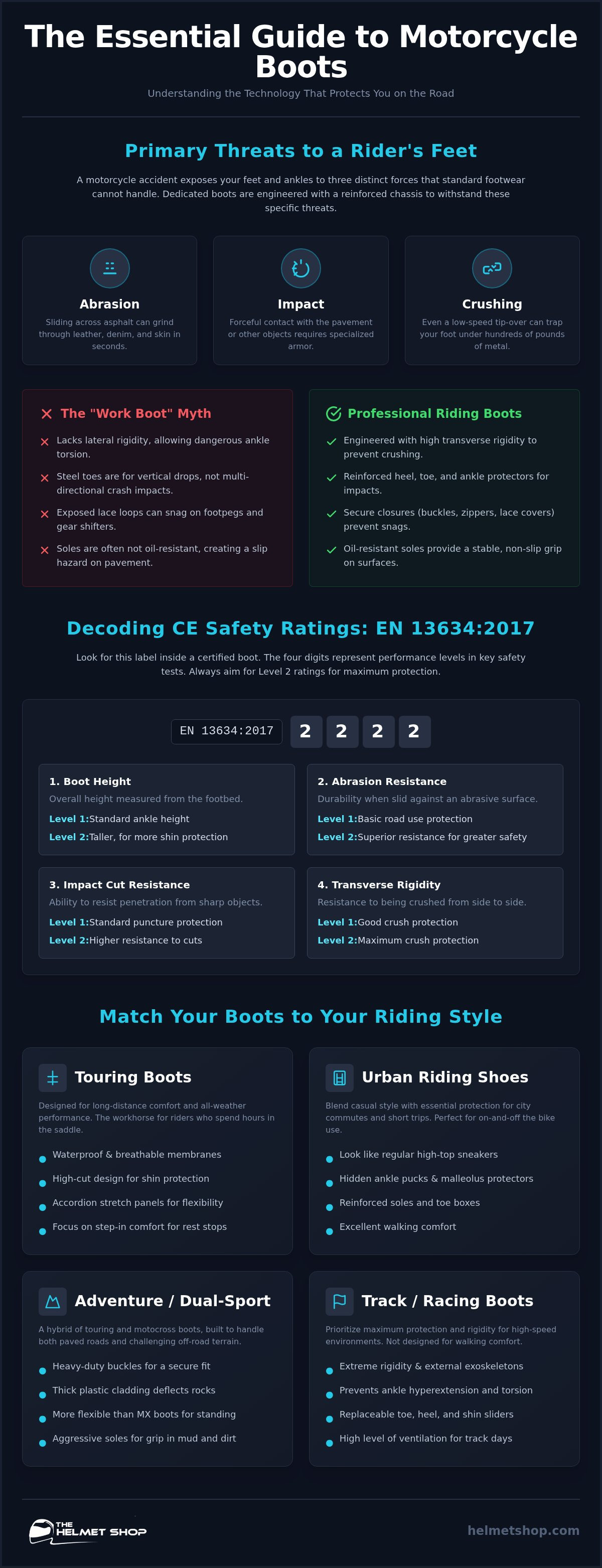
Your feet are the closest part of your body to the ground and the bike's mechanical components. During a crash, they face three primary threats: abrasion, impact, and crushing forces. Abrasion happens during a slide across asphalt. Impact occurs when your foot hits an object or the pavement. Crush protection is perhaps the most critical, as even a low-speed tip can trap your foot under hundreds of pounds of metal. Standard footwear simply isn't built to withstand these specific mechanical stresses. A dedicated motorcycle boot is engineered with a reinforced chassis to handle these extreme conditions.
Professional gear relies on internal shanks to prevent foot hyperextension and folding. This rigid insert runs through the sole, ensuring the boot maintains its shape during an accident. Material choice is equally important for long-term safety. Full-grain leather offers classic durability and natural abrasion resistance. However, 2026 designs frequently utilize advanced synthetic microfibers. These materials provide high-level protection with less weight and better resistance to repeated weather cycles than traditional hides. They don't stretch over time, which keeps the protective armor exactly where it needs to be.
Decoding CE Safety Ratings (EN 13634)
The EN 13634:2017 standard is the essential benchmark for safety. When you inspect a boot, look for a label with a four-digit code. These digits represent height, abrasion resistance, impact cut resistance, and transverse rigidity. A "1" meets the basic requirements for road use, while a "2" indicates the highest level of tested protection. For instance, a Level 2 rating for transverse rigidity means the boot can withstand significantly more crushing force before the foot is compromised. If you commute on highways or ride in high-traffic areas, prioritizing Level 2 ratings is a smart investment in your safety.
The "Work Boot" Myth
Relying on heavy-duty work boots is a common mistake among new riders. While they seem tough, they often lack the lateral rigidity needed to prevent ankle torsion or snapping. Steel toes are another concern. They are designed for vertical drops in a warehouse, not the multi-directional impacts of a motorcycle accident. Also, work boots often have large lace loops that can snag on footpegs or gear shifters. This can lead to a dangerous fall when you try to put your foot down at a stop. Professional motorcycle riding boots solve this with lace covers or specialized closures. They also feature oil-resistant soles, giving you a stable, non-slip platform on greasy pavement.
Choosing Boots Based on Your Riding Style
Every rider has a unique set of requirements based on where and how they ride. A track enthusiast needs maximum rigidity, while a cross-country traveler prioritizes dry feet and step-in comfort. Aligning your motorcycle riding boots with your specific discipline ensures you don't end up with gear that's either too restrictive for the street or too flimsy for the dirt. This alignment is a core component of broader NHTSA Motorcycle Safety Guidelines, which emphasize that protective equipment should be fit-for-purpose and properly maintained.
Touring Boots: The All-Weather Workhorse
Touring riders often face eight-hour days in changing climates. These boots focus on a balance of flexibility and weather resistance. Look for integrated waterproof membranes that breathe while keeping moisture out. Brands like Tourmaster and Cortech excel in this category by adding accordion stretch panels at the Achilles and instep. These panels allow for a natural range of motion when shifting or walking through a rest stop. High-cut designs are standard here, providing essential shin protection against road debris and wind blast on the highway.
Urban Riding Shoes: Style Meets Safety
Urban gear has undergone a massive transformation recently. You can now find riding shoes from brands like Noru that look identical to high-top sneakers but contain hidden ankle pucks and reinforced soles. These are ideal for short commutes or social rides where you spend as much time walking as you do riding. The trade-off is height and absolute rigidity. While they offer excellent comfort, they don't provide the same shin or calf protection as a full-height touring boot. If your riding is primarily city-based, these are a practical compromise that ensures you stay protected without carrying a change of shoes.
Adventure and dual-sport riding require boots that can handle the weight of a falling bike in soft terrain. These models often look like motocross boots but offer more flexibility for standing on pegs for hours. They feature heavy-duty buckles and thick plastic cladding to deflect rocks and branches. Conversely, track and racing boots prioritize extreme rigidity. They use external exoskeletons to prevent the ankle from moving in any direction it wasn't meant to. Replaceable toe sliders are a must-have for the track, as they protect the boot's structure during deep leans.
Selecting the right category is the first step toward long-term riding satisfaction. You can explore a wide variety of these specialized motorcycle boots to find the pair that matches your specific bike and environment.
The Anatomy of a High-Quality Riding Boot
Understanding the internal architecture of motorcycle riding boots helps you distinguish between fashion-first footwear and genuine protective equipment. A high-quality boot is a multi-layered system designed to survive a high-speed slide while maintaining tactile control of your machine. Every component, from the stitching to the closure system, must work together to ensure the boot stays on your foot and the armor stays in place during an accident.
Reinforced heel cups and toe boxes provide the structural foundation of the boot. These are typically made from molded thermoplastics that resist deformation under extreme pressure. While the toe box protects against frontal impacts and prevents the front of the foot from being crushed, the heel cup stabilizes the rear of the foot. This stabilization is critical for preventing the foot from slipping out of the boot during a tumble. You should also look for gear shifter pads on the top of the toe. These textured overlays prevent the metal shifter from wearing through the boot material over time, preserving the structural integrity of the leather or microfiber.
The malleolus, or the bony protrusion of the ankle, is highly vulnerable in almost every type of motorcycle accident. Dual-sided ankle protectors are vital because you can't predict which side of your foot will hit the pavement first. These protectors act as a buffer, absorbing impact energy that would otherwise cause a fracture. Closure systems also play a secondary safety role. While zippers offer quick entry, they should be paired with a Velcro flap to secure the zipper pull. BOA dials and ratcheting buckles provide the most precise fit, ensuring the boot remains tight even under the stress of a slide.
Armor and Reinforcements
Modern boots use a mix of hard and soft armor to manage different forces. TPU (Thermoplastic Polyurethane) is commonly used for hard external shells because it slides easily across asphalt, reducing the risk of your foot catching and tumbling. In contrast, materials like D3O are used for internal padding. D3O stays soft and flexible during normal movement but hardens instantly upon impact to absorb energy. High-quality boots from brands like Cortech and Noru also integrate medial and lateral supports into the chassis to limit dangerous ankle rotation. If your bike has high-exit exhausts, check for integrated heat shields on the inner calf to prevent the boot from melting.
Soles and Grip Patterns
The sole is your primary interface with the motorcycle's controls. Vulcanized rubber soles are bonded directly to the boot, offering a lightweight and flexible feel that's great for tactile feedback. Stitched soles, often using a Goodyear welt, provide a more traditional feel and allow the boot to be resold after years of use. A defined heel is essential for locking your foot onto the pegs securely. Manufacturers also design specific flex zones into the forefoot. These zones ensure you can operate the rear brake and gear shifter with precision without fighting the stiffness of the boot's protective shell.
Ensuring the Perfect Fit and Maintenance
Properly fitting motorcycle riding boots are just as important as the armor inside them. If a boot is too loose, the internal protectors won't stay aligned with your joints during an impact. If it's too tight, you'll suffer from foot fatigue and restricted circulation on long tours. Sizing often varies significantly between brands. European sizing is the industry standard for many premium manufacturers, so you'll need to consult brand-specific conversion charts to find your match. Always measure your feet at the end of the day when they are slightly swollen to ensure the most accurate fit.
High-quality leather boots require a dedicated break-in period. They will feel stiff initially, particularly around the ankles and the shift pad area. This stiffness is a byproduct of the protective reinforcements we discussed in previous sections. Wear your new boots around the house for several hours before heading out on a multi-day trip. You should also choose your socks carefully. Avoid cotton, which traps moisture and leads to blisters. Instead, use moisture-wicking synthetic blends or merino wool to keep your feet dry and comfortable in all temperatures.
These technical fabric requirements are similar to what you'd find in professional athletic wear. To find high-quality apparel that manages moisture and supports performance during your off-bike training, you can learn more about REP Store.
Fitting for Performance
To verify the fit, perform the finger test. With your toes pushed to the front of the boot, you should be able to slide one finger behind your heel. This ensures there is enough room for your foot to move without the boot slipping off. Next, check for pressure points while in a riding position. Your foot's shape changes when you're on the pegs. A boot that feels comfortable while standing might pinch your instep when you're crouched. Finally, consider your pant style. If you wear your pants over your boots, ensure the boot's calf profile isn't so bulky that it prevents your gear from sealing properly.
Maintenance for All-Season Riders
Regular cleaning extends the life of your investment. Use a damp cloth to remove road salt, mud, and grime after every ride. If you ride in leather, apply a specialized leather conditioner at least twice a year to prevent the material from drying out and cracking. For boots with waterproof membranes, use a dedicated DWR (Durable Water Repellent) spray on the exterior. This prevents the outer material from soaking up water, which can block the membrane's ability to breathe. Inspect your gear regularly for worn soles or damaged sliders. Replacing these components early prevents permanent damage to the boot's chassis.
Finding the right balance of size and style is easier when you have expert guidance. You can browse our full selection of motorcycle boots to find a pair that fits your feet and your riding habits perfectly.
Safety from Head to Toe: Completing Your Gear Setup
Choosing high-quality motorcycle riding boots is the first step in a comprehensive safety strategy. While riders often prioritize helmets, your feet and ankles require equal attention due to their proximity to the road. A complete gear setup creates a protective envelope that manages abrasion and impact across your entire body. By coordinating your footwear with other technical apparel, you ensure that no single point of your anatomy remains vulnerable during a slide. Each piece of gear serves a specific mechanical purpose in the event of an accident.
The hierarchy of protection generally places the helmet and boots at the top of the list. These items protect the most complex structures of the human body. Once you have secured your feet, the next logical step is integrating your boots with armored motorcycle pants. This combination prevents the gap at the ankle where skin often becomes exposed during an accident. Buying within a brand ecosystem like Tourmaster or Cortech often guarantees that the shin guards in the pants overlap perfectly with the top of the boot.
Pairing Boots with Armored Apparel
Effective protection requires a seamless interface between your gear. When wearing motorcycle riding boots, the hem of your pants should securely cover the top of the boot or tuck inside, depending on the design. Noru and Cortech gear is engineered to work together, featuring adjustable cuffs that accommodate different boot thicknesses. This overlap is essential for keeping the weather out and the armor in place. It also ensures that if you go down, your pants won't ride up and leave your shins unprotected.
The Next Step: Modular Protection
Once your lower body is secure, prioritize your head with a modular motorcycle helmet. These designs offer the safety of a full-face helmet with the convenience of an open-face option during stops. High-end models like the Shoei Neotec 3 are perfect for touring riders who demand versatility without sacrificing safety ratings. You can explore our full collection of modular helmets to find a match for your riding style and complete your 2026 gear setup.
Are you ready for the open road? Use this final checklist before your next ride:
- Check that all closure systems on your boots are secure and functional.
- Ensure your pants properly overlap your boot tops to prevent gaps.
- Verify that your helmet visor is clean and the chin strap is tight.
- Confirm your gloves provide enough overlap with your jacket sleeves.
Step into Your Next Adventure with Confidence
Investing in high-quality motorcycle riding boots is a commitment to your long-term safety on the road. You now understand that these boots provide the lateral rigidity and crush protection that standard footwear simply cannot match. By selecting gear based on your specific riding style and ensuring a precise fit, you've taken a significant step toward a more comfortable and secure journey. Remember to maintain your gear regularly to preserve its protective qualities for years to come.
As an authorized dealer for world-class brands like Shoei, Arai, and HJC, we provide an expertly curated selection of Cortech and Tourmaster gear to meet every rider's needs. Our team is dedicated to helping you build a complete protection system with fast national shipping across the US. Once your feet are protected, don't forget the most critical piece of equipment in your kit. Browse our Modular Helmet Collection to complete your safety gear and experience the perfect balance of versatility and protection. Ride safe and enjoy the freedom of the open road.
Frequently Asked Questions
Can I just wear regular leather work boots for motorcycle riding?
No, regular work boots lack the lateral rigidity and specific crush protection found in dedicated motorcycle riding boots. While thick leather provides some abrasion resistance, work boots don't have internal shanks to prevent foot hyperextension or malleolus pucks to protect your ankle bones. Work boots also have large lace loops that can easily snag on your footpegs, potentially causing a fall at a stoplight.
What does the CE rating on motorcycle boots actually mean?
The CE rating indicates that the footwear meets the EN 13634:2017 safety standard for protective use. This rating is based on lab tests for four specific criteria: boot height, abrasion resistance, impact cut resistance, and transverse rigidity. You'll see a series of 1s or 2s on the label. A Level 2 rating means the boot provides superior protection against the mechanical stresses of a high-speed accident.
How tight should my motorcycle boots be when I first buy them?
Your boots should feel snug but shouldn't pinch your feet or restrict circulation. A firm fit is necessary to keep the internal armor properly aligned with your joints during an impact. You should have enough room to wiggle your toes, but your heel shouldn't lift more than a few millimeters when you walk. Keep in mind that leather models will soften and stretch slightly during the initial break-in period.
Are waterproof motorcycle boots actually breathable in the summer?
Yes, modern waterproof membranes are designed to be breathable by allowing sweat vapor to escape while blocking liquid water droplets. However, any boot with a waterproof liner will feel warmer than a fully perforated or mesh alternative. If you ride primarily in hot climates, you might find a ventilated boot more comfortable. For all-weather touring, a breathable waterproof membrane is the most versatile choice for year-round protection.
How long do motorcycle riding boots typically last?
A quality pair of motorcycle riding boots typically lasts between three and five years with regular use. Their lifespan depends heavily on how well you maintain the materials. Cleaning off road salt and conditioning the leather prevents the chassis from cracking over time. Some premium brands offer replaceable soles and toe sliders, which can significantly extend the life of the boot if the upper remains in good condition.
What is the difference between a mid-cut and a full-height boot?
The primary difference is the level of shin and calf protection. Full-height boots are the standard for touring and racing because they cover the lower leg and prevent the pant leg from riding up during a slide. Mid-cut boots, or riding shoes, are designed for urban commuting and short trips. They offer essential ankle protection and a casual look but leave your shins vulnerable to debris and engine heat.
Do I need different boots for different types of motorcycles?
Your boot choice should depend on your riding discipline rather than the specific bike you own. An adventure rider needs stiff, tall boots for off-road impacts, much like the protective gear needed when operating a high-performance Yamaha Banshee for sale in rural environments. A track rider, conversely, requires a rigid exoskeleton to prevent ankle torsion. If you use a cruiser for long-distance travel, a touring boot from a brand like Tourmaster provides the best balance of comfort and weatherproofing regardless of the motorcycle's brand.
Should I buy boots with laces or zippers?
Zippers are generally preferred for safety and convenience because they don't have loops that can snag on your bike's controls. Most professional boots use a side zipper protected by a large Velcro flap to keep it secure during a slide. Laces offer a more customizable fit for different foot shapes, but you must ensure they have a cover or a lace-keeper strap to prevent them from catching on the gear shifter or footpegs.


