

Last Updated: November 9, 2026
Quick Summary
To choose motorcycle luggage for sport bikes without saddlebags, measure your tail and seat space first, then check clearance for the exhaust, tire, and bodywork. Pick a low-profile tank bag plus a rackless roll-top tail bag, and match capacity to your trip.
- Measure the flat seat space, width to the tail light, and height to the tail's highest point.
- Keep at least a finger's width of gap above the exhaust at its hottest point.
- A tank bag plus a roll-top tail bag covers commuting and weekend trips without bolts.
- Route straps clear of the chain, sprocket, rear wheel, and exhaust, then tug the bag to test.
- Keep heavy items low and centered, since a tail-heavy load makes the front feel light.
Table of Contents
- Step 1: Measure Your Sport Bike's Actual Mounting Space
- Step 2: Check Fit, Clearance, and Bodywork Before You Buy
- Step 3: Pick a Tank Bag for Sport Bike Ergonomics
- Step 4: Choose a Tail Bag Motorcycle Riders Can Mount Without a Rack
- Step 5: Compare Rackless Motorcycle Luggage System Options
- Step 6: Get Motorcycle Luggage Mounting and Fit Right
- Step 7: Match Capacity and Protection to Your Trip
- Kit Your Sport Bike for the Next Ride
- Frequently Asked Questions
Step 1: Measure Your Sport Bike's Actual Mounting Space
Learning how to choose motorcycle luggage for sport bikes without saddlebags starts with a tape measure, not a shopping cart. At Helmet Shop, we tell riders the same thing: your bike's bodywork decides what fits long before your budget does.
Sport bikes leave very little room for bags. Measure three things before you buy:
- The flat space on your rear seat or pillion pad
- The width between your tail light and the rear of the seat
- The height from the seat surface to the highest point of the tail
Write those numbers down. A compact bag that fits your measurements beats a bigger bag that rubs paint.
Motorcycle safety guidance from the National Highway Traffic Safety Administration reminds riders that unsecured loads affect handling. Your measurements are the first step toward a load that stays put.
Step 2: Check Fit, Clearance, and Bodywork Before You Buy
Fit checks come before features. A bag that touches your exhaust, tire, or rear shock will damage itself and your bike.
Run through this checklist with the bag mocked up or measured against your notes:
- At least a finger's width of gap above the exhaust, measured at the hottest point (usually the mid-pipe or catalytic converter)
- No contact with the rear tire under full suspension travel, compress the rear by loading the seat or using a ratchet strap
- Straps clear of brake lines, wiring, turn signals, and the rear brake reservoir
- Bag sits behind your hips, not against your lower back, so you can still move on the seat
- Nothing blocks the tail light, license plate, or rear reflector
- Bag does not interfere with the passenger seat or grab rail if you ride two-up
Sport-bike-specific fit issues you will actually encounter:
Seat shape. Most sport bikes have a narrow, sloped pillion pad. A flat-bottomed tail bag can rock side to side on that slope. Look for a bag with a contoured base or add a non-slip pad underneath.
Exhaust heat. Undertail exhausts and high-mounted cans radiate heat directly at the rear of the seat.
Bodywork curves. Sport bike tails taper and curve. A bag with rigid sides can press against painted panels and rub through the clear coat.
Suspension travel. The rear wheel moves several inches through its stroke. A bag that looks clear at rest can contact the tire under braking or over a bump.
Rider position. Sport bike ergonomics lean you forward. A tall tank bag becomes a chest barrier, and a wide tail bag can catch your heel when you shift your weight in corners.
Carbon fiber, aluminum, and plastic tanks also rule out magnetic mounts. Check your tank material before you fall in love with a magnetic bag.
What most guides miss is that clearance changes when a passenger rides. That same loaded-clearance check matters on supermoto builds, where secure mounting keeps luggage clear of moving parts.
Step 3: Pick a Tank Bag for Sport Bike Ergonomics
A tank bag for sport bike use has one job: keep essentials close without crowding your chest. Sport bike ergonomics lean you forward, so a tall bag becomes a barrier fast.
Look for a low-profile bag with a tilted top. That shape lets you glance at a phone or map without sitting up.
The Cortech Ct Micro 2.5 Tank Bag Black Os shows the pattern well. It measures 9" L x 4.5" H x 6.5" W, holds a phone under a clear top, and uses a magnetic mount with a steering stem stabilizing strap. A rubberized base protects your paint, and a waterproof zipper guards the main compartment.

If your tank is not magnetic, the Cortech Strp Mt Tank Bag Mount Kt Duraflex converts compatible Cortech bags to strap mounting with quick-release buckles.
Best for: riders who want phone access and small essentials within reach.
Step 4: Choose a Tail Bag Motorcycle Riders Can Mount Without a Rack
A tail bag motorcycle riders can strap down without drilling or bolting solves the sport bike storage problem. Rackless designs use cam-buckle straps, subframe loops, or seat straps instead of permanent hardware.
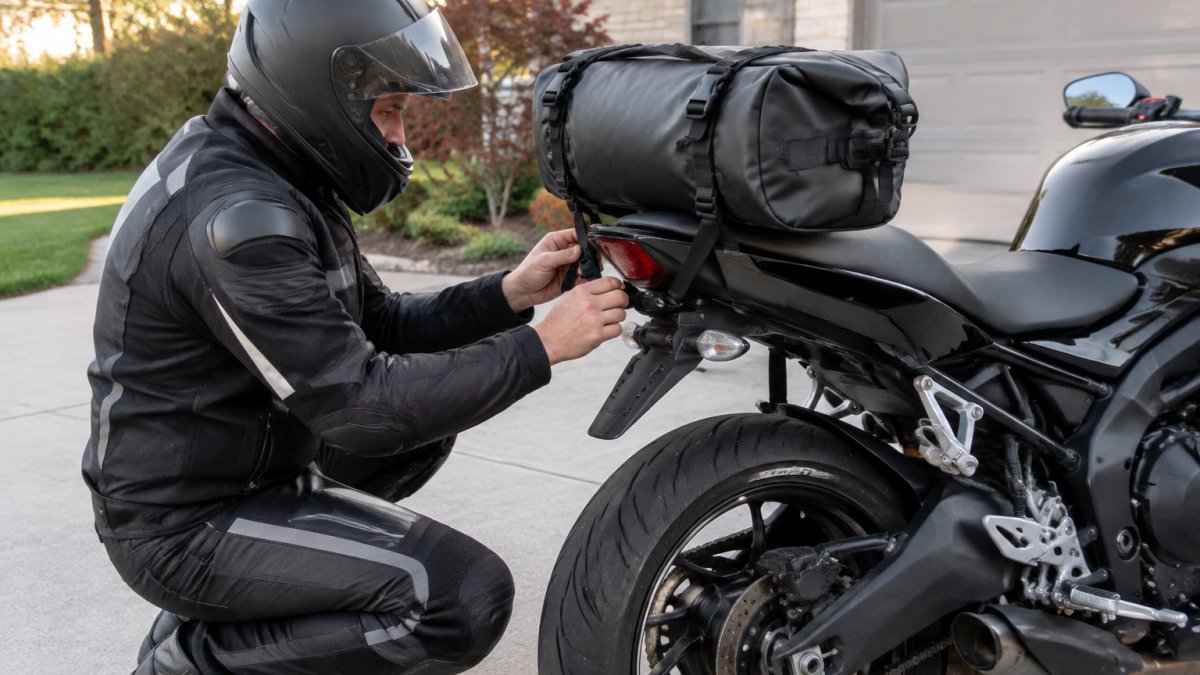
Roll-top designs work well here. The Kriega Rollpack 20 gives you 20 liters of 100% waterproof storage with a double-ended roll-top closure. It includes four Subframe Loops for bikes with no obvious frame to strap to.

Need more room? The Kriega Rollpack 40 offers 40 liters of 100% waterproof storage for longer trips. Both packs cinch down with compression straps when half empty, so the bag does not flop around.

Watch out: a loose tail bag can shift into your rear wheel. Always cinch straps tight and tug the bag side to side before you ride.
Step 5: Compare Rackless Motorcycle Luggage System Options
A rackless motorcycle luggage system trades carrying capacity for clean bodywork and quick removal. Here is how the main options stack up.
| Option | Capacity | Mounting | Best For |
|---|---|---|---|
| Tank bag | Small, phone and essentials | Magnetic or strap | Daily commuting |
| Tail bag | Medium, 20-40 liters | Cam-buckle straps, subframe loops | Weekend rides |
| Soft saddlebags | Medium to large, paired | Straps over seat | Touring without racks |
| Hard cases | Large, lockable | Requires racks or mounts | Long trips, security |
Soft saddlebags drape over the seat but can rub sport bike bodywork. Hard luggage needs mounting hardware most sport bikes lack. For a deeper look at alternatives, read our guide to motorcycle luggage for touring bikes.
Our pick for most sport bikes: a tank bag plus a roll-top tail bag. Two bags cover commuting and weekend trips without a single bolt.
Step 6: Get Motorcycle Luggage Mounting and Fit Right
Motorcycle luggage mounting and fit decides whether your gear survives the ride. Straps that loosen, hooks that slip, and bags that sag all cause trouble at highway speed.
Follow this mounting sequence every time:
- Set the bag on the seat or tank and check clearance again with the suspension compressed
- Route straps away from hot and moving parts, keep them clear of the chain, sprocket, rear wheel, and exhaust
- Cinch buckles until the bag cannot shift by hand, then tug it side to side and front to back
- Tuck loose strap ends so they cannot flap, catch the tire, or wrap the chain
- Recheck tension after the first few miles and again after the first fuel stop
Sport-bike-specific mounting hazards:
- Chain and sprocket interference. A loose strap end can be pulled into the chain and locked rear wheel. Route every strap above the swingarm or tuck it fully inside the bag.
- Exhaust contact. Straps that cross near the exhaust can melt. Use heat-resistant routing or keep straps on the seat side of the pipe.
- Bodywork abrasion. Straps that cross painted panels will rub through the clear coat over time. Use soft straps or add clear protective film at contact points.
- Turn signal and brake light blockage. A bag that covers the tail light or signals is a safety problem and can be a legal one. Check visibility from behind before you ride.
Payload limits. Every motorcycle has a gross vehicle weight rating (GVWR) and a payload limit printed in the owner's manual. That limit includes you, your passenger, and all luggage.
Weight distribution. Keep heavy items low and centered, close to the bike's middle. A tail-heavy load makes the front end feel light in corners and can cause headshake at speed.
Handling effects. Added weight changes suspension sag and steering effort. A loaded tail bag raises the center of gravity and slows turn-in. Test your setup on a familiar road at moderate speed before you load it for a trip.
Use bags with reinforced stitching and quality hardware. Duraflex buckles and alloy hooks hold tension better than generic plastic clips. Add a rain cover or choose a waterproof roll-top bag if you ride in wet weather.
Step 7: Match Capacity and Protection to Your Trip
Capacity should follow your packing list, not the other way around. Write down what you actually carry, then size the bag to it.
- Commuting: tank bag for phone, wallet, visor cleaning cloth, and water
- Day rides: 20-liter tail bag for a layer, tools, and a camera
- Weekend trips: 40-liter tail bag plus a tank bag for essentials
- Touring: rackless soft luggage or a mix of bags, checked against load limits
Protection matters as much as space. Waterproof liners or roll-top closures keep clothing dry. For theft prevention, never leave bags unattended on the bike, and carry valuables with you.
Weight placement changes handling too. Keep heavy items low and centered, close to the bike's middle. A tail-heavy load makes the front end feel light in corners.
Kit Your Sport Bike for the Next Ride
Choosing luggage for a bike with no saddlebags comes down to measuring first, checking clearance, and matching capacity to the trip. Get those three right, and a sport bike carries gear as well as any tourer.
Helmet Shop stocks the bags and mounting kits covered here, including Cortech tank bags and Kriega roll packs, alongside helmets and Bluetooth headsets. Orders over $49 ship free, and our 30-day returns policy applies to your purchase.
Read your tape measure, write down your clearances, and pick the bag that fits the bike you own. Start with a tank bag for daily rides, add a roll-top tail bag for weekends, and recheck your straps before every trip. Get started with Helmet Shop and build a luggage setup that fits your sport bike without a single permanent rack.
Frequently Asked Questions
What is the best rackless motorcycle luggage system for a sport bike?
A waterproof roll-top pack strapped to the pillion seat is the most versatile rackless option for a sport bike. The Kriega Rollpack 20 and Rollpack 40 both use cam-buckle straps that loop around the seat or subframe, and each ships with four Subframe Loops for bikes without an obvious anchor point. The 20L version suits commuting and day rides, while the 40L version covers weekend touring. Both have a double-ended roll-top closure and a taped-seam liner, so gear stays dry without a separate rain cover.
Can you use a tank bag on a sport bike?
Yes, but check your tank material first. A magnetic tank bag like the Cortech Ct Micro 2.5 uses a magnetic mount with a steering stem stabilizing strap for extra security. Carbon fiber, aluminum, and plastic tanks will not hold a magnet, so you need a strap-based mount such as the Cortech Strap Mount Tank Bag Mount Kit. On a sport bike, keep the bag small and low-profile so it does not interfere with your chest or the bars at full lock.
How do you keep a tail bag secure on a sport bike?
Use cam-buckle straps rated for the load rather than bungee cords, and anchor them to the subframe or passenger seat rather than bodywork panels. Cinch the bag down so it cannot shift under braking or acceleration, and recheck the straps after the first few miles. A half-empty bag should be compressed with its own compression straps so it does not flop around. Kriega's alloy hooks and included Subframe Loops support mounting on bikes without an obvious frame to strap to.
How much luggage capacity do you need for a motorcycle trip?
Start with your actual packing list, not a round number. A daily commute can be handled with a compact tank bag plus a small tail pack. An overnight trip usually needs 20 to 40 liters total once you account for clothing, tools, water, and a rain layer. For multi-day touring, combine a tank bag with a 40L roll pack. Waterproof construction matters more than raw capacity, because wet gear takes up space and ruins the trip.


