

Your motorcycle gear is not just a collection of accessories; it is a unified life-support system where the helmet serves as the primary anchor. It's common to feel overwhelmed by the technical shift to ECE 22.06 standards or the complex differences between DOT and Snell ratings. You need equipment that fits correctly and ventilates well, but you also want to know which premium brands actually justify their price tag. We understand that finding the balance between maximum safety and everyday comfort is a constant challenge for every rider in 2026.
This guide will help you master the essentials of rider safety with a comprehensive look at choosing the right helmets, apparel, and tech for a secure ride. You'll gain the confidence to select the perfect size and style while learning why industry leaders like Shoei and ARAI remain the gold standard. We provide a clear checklist of essential gear and explain how modern Bluetooth 5.4 and Mesh networking keep you connected on the road. From abrasion-resistant jackets to impact-rated boots, here is everything you need to build a professional-grade protective system.
Key Takeaways
- Adopt the ATGATT philosophy to build a foundational safety system that prioritizes impact protection and abrasion resistance.
- Evaluate different helmet styles and see why premium brands like Shoei and ARAI serve as critical long-term investments for your safety.
- Distinguish between textile and leather apparel while identifying the specific roles of CE-rated armor in your shoulders, elbows, and back.
- Identify the must-have features in motorcycle gear for your extremities, including palm sliders for gloves and crush protection for boots.
- Integrate modern communication tools like Sena or Cardi headsets to improve navigation and group safety through Mesh 2.0 technology.
The Essential Hierarchy of Motorcycle Gear for 2026
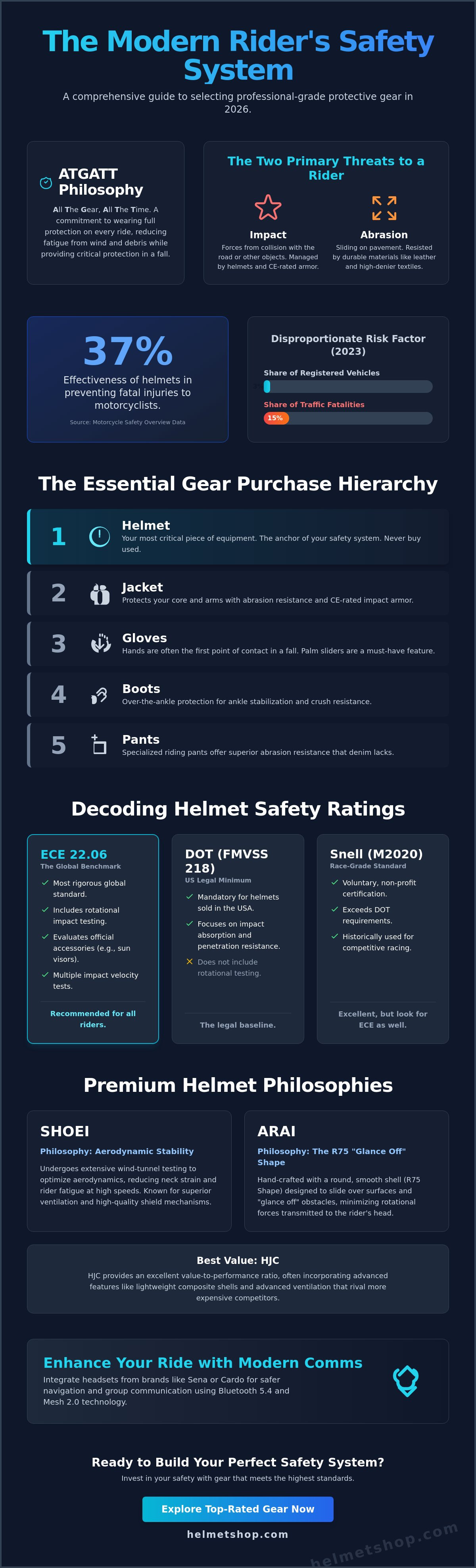
Effective motorcycle gear functions as a cohesive system designed to manage two primary threats: impact and abrasion. While many riders select items based on aesthetics or convenience, a structured hierarchy of protection ensures your most vulnerable areas are shielded first. The helmet is the undisputed anchor of this system. According to a Motorcycle safety overview, helmets are approximately 37% effective in preventing fatal injuries. Since motorcycles accounted for 15% of all traffic fatalities in 2023 despite being only 3% of registered vehicles, prioritizing your head protection is a logical necessity. Your initial investment should focus on the highest quality helmet you can afford before expanding to other layers.
Understanding ATGATT: A Lifestyle of Safety
ATGATT stands for All The Gear, All The Time. It is a commitment to wearing full protection on every single ride, regardless of distance, weather, or speed. Many accidents occur during short, familiar trips where riders often neglect their equipment. High-quality motorcycle gear does more than protect during a fall; it improves your endurance. By shielding you from wind blast and road debris, it significantly reduces rider fatigue. This keeps you more alert and responsive to road hazards. Wearing a complete kit also provides a psychological benefit, allowing you to focus on the technical aspects of riding with the confidence that you're well-protected.
Decoding Safety Ratings: DOT vs. ECE vs. Snell
In 2026, the ECE 22.06 standard is the most rigorous global benchmark. It replaced the older 22.05 standard by adding rotational impact testing and evaluating official accessories. In the United States, the DOT (FMVSS 218) certification remains the mandatory minimum for all helmets. While DOT is the legal baseline, many enthusiasts look for additional certifications. Snell Memorial Foundation ratings offer a voluntary, race-grade testing process that exceeds federal requirements. For the best protection, look for helmets that carry both DOT and ECE 22.06 labels. This combination ensures the helmet meets both legal requirements and modern, data-driven safety benchmarks.
If you're building your kit for the first time, follow this specific purchase order to maximize your safety per dollar spent:
- Helmet: Your most critical piece of equipment. Never buy a used helmet.
- Jacket: Essential for protecting your core and arms from impact and sliding.
- Gloves: Your hands are often the first point of contact in a slide.
- Boots: Over-the-ankle protection is necessary for stabilization and crush resistance.
- Pants: Specialized riding pants offer the abrasion resistance that denim lacks.
By treating your motorcycle gear as a complete protective suit rather than a series of separate items, you create a redundant safety net. This methodical approach ensures that no matter the riding conditions, your body is prepared for the unexpected.
Selecting a High-Performance Helmet: The Core of Your Safety Kit
Choosing a helmet is the most personal decision you'll make when selecting motorcycle gear. While full-face helmets offer the highest level of protection, modern modular designs provide incredible convenience for touring riders. Dual-sport helmets bridge the gap for adventure enthusiasts, and off-road models focus on maximum airflow and goggle compatibility. Each style serves a specific purpose, but the underlying goal remains consistent: mitigating impact forces according to NHTSA motorcycle safety guidelines. Your helmet must be more than a legal requirement; it should be a precision-engineered tool for survival.
Premium Brands: The Shoei and ARAI Difference
Every ARAI helmet is hand-crafted and follows the "R75" shape philosophy. This design prioritizes a round, smooth shell to help the helmet glance off obstacles during a slide, reducing rotational force. In contrast, Shoei helmets undergo extensive wind-tunnel testing to optimize aerodynamics and reduce neck strain. These premium brands are long-term investments because they use superior multi-density liners and high-quality shield mechanisms. For riders on a mid-range budget, HJC provides an excellent value-to-performance ratio. HJC often incorporates advanced ventilation systems and lightweight composite shells that rival more expensive competitors.
Finding the Perfect Fit: Measurements and Comfort
A helmet's safety is compromised if it doesn't fit your specific head shape. Most riders fall into the Intermediate Oval category, but those with a narrower profile require a Long Oval fit. To find your size, wrap a flexible measuring tape around the widest part of your head, about one inch above your eyebrows. Your new helmet should feel snug, almost tight, during the first 10 hours of use. This is the "break-in" period where the interior foam contours to your face. If you experience sharp pressure points on your forehead or feel the helmet "lift" at highway speeds, the fit is incorrect. A properly fitted helmet remains stable without causing headaches or hot spots.
Proper ventilation is another hallmark of high-quality motorcycle gear. Brands like Shoei and HJC engineer intricate channel systems that pull heat away from your scalp. This prevents overheating and shield fogging, keeping you focused on the road ahead. If you're ready to upgrade your protection, you can explore our curated helmet collection to find the right balance of safety and style for your next ride. Investing in a premium helmet today ensures you have the best technology available for years to come.
Protective Apparel: Balancing Abrasion Resistance and Comfort
While casual riders often reach for reinforced denim, dedicated motorcycle gear from technical brands like Tourmaster and Cortech offers a superior level of protection. Casual clothing, even when reinforced, rarely provides the same structural integrity as purpose-built apparel. According to IIHS motorcycle safety research, the use of protective clothing significantly reduces the risk of skin loss and deep tissue damage during a slide. Your choice of apparel should focus on two main functions: absorbing impact energy through armor and resisting friction through durable outer shells.
Leather remains the gold standard for pure abrasion resistance, making it the preferred choice for high-speed sport riding. However, modern textiles have closed the gap, offering better weatherproofing and climate control. Brands like Tourmaster and Cortech lead the industry in creating versatile gear for long-distance touring and daily commuting. If you're a new rider looking for a high-quality entry point, Noru apparel provides excellent protection and modern styling without the premium price tag. Selecting the right material depends entirely on your environment and how you intend to use the bike.
Jackets and Pants: The Outer Shell of Defense
Tourmaster is well-known for multi-season touring jackets that feature removable thermal liners and waterproof membranes. These jackets allow you to adapt to changing weather conditions on the fly. It's also vital to prioritize armored motorcycle pants over standard jeans. Unlike denim, which can fail in less than a second of sliding, dedicated riding pants feature reinforced panels in the seat and knees. For summer riding, mesh textiles provide maximum airflow while keeping the armor securely in place. Solid textiles are better suited for cooler temperatures or high-speed runs where wind protection is a priority.
The Importance of CE Ratings in Apparel
Armor is categorized by CE levels to indicate its impact absorption capabilities. CE Level 1 armor is the standard for most urban and commuting gear because it's thin and flexible. CE Level 2 armor is thicker and designed to absorb significantly more energy, making it ideal for high-speed touring or track use. The AA abrasion rating signifies that a textile garment has passed rigorous testing for seam strength and material durability at speeds typical of road touring. Beyond the rating, always check for reinforced stitching in high-impact zones like the shoulders and hips. Double or triple stitching ensures the garment stays together when it matters most.
By investing in motorcycle gear that balances these technical ratings with your personal comfort, you ensure that you'll actually wear your equipment on every ride. Protective apparel only works when it's on your body, so find a fit that allows for a full range of motion without being overly loose.
Gloves and Boots: Critical Protection for Your Extremities
Protecting your hands and feet is often secondary to selecting a helmet, yet these areas are highly vulnerable during even minor incidents. When a rider loses balance, the natural human instinct is to reach out and break the fall with the hands. Without specialized motorcycle gear, this leads to severe abrasion or fractured small bones. Proper riding gloves feature palm sliders made of hard plastic or ceramic. These sliders allow your hand to skid across the pavement rather than catching on the surface, which prevents the wrist from snapping or tumbling. Similarly, your feet require more than just a sturdy pair of work boots to survive the forces of a crash.
Impact protection is only half the battle. Your extremities also face constant environmental stress. High-quality boots shield your ankles from engine heat and flying road debris. Meanwhile, gloves must provide enough tactile feedback to operate the throttle, brakes, and clutch with precision. Balancing this "feel" with heavy-duty protection is the hallmark of professional-grade equipment. If you're looking to complete your safety system, you can browse our selection of gloves and boots to find the right fit for your riding style.
Riding Gloves: Grip, Feel, and Protection
Your choice of gloves depends on your environment. Short-cuff urban gloves are excellent for commuting because they offer high airflow and easy removal. For high-speed riding or touring, full-gauntlet racing styles are superior. These extend over your jacket sleeves to prevent skin exposure and provide extra wrist stabilization. Many riders prefer Cortech gear because of their pre-curved finger designs. This feature reduces the muscular effort needed to grip the bars, which prevents hand fatigue on long journeys. Modern gloves also include touch-screen compatible fingertips. This allows you to adjust your GPS navigation without removing your protection.
Motorcycle Boots: Beyond the Standard Work Boot
Standard work boots lack the specific reinforcements needed for motorcycling. A dedicated riding boot includes a reinforced toe box to prevent "shifter wear" and a stiffened sole to protect against crushing forces. Ankle stabilization is perhaps the most critical feature. It prevents the joint from twisting or hyperextending during a slide. You should also look for oil-resistant soles. These provide vital traction when you're stopped at intersections where oil and coolant often pool on the road. For all-weather touring, waterproof boots are a necessity. They keep your feet dry and warm, which is essential for maintaining the focus and reaction speed required for safe riding.
Enhancing the Ride with Bluetooth Communication and Gear Care
Modern riding involves more than just physical armor. Integrating smart technology and committing to a strict maintenance schedule ensures your motorcycle gear remains effective and reliable. Tech upgrades aren't merely for entertainment; they serve as critical tools for situational awareness and team coordination. When you combine advanced communication with proper equipment care, you create a safer and more professional riding environment. This final layer of the safety system helps you stay focused on the road while protecting the financial investment you've made in your kit.
Communication Systems: Sena vs. Cardo
Adding a bluetooth motorcycle headset significantly improves your safety by allowing for hands-free navigation and instant alerts. Sena and Cardo are the dominant forces in this space, both offering Mesh 2.0 technology. This protocol is a major advancement over traditional Bluetooth because it creates a self-healing network. If a rider in a group falls out of range, the system automatically reconnects them without requiring manual pairing. This allows you to keep your hands on the bars and your eyes on the road.
Voice commands are a modern necessity for safer navigation. You can adjust your volume, change tracks, or check your GPS status without ever touching the unit. Premium helmet manufacturers like Shoei and HJC design their liners with dedicated speaker pockets to accommodate these systems. This integration ensures the speakers don't create uncomfortable pressure points against your ears. High-quality audio combined with noise-canceling microphones allows for clear communication even at highway speeds.
Gear Maintenance and Longevity
Proper cleaning is essential for maintaining the visibility and structural integrity of your equipment. Use a dedicated visor cleaner and a microfiber cloth for your helmet shield and anti-fog inserts. Avoid using glass cleaners containing ammonia, as these can damage the protective coatings on the visor. For textile jackets and pants, use technical washes that don't strip away waterproof membranes. Standard laundry detergents often contain surfactants that can ruin the water-repellent properties of your motorcycle gear.
Storage habits also dictate how long your equipment lasts. Keep your leather apparel in a climate-controlled area to prevent the hide from drying or molding. Never store your helmet by hanging it on a mirror or a hook by the chin strap; this causes the internal EPS liner to compress and lose its protective shape. Instead, place it on a flat, stable surface or a dedicated helmet bag.
Even the best-maintained gear eventually needs replacement. The industry standard for helmets is the 5-year rule. The resins and foams used in construction naturally degrade over time, even if you've never had a crash. If your gear shows signs of frayed stitching, cracked armor, or a loose fit, it's time to retire the item. Regular inspections ensure that when you need your protection most, it's ready to perform.
Prepare for Your Next Journey with Professional Protection
Mastering your safety requires a systematic approach to protection. By prioritizing a high-performance helmet and layering with CE-rated apparel, you create a redundant shield against the unpredictable. We've explored the critical importance of modern standards like ECE 22.06 and the performance benefits of premium brands. Investing in quality motorcycle gear is a commitment to your longevity on the road. Proper maintenance and the integration of Mesh 2.0 communication units ensure your kit remains a reliable asset for every mile.
As an authorized dealer for Shoei, ARAI, and HJC, we provide the curated excellence you need for every journey. Our expert, rider-led support team is ready to help you find the perfect fit for your specific needs. We offer nationwide shipping on all premium riding apparel to get your equipment to your door quickly. Shop the best selection of Shoei, ARAI, and premium motorcycle gear at The Helmet Shop. Your next adventure is waiting. Ride with the confidence that only professional-grade protection can provide.
Frequently Asked Questions
What is the most important piece of motorcycle gear for a beginner?
The helmet is the most critical component of your safety kit. It serves as the primary defense against traumatic brain injuries and is the first item every rider should purchase. High-quality motorcycle gear starts with a certified shell that fits your head shape perfectly. While other items like jackets and gloves are essential, the helmet is the only piece of equipment that provides life-saving protection for your most vulnerable area.
How much should I expect to spend on a full set of quality motorcycle gear?
Costs vary significantly based on the level of protection and the brand you choose. Beginners often start with budget-friendly options like Noru apparel to cover the basics. More experienced riders often transition to premium brands like Shoei or ARAI as long-term investments. Your total investment depends on whether you prioritize entry-level functionality or advanced features like professional-grade abrasion resistance and integrated technology. Focus on building your kit according to the safety hierarchy.
Do I really need a full-face helmet if I am just riding a cruiser?
A full-face helmet is highly recommended regardless of the bike you ride. Statistics show that a significant percentage of helmet impacts occur in the chin and jaw area. Cruiser riders often prefer modular helmets because they offer the convenience of an open-face design at stops while providing full-face protection while moving. Choosing a style with a chin bar ensures you have maximum coverage during a slide, protecting your face from severe injury.
How often should I replace my motorcycle helmet?
You should replace your helmet every five years or immediately after any impact. The internal EPS liner degrades over time due to sweat, hair oils, and environmental exposure. Even if the shell looks perfect, the protective materials inside lose their ability to absorb energy. If you drop your helmet on a hard surface, the structural integrity may be compromised. This makes a replacement necessary to ensure the motorcycle gear performs as designed in an accident.
What is the difference between DOT and ECE safety ratings?
DOT is the mandatory legal standard for helmets sold in the United States. ECE 22.06 is the updated European standard recognized globally for its rigorous testing. Unlike DOT, ECE 22.06 includes specific tests for rotational impact and evaluates the safety of official accessories. Many riders prefer helmets that carry both certifications. This combination ensures the helmet meets basic legal requirements while also passing the most modern, data-driven safety benchmarks available today.
Can I use a regular leather jacket for motorcycle riding?
No, regular leather jackets are not suitable for riding because they lack essential safety features. Motorcycle-specific jackets use specialized stitching to prevent seams from bursting during a slide. They also include pockets for CE-rated armor in the shoulders and elbows. A standard fashion jacket will likely tear upon impact, offering very little protection against road rash or blunt force trauma. Always choose apparel designed specifically for the stresses of motorcycling.
How should motorcycle boots fit compared to normal shoes?
Motorcycle boots should fit snugly without any heel slip while allowing enough room for your toes to move. Unlike normal shoes, riding boots feature stiff soles and reinforced ankle protection to prevent crushing and twisting. You should feel a sense of stability and support that standard footwear doesn't provide. Ensure the boot allows you to operate the shifter and rear brake comfortably. A proper fit is essential for maintaining control and preventing foot fatigue.
Are Bluetooth headsets legal to use while riding a motorcycle?
Bluetooth headsets are legal in most jurisdictions, but you must check your specific state or local regulations regarding earplugs or headphones. Most systems, like those from Sena or Cardi, use speakers tucked into the helmet liners rather than earplugs. This helps you maintain situational awareness of your surroundings. Using voice commands allows you to keep your hands on the bars. Always ensure you can still hear ambient sounds like sirens or horns while riding.


