

The thickest armor on your knuckles might actually be the least important feature for your safety. While impact protection looks impressive, your ability to slide is what truly prevents serious injury during a high-speed fall. When you select your next pair of motorcycle gloves, prioritizing abrasion resistance over bulky padding is the most critical decision you can make. It's easy to get distracted by aggressive styling, but the technical reality of how materials react to asphalt determines your level of control and safety on the road.
You likely know the frustration of hands going numb from engine vibration or palms becoming slick with sweat during a summer ride. It's hard to feel confident on the throttle when your gear feels like a bulky oven mitt rather than a precision instrument. This guide will help you master the technical details of EN 13594:2015 safety ratings and modern armor so you can find the perfect balance of protection and tactile feel. We'll explore the latest 2026 innovations, including touchscreen compatibility and the specific benefits of various leather and textile blends for your unique riding style.
Key Takeaways
- Learn why slide protection and abrasion-resistant materials are more vital than impact armor alone for road safety.
- Understand the technical requirements of the EN 13594:2015 standard to ensure your motorcycle gloves meet verified safety benchmarks.
- Identify the specific features your riding style demands, ranging from high-speed wrist protection in gauntlets to the breathability of adventure gear.
- Master the "snug but not stiff" sizing rule to maintain a precise tactile feel and sharpen your control over the bike's interface.
- Explore how modern innovations like palm sliders and touchscreen-ready fingertips enhance both your protection and daily riding convenience.
Why Motorcycle Gloves are Your Most Critical Safety Layer
Human instinct is a powerful force. When you lose your balance, your brain sends an immediate signal to your hands to break the fall. Industry observations show that a vast majority of riders instinctively extend their palms during an accident. This makes your hands the first point of impact with the road. Without dedicated Motorcycle personal protective equipment, the resulting injuries can be life-altering. Protecting these complex tools is non-negotiable for any serious rider.
High-quality motorcycle gloves do more than just guard against road rash. They act as the primary interface between you and your machine. They dampen high-frequency engine vibrations that lead to hand numbness and shield your skin from harsh UV rays and wind chill. While standard leather work gloves might look tough, they lack the specialized construction and thread strength needed to survive the extreme forces of a high-speed slide.
To better understand this concept, watch this helpful video:
The Anatomy of a Motorcycle Slide
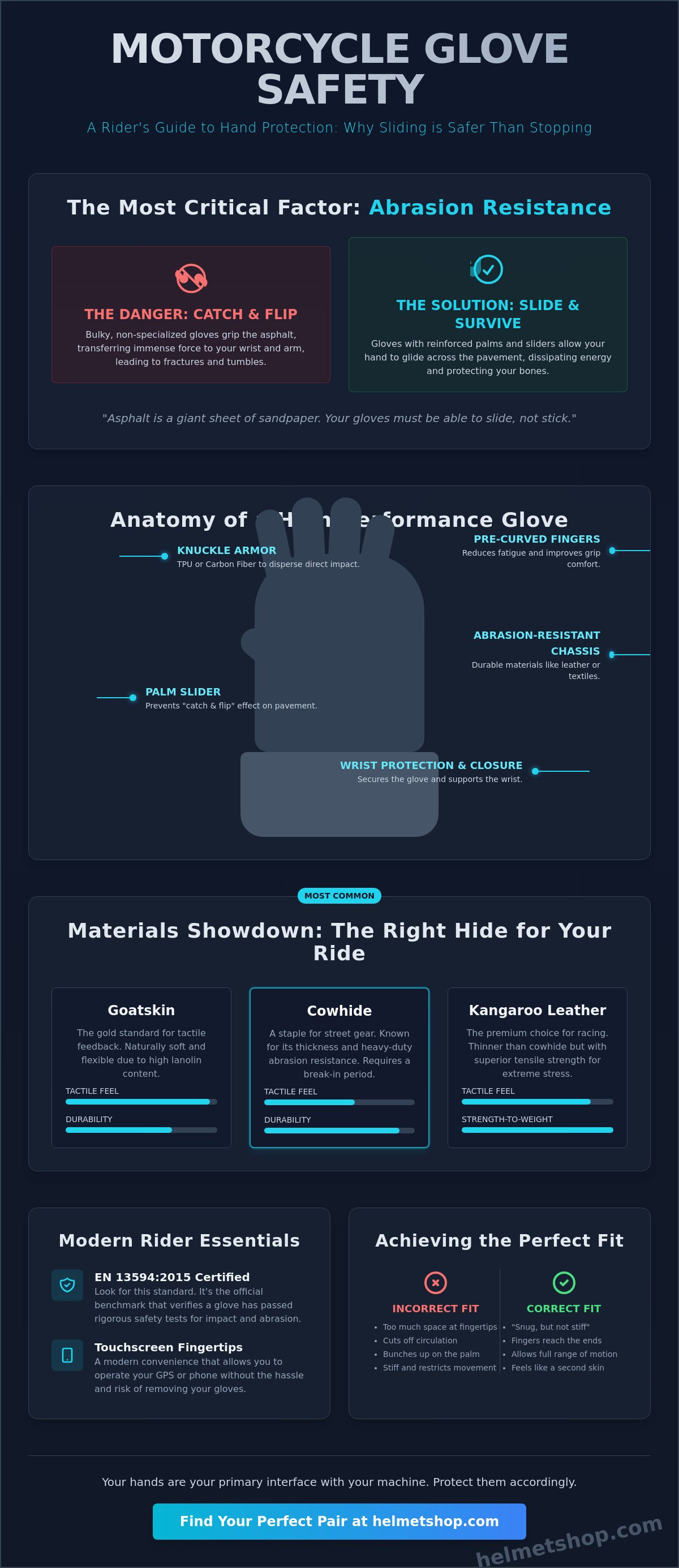
Street asphalt is essentially a giant sheet of heavy-grit sandpaper. At even moderate speeds, the friction heat generated during a slide can shred standard materials in a fraction of a second. Specialized motorcycle gloves utilize reinforced palms and palm sliders to prevent the "catch and flip" effect. This design allows your hand to slide smoothly across the pavement rather than gripping it, which significantly reduces the risk of wrist fractures. Manufacturers also pay close attention to seam placement. By moving seams away from high-impact zones, they ensure the glove won't burst open upon contact with the ground.
Control and Dexterity: The Performance Factor
Performance-oriented gear prioritizes tactile feedback. If your gloves are too thick or poorly constructed, you lose the ability to modulate the throttle or feel the bite point of your brakes. Modern designs often feature pre-curved fingers. This anatomical shaping reduces the effort required to hold the grips and prevents hand fatigue during long-distance tours. These precision-engineered gloves complement other high-end gear like Shoei helmets to create a complete safety kit. When every piece of equipment works together, you can focus entirely on the road ahead.
The Anatomy of Protection: Materials and Safety Ratings
Choosing the right materials for your motorcycle gloves is a balance between comfort and survival. While aesthetics matter, the technical composition of the glove determines how well it performs when friction meets the pavement. According to NHTSA motorcycle safety guidelines, proper hand protection is vital for maintaining a secure grip and preventing severe trauma during an impact. Modern gear uses a mix of organic hides and synthetic polymers to achieve this goal.
Leather Varieties: Which Hide is Best?
- Goatskin: This is the gold standard for riders who prioritize feel. It contains high levels of lanolin, making it naturally soft and flexible. It offers excellent tactile feedback for operating small buttons and switches.
- Cowhide: Known for its thickness and durability, cowhide is a staple for cruiser and street gear. It provides heavy-duty abrasion resistance but requires a "break-in" period to reach maximum comfort.
- Kangaroo Leather: This is the premium choice for racing. It is significantly thinner than cowhide but offers superior tensile strength. This allows for a lightweight glove that won't tear under extreme stress.
Beyond the chassis of the glove, hard armor plays a decisive role in safety. Knuckle protection typically utilizes Thermoplastic Polyurethane (TPU) or carbon fiber. These rigid materials disperse the energy of a direct blow, protecting the small bones in your hand from fractures. If you want to see how these materials are integrated into professional-grade gear, you can browse our curated selection of protective apparel.
Armor and Reinforcements
One of the most overlooked safety features is the palm slider. These high-density plastic inserts are placed on the heel of the palm. In a fall, they allow your hand to slide across the asphalt. Without them, your palm can "grab" the road, sending a massive amount of force into your scaphoid bone, which is one of the most common motorcycle-related injuries. Look for gloves that feature double-layer leather on the pinky finger and the outer edge of the hand, as these areas face the highest wear during a slide.
To ensure you are getting verified protection, look for the CE EN 13594:2015 label. This European standard is the global benchmark for motorcycle glove safety. A Level 1 rating is suitable for urban riding and lower speeds. Level 2 is more robust, designed for high-speed track use or long-distance touring. If you see a "KP" marking on the tag, it confirms the knuckle protection has passed specific impact testing. Finally, check for a secure wrist closure. A dual-closure system ensures the glove stays on your hand, even when subjected to the violent tumbling forces of a crash.
Matching Your Motorcycle Gloves to Your Riding Style
Selecting the right motorcycle gloves depends entirely on where and how you ride. A track-focused racer has vastly different technical requirements than a weekend adventure tourist or a daily city commuter. Matching your gear to your specific riding environment ensures you don't sacrifice safety for comfort, or vice versa. One pair of gloves rarely excels in every scenario, so understanding the trade-offs is essential for a smart investment.
Sport and racing environments demand the highest level of protection available. Full gauntlets are a necessity for these riders. They extend well past the wrist to provide a secondary layer of armor over your jacket sleeve. This overlap is crucial because it prevents the glove from being pulled off during a high-speed slide and protects the vulnerable wrist bones from direct impact. Conversely, cruiser and urban riders often prefer short-cuff designs. These offer a discreet aesthetic and are much easier to pull on and off for quick trips around town or commuting to work.
For those who spend long hours in the saddle, such as touring and adventure riders, the priorities shift toward versatility. You need gear that can handle 500-mile days and sudden weather shifts without causing hotspots or blisters. Off-road and dirt riders require the most mobility. Their gloves are typically lightweight and highly breathable. They focus on maximum grip feel and basic knuckle shielding to protect against brush and debris rather than the heavy abrasion resistance needed for asphalt.
Gauntlet vs. Short Cuff: The Great Debate
The choice between a gauntlet and a short cuff often comes down to a trade-off between safety and convenience. Gauntlets provide the most comprehensive coverage. They seal out the elements and ensure no skin is exposed between your glove and jacket. Short cuffs are the go-to choice for summer heat. They allow air to circulate up your sleeves, which helps regulate body temperature in stop-and-go traffic. Adventure riders often look for hybrid options. These mid-length gloves provide more protection than a short cuff but aren't as bulky as a full race gauntlet, making them ideal for mixed-terrain travel.
Seasonal Considerations
Temperature control is a major factor in preventing hand fatigue. Perforated leather is the best solution for summer riding. It maintains the abrasion resistance required for safety while allowing massive airflow to cool your skin. When the weather turns, waterproof membranes like Gore-Tex or Drystar are essential. These technologies keep your hands dry without adding the bulky feel of old-school rain gear. Winter riding presents a unique challenge. Thermal liners are necessary, but they often require you to size up to maintain blood flow and dexterity. Choosing the right seasonal gear helps you follow NHTSA motorcycle safety standards by ensuring you remain in full control of your vehicle regardless of the external conditions.
Achieving the Perfect Fit: Sizing and Modern Features
The most advanced armor and highest-grade kangaroo leather won't protect you if the gear doesn't stay in place. Fit is the foundation of safety. If your motorcycle gloves are too loose, the palm sliders and knuckle guards can shift away from your bones during a slide. If they're too tight, they'll restrict blood flow and lead to hand numbness within minutes of hitting the highway. You need a pair that feels like a second skin, offering a precise tactile connection to your bike's controls.
Modern gear often utilizes pre-curved construction to enhance this connection. Traditional gloves are stitched flat, which causes the material to bunch up in the palm when you wrap your hand around a grip. This bunching creates uncomfortable pressure points and reduces your ability to feel the subtle vibrations of the throttle and brake levers. Pre-curved designs follow the natural resting shape of your hand, ensuring a smooth, interference-free interface with your machine.
The 4-Step Sizing Process
Don't rely on generic "Small" or "Large" labels. Sizing varies significantly between brands. Follow these steps to find your true size:
- Measure the circumference: Use a soft tape measure to find the distance around the widest part of your palm, excluding the thumb. This is the primary metric for most manufacturers.
- Check the finger length: Press your hand into the glove and extend your fingers. There should be a tiny gap at the tips. If the material is pulled tight against your fingernails, the gloves are too short and will cause pain during long rides.
- Verify the wrist closure: Secure the straps and try to pull the glove off by the fingers. If it slides over your palm, it's too big. The closure must be tight enough to keep the glove anchored during the violent forces of a crash.
- Test the grip: Make a fist as if you're holding a handlebar. Ensure the knuckle armor doesn't dig into your skin or pinch your joints.
Modern Utility and Convenience
2026 gear is more than just a safety layer; it's a tool for the modern cockpit. Conductive stitching in the fingertips is now a standard requirement for touring and urban riders. This touchscreen compatibility allows you to adjust GPS navigation or manage calls without removing your gear. Many premium options also include integrated visor wipes. These small suede or rubber strips on the index finger allow you to clear rain or road grime from your helmet with a single motion.
For a fully integrated experience, pair your high-tech gloves with Bluetooth motorcycle headsets. This combination allows you to maintain total control of your environment while keeping your hands securely on the bars. Ready to upgrade your riding experience? Find your perfect fit in our motorcycle gloves collection today.
Top Picks: Standout Motorcycle Gloves for 2026
Finding the right balance between technical protection and individual style is the final step in your gear selection. While previous sections detailed the importance of CE ratings and material strength, applying those standards to specific brands helps narrow your search. For 2026, we've curated a selection of motorcycle gloves that cater to various demographics, ensuring every rider has access to professional-grade equipment.
Featured: The Fasthouse Collection
The Fasthouse Stay Golden series remains a premium choice for riders who demand high-performance flexibility. These gloves utilize goatskin palms, which we've noted for their superior tactile feedback, paired with form-fitting 4-way stretch materials on the back of the hand. A standout feature is the neoprene cuff. This material provides a secure, comfortable fit that stays anchored without digging into your wrist. Fasthouse leads the industry in "rider-ready" aesthetics, proving that safety gear doesn't have to look clinical to be effective.
We recognize that female and youth riders are often underserved by generic gear lists. The Fasthouse Women’s Elrod Stay Golden is engineered specifically for narrower hand profiles. It maintains the same goatskin palm and stretch construction as the men's version, ensuring women don't have to compromise on armor or feel. For the next generation, the Fasthouse Youth Speed Style Grit offers essential protection. It provides young riders with the same technical foundation as adult gear, fostering safe habits from their very first ride.
Why Shop at The Helmet Shop?
Selecting gear is easier when you have access to a curated inventory. At The Helmet Shop, we carry over 275 different glove options for every riding discipline. While we feature premium collections like Fasthouse, we also offer mid-range value through trusted brands like Cortech and Noru. Our team acts as a bridge between complex technical options and your specific needs, drawing on decades of experience with industry leaders like Shoei and Arai. We understand how different motorcycle gloves interface with various grip types and control setups.
Our goal is to ensure you leave with a pair of gloves that balances protection with a perfect tactile feel. You can explore our full range of Motorcycle Gloves Collection online to find the size and style that fits your journey. Whether you're a track veteran or a weekend explorer, we have the expert advice and inventory to help you ride with confidence.
Master Your Control on Every Ride
Your hands are your primary tools for navigation and safety. Choosing the right pair of technical gear ensures you maintain a precise connection to your bike. It's your first line of defense. By prioritizing slide protection and insisting on a perfect fit, you've taken the most important step toward a safer 2026 season. Don't settle for equipment that feels bulky or lacks the technical standards your riding style demands.
The Helmet Shop is your trusted advisor for premium protection. We're an authorized dealer for Shoei, ARAI, and HJC. Our expert-curated inventory includes standout brands like Fasthouse, Cortech, and Noru. Whether you need a full gauntlet for the track or lightweight gear for the dirt, we have the options you need. Stay protected.
Ready to upgrade? Browse Our Full Collection of 275+ Motorcycle Gloves and find your perfect fit today. We're here to help you gear up with confidence. Enjoy the journey ahead.
Frequently Asked Questions
How should motorcycle gloves fit when they are new?
New motorcycle gloves should feel snug across the palm and knuckles without cutting off your circulation. Leather will stretch slightly and mold to your hands over several rides, so a tight initial fit is often better than a loose one. You must ensure your fingers don't bottom out at the tips. This prevents painful pressure when you are reaching for the brake and clutch levers.
What is the difference between CE Level 1 and Level 2 gloves?
CE Level 1 is the standard for urban and lower-speed riding, providing essential abrasion resistance for daily commutes. Level 2 offers a higher level of protection designed for high-speed use and professional racing. These gloves withstand longer slide times on asphalt and feature more robust armor. If you ride on the highway frequently, Level 2 provides the necessary safety margin for high-velocity impacts.
Are leather motorcycle gloves better than textile ones?
Leather is the traditional choice for maximum abrasion resistance and a custom-molded fit. It holds up better than most textiles during a high-speed slide. Textile options offer superior versatility, featuring waterproof membranes and better airflow for summer riding. If you prioritize pure safety on the pavement, leather is best. If you ride in varied weather conditions, a high-quality textile or hybrid glove is often more practical.
Can I use touchscreen devices with all motorcycle gloves?
No, standard leather and textile materials are not conductive and won't work with modern smartphone screens. You must select motorcycle gloves that feature specialized conductive stitching or patches on the fingertips. This utility is now common in most touring and urban gear. It allows you to operate your GPS or handle calls through your Bluetooth headset without exposing your hands to the elements or compromising your safety.
How often should I replace my riding gloves?
You should replace your gear immediately after any crash, even if the damage isn't visible to the naked eye. For general wear, inspect your gear annually for thinning leather, frayed seams, or degraded armor. Most premium gloves last between three and five years with proper maintenance. Exposure to salt from sweat and UV rays eventually breaks down the fibers, reducing the glove's ability to protect you.
What are palm sliders and do I really need them?
Palm sliders are hard plastic or carbon fiber inserts located on the heel of your palm. They are a critical safety feature because they encourage your hand to slide across the road surface. Without them, your palm can "grab" the asphalt, causing your wrist to hyper-extend or snap. This simple addition significantly reduces the risk of scaphoid fractures, which are among the most common motorcycle injuries.
How do I clean and maintain leather motorcycle gloves?
Clean your leather gear by wiping it down with a damp cloth to remove road grime and salt. Apply a high-quality leather conditioner every few months to keep the material supple and prevent it from becoming brittle. Avoid using harsh detergents or submerging them in water. Always let them air dry naturally. Never use a hairdryer or radiator, as intense heat will shrink and ruin the protective fibers.
Do short cuff gloves offer enough protection for highway riding?
Short cuff gloves offer excellent protection for the hand itself but leave the wrist and forearm vulnerable. While they are convenient for city trips, a full gauntlet is the safer choice for highway riding. Gauntlets provide a secure overlap with your jacket sleeve, preventing the glove from being pulled off during a tumble. If you prefer short cuffs, ensure your jacket has a secure wrist closure to minimize skin exposure.


