

Imagine crossing the 400-mile mark and realizing you haven't adjusted your chin strap or cracked your visor once. Finding the best motorcycle helmet for touring isn't about style; it's about managing the physical toll of the road. You know the feeling of wind noise leading to hearing fatigue or that nagging neck strain from a poorly balanced shell. These aren't just inconveniences. They're safety risks that can cut a trip short.
Many riders believe that persistent noise and pressure points are just part of the long-distance experience. They don't have to be. This 2026 guide promises to help you discover the essential features and top-rated models that define the ultimate touring helmet for comfort, silence, and safety. We'll preview high-performance options from industry leaders like Shoei, Arai, and HJC. You'll also learn how modern aerodynamics and seamless Bluetooth integration from brands like Sena and Cardo can transform your riding environment into a quiet, connected space.
Key Takeaways
- Learn why neutral balance is critical for an upright riding position to prevent neck strain during long days in the saddle.
- Understand how neck rolls and chin curtains work together to seal out wind noise and reduce auditory fatigue.
- Compare the convenience of modular designs with the security of full-face models and discover what the P/J dual-homologation rating means for your safety.
- Discover how the 2026 ECE 22.06 safety standard impacts your choice when searching for the best motorcycle helmet for touring.
- Identify why top-tier models from Shoei and Arai remain the industry standards for acoustic management and all-day comfort.
What Defines the Best Motorcycle Helmet for Touring?
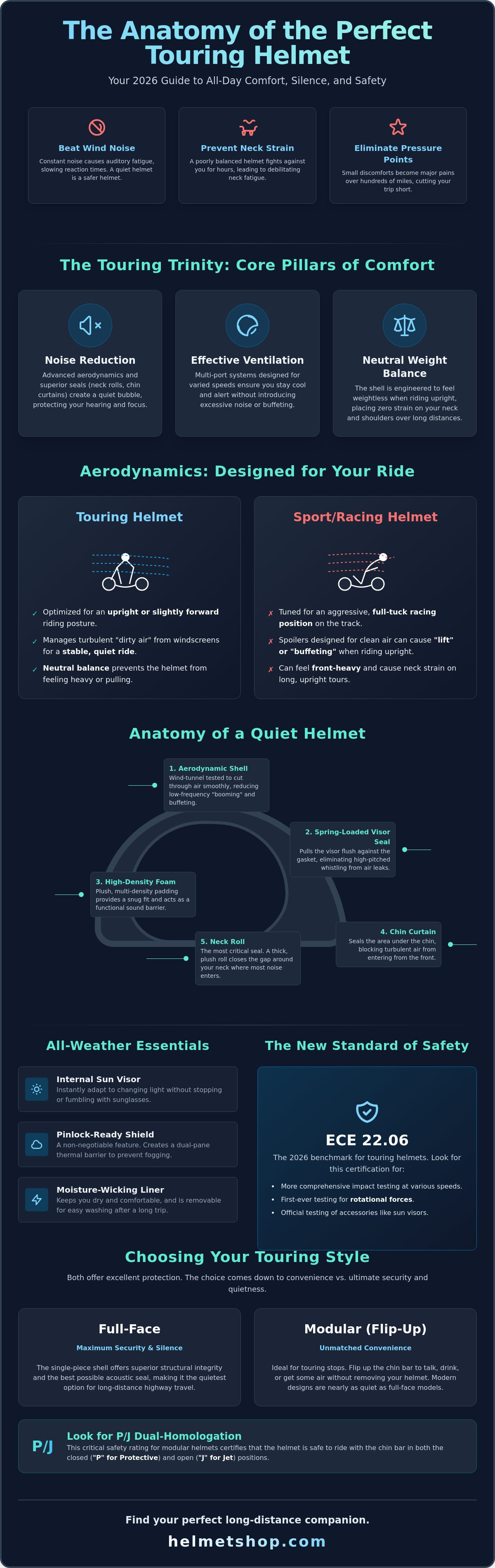
A touring helmet is a specialized piece of engineering designed for the unique demands of the long haul. Unlike a racing lid built for short bursts of speed, the best motorcycle helmet for touring must prioritize the "Touring Trinity": noise reduction, ventilation, and weight distribution. When you spend eight hours in the saddle, small inconveniences like a slight whistle or a minor pressure point become exhausting physical burdens. True touring excellence lies in a helmet's ability to remain unnoticed while providing maximum protection.
Safety remains the foundation of any gear choice. While all reputable options meet basic motorcycle helmet safety standards, touring models focus on how that protection feels over hundreds of miles. Designers achieve a "neutral" balance to ensure the helmet doesn't feel front-heavy or pull at your neck. This stability is vital for preventing the chronic neck fatigue that can ruin a multi-day trip. It's the difference between reaching your destination ready to explore and arriving with a headache.
To better understand how these features come together in the latest models, watch this helpful video:
Touring vs. Sport Helmets: The Aerodynamic Shift
Aerodynamics are not universal. Track-focused helmets feature aggressive spoilers tuned for a chin-on-tank tuck position. If you wear a racing helmet while sitting upright on a touring bike, you'll likely feel the wind trying to "lift" or "push" your head back. Touring shells are shaped for an upright or slightly forward-leaning posture. This design accounts for the "dirty air" or buffeting created by large windscreens. By managing this turbulence, the helmet stays stable and quiet even at sustained highway speeds.
The Necessity of All-Weather Versatility
Touring riders often face four seasons in a single afternoon. This makes all-weather features essential rather than optional. Internal sun visors allow you to adapt to changing light instantly without stopping to swap shields. For moisture management, Pinlock-ready shields are non-negotiable. They create a dual-pane thermal barrier that stops fogging in cold rain or high humidity. Look for ventilation systems designed to flow air at varied speeds and lower RPMs. Combined with moisture-wicking liners that dry quickly between stops, these features ensure your environment remains controlled regardless of the weather outside.
Acoustics and Aerodynamics: Solving the Noise Problem
Constant wind noise at highway speeds is more than a nuisance. It creates auditory fatigue. This physiological state slows your reaction times and dulls your spatial awareness over long distances. Protecting your hearing is a primary safety priority. The best motorcycle helmet for touring manages these acoustics through superior mechanical seals. High-quality neck rolls and chin curtains are vital. They close the gap around your neck where most turbulence enters the shell. By sealing this area, manufacturers prevent air from swirling inside the helmet and creating a roar that earplugs alone can't always fix.
Every component plays a part in this silence. While meeting DOT safety standards ensures impact protection, acoustic management is what preserves your comfort over hundreds of miles. Designers spend years refining shell shapes to minimize the whistling effect caused by air passing over intake vents. The goal is a quiet interior that still allows for enough oxygen and cooling to keep the rider alert.
The Anatomy of a Quiet Helmet
Silence starts with the interior environment. High-density foam padding doesn't just provide a snug fit; it acts as a functional sound barrier. Shield baseplate designs are equally critical. Premium helmets often use spring-loaded mechanisms that pull the visor flush against the rubber gasket upon closing. This prevents the tiny air leaks that cause high-pitched whistling at 70 mph. Acoustic management is the reduction of low-frequency "booming" caused by wind rushing over the shell. Finding the right balance is key. If a helmet is too sealed, it becomes hot. If it's too open, it's deafening. Many riders find that premium full-face helmets offer the most sophisticated balance between active ventilation and acoustic dampening.
Wind Tunnel Testing: Beyond the Marketing
True touring stability comes from rigorous wind tunnel testing. Brands like Shoei and Arai refine their shell shapes to handle air specifically at highway speeds. They focus on the aerodynamics of an upright riding position rather than a racing tuck. This testing ensures the helmet doesn't "lift" or "buffet" when you encounter crosswinds or pass a large truck on the interstate. A smooth shell exterior is essential to this process. Even a small protrusion can create drag or unwanted noise. By streamlining the vents and shield attachments, engineers minimize the air resistance that leads to rider fatigue. This focus on aerodynamics ensures your head remains stable and your neck remains relaxed. It's this attention to detail that allows you to focus on the road for hours at a time without the physical toll of wind resistance.
Modular vs. Full Face: Choosing Your Touring Style
Choosing the best motorcycle helmet for touring often involves a trade-off between convenience and absolute performance. Modular helmets have become the preferred choice for many long-distance travelers. They offer the ability to flip up the chin bar during a quick fuel stop or while checking a map. This versatility is a significant advantage when you're moving through different environments or need to communicate without removing your gear. However, this mechanical flexibility introduces complexity that a traditional full-face helmet avoids.
Safety remains the most important factor in this decision. When you're evaluating modular options, look for "dual homologation" or a P/J rating. This certification confirms that the helmet is safe to wear in both the closed (Protective) and open (Jet) positions. While modern locking mechanisms are highly engineered, they don't provide the same monolithic structural integrity as a solid, fixed chin bar. According to motorcycle safety statistics, a helmet's primary job is to manage impact energy, and a fixed shell offers the most consistent protection across the entire surface.
Weight is another critical consideration for the touring rider. The hinges and metal locking components in a modular helmet typically increase the overall mass. Over an eight-hour ride, even a few extra ounces can lead to significant neck strain and physical fatigue. Full-face models generally offer a lighter weight profile. This helps maintain a neutral balance, allowing you to stay focused on the road longer without discomfort.
The Case for the Modular Touring Helmet
The Shoei Neotec series remains a benchmark for modular touring excellence. These helmets are designed for riders who value accessibility. If you wear glasses, a modular design is a game-changer. It allows you to put on and take off the helmet without fumbling with your frames. Additionally, the ability to get a blast of fresh air at a stoplight or during slow-speed urban riding provides a level of comfort that a sealed full-face lid can't match.
Why Full-Face Still Wins for Pure Performance
For those who prioritize a quiet ride, full-face helmets are still the gold standard. They feature fewer moving parts and gaps in the shell, which leads to superior noise isolation. This reduction in wind roar is essential for preventing auditory fatigue on the interstate. Full-face helmets also provide a consistent safety rating across the entire shell. Without the seams required for a flip-front mechanism, they offer a streamlined exterior that slices through the wind with minimal drag and buffeting.
Evaluating Fit, Tech, and Safety Standards
Finding the best motorcycle helmet for touring requires looking beyond the spec sheet. A helmet that feels perfect in a showroom for ten minutes can become a torture device after six hours on the interstate. This is the "Pressure Point" test. True touring comfort demands a fit that remains neutral over long durations. You need to identify "hot spots" early. Any localized pressure on the forehead or temples will eventually turn into a debilitating headache. A proper fit should be snug across the cheeks but free of hard contact points against the skull.
Safety standards have evolved significantly for 2026. While the DOT FMVSS 218 remains the legal minimum in the United States, the ECE 22.06 standard is now the global benchmark for touring safety. This newer certification involves much tougher testing protocols. It includes impacts at various speeds and specifically measures rotational forces, which are common in real-world touring accidents. Choosing a helmet with ECE 22.06 certification ensures your gear meets the most rigorous modern requirements for impact absorption and shell integrity.
The Importance of Head Shape
Size is only half of the equation. Your head shape determines how the internal EPS liner distributes weight. Most riders fall into the Intermediate Oval category, but many require a Long Oval shape to avoid forehead pressure. Brands like Arai are industry leaders here. They utilize different interior shell shapes across their product line to provide a custom-like fit. Don't assume one brand's "Large" fits like another's. Always test the helmet for at least 15 minutes to see if any hidden pressure points emerge before committing to a long trip.
Communication on the Go
Modern touring is rarely a silent experience. Most premium helmets now come "Bluetooth ready" with dedicated speaker pockets and internal cable routing. You need to decide between integrated systems and universal mounts. Integrated units are designed specifically for the shell, which maintains the helmet's aerodynamic profile and prevents wind whistle. Universal mounts offer more flexibility if you already own Sena or Cardo Bluetooth headsets. Look for systems with large, tactile buttons that are easy to operate with gloved hands, or prioritize voice-command features to keep your hands on the bars.
Long-haul hygiene is the final piece of the puzzle. Road grime, sweat, and sunscreen will eventually saturate your interior. Ensure your chosen model features a fully removable and washable liner. This simple maintenance task extends the life of your gear and keeps your environment fresh during multi-day expeditions. If you are ready to upgrade your long-distance kit, you can browse our curated selection of touring helmets to find the perfect match for your next adventure.
Top Touring Helmet Recommendations for 2026
Selecting the best motorcycle helmet for touring depends on your specific priorities, whether you value the absolute silence of a full-face shell or the convenience of a modular design. The current market offers several standout options that have been refined through extensive wind tunnel testing and rider feedback. These models represent the pinnacle of 2026 technology, balancing the need for impact protection with the practical requirements of long-distance travel.
The Shoei GT-Air series remains the gold standard for full-face touring. It's engineered specifically for the upright riding position, featuring an aerodynamic shell that minimizes lift and buffeting at highway speeds. Its integrated sun shield and sophisticated ventilation system make it a versatile choice for riders who face changing light and weather conditions. For those who prioritize a rounder safety profile, the Arai Contour-X offers premium ventilation and the brand's signature R75 safety shape. This design focuses on a smooth, round shell that excels at "glancing off" energy during an impact.
Riders seeking high-performance features at a competitive price point should consider the HJC RPHA series. These helmets utilize advanced composite materials to keep weight low without compromising structural integrity. If versatility is your primary goal, the Shoei Neotec series continues to define modular excellence. It provides the convenience of a flip-up chin bar while maintaining acoustic levels that rival many high-end full-face helmets.
Why Shoei and Arai Lead the Touring Market
Investing in premium protection offers a significant long-term ROI. When you choose Shoei helmets, you're paying for durability and a finish that withstands years of road debris and UV exposure. Arai’s design philosophy is equally focused on longevity. Their commitment to the R75 shape ensures that the helmet remains effective in various crash scenarios. Both brands support their products with a wide availability of replacement parts. You can easily find new visors, cheek pads, or breath guards to keep your helmet in top condition for several seasons of service.
Completing Your Touring Kit
The best motorcycle helmet for touring is only one part of a successful long-distance setup. To maintain comfort in all conditions, you should pair your headgear with high-quality apparel. Consider matching your helmet with Tourmaster or Cortech touring jackets, which offer the abrasion resistance and weatherproofing needed for multi-day trips. Don't forget the importance of waterproof boots and gloves to keep your extremities dry during unexpected storms. A complete gear strategy ensures that you stay focused on the ride rather than your discomfort. If you're ready to upgrade, you can browse our curated collection of touring helmets here.
Prepare for Your Next 1,000 Miles
Choosing the best motorcycle helmet for touring is a decision that impacts every mile of your journey. You now understand how specialized aerodynamics reduce neck strain and how advanced acoustic seals protect your hearing from auditory fatigue. Whether you prefer the versatile flip-front design of a modular or the streamlined performance of a full-face lid, your comfort depends on a neutral balance and a pressure-free fit. Don't overlook the importance of the latest safety standards like ECE 22.06 to ensure you're riding with the most advanced protection available in 2026.
The right gear transforms your riding experience from a physical challenge into a pure pursuit of the open road. As an authorized dealer for Shoei, Arai, and HJC, we provide access to the industry's most trusted brands. Our expert staff brings decades of riding experience to help you find the perfect match for your head shape and riding style. We also offer national shipping on all premium gear to get you ready for your next expedition quickly.
Find your perfect touring helmet at The Helmet Shop and experience the difference that professional-grade gear makes on your next long-distance adventure. Ride safe and enjoy the miles ahead.
Frequently Asked Questions
What is the quietest motorcycle helmet for touring?
The Schuberth C5 and Shoei GT-Air 3 are widely considered the quietest options for long-distance riders. The Schuberth C5 has been tested to produce only 85 decibels of noise at 100km/h on a naked motorcycle, which is an industry-leading figure. These models use wind-tunnel-tested shell shapes and thick neck rolls to seal out turbulence. Finding the best motorcycle helmet for touring involves prioritizing this acoustic management to prevent auditory fatigue during long highway stretches.
Are modular helmets safe enough for high-speed highway touring?
Yes, modern modular helmets are safe for highway use provided they carry ECE 22.06 and P/J certifications. The P/J rating, or dual homologation, ensures the chin bar remains securely locked during impacts. While a full-face helmet offers a monolithic shell structure, premium modular designs from brands like Shoei and HJC use robust metal locking mechanisms. These systems are specifically engineered to withstand the high-velocity forces encountered during long-distance touring expeditions.
How often should I replace my touring motorcycle helmet?
You should replace your helmet every five to seven years regardless of its outward appearance. The internal EPS liner and resin materials degrade over time, losing their ability to absorb impact energy effectively. Additionally, you must replace your helmet immediately after any impact, even if you don't see visible damage. Regular inspection of the chin strap and visor gaskets ensures your gear remains dependable for every trip you take.
Do I really need a Pinlock insert for long-distance riding?
A Pinlock insert is practically essential for any long-distance rider facing varied weather conditions. It creates a dual-pane thermal barrier that prevents your visor from fogging in cold or humid environments. Without this air-tight seal, your vision can become compromised in seconds during a sudden temperature drop or rain shower. Most premium touring helmets come Pinlock-ready as a standard feature to ensure consistent clarity on the road regardless of the season.
Can I install a Bluetooth headset in any touring helmet?
Most modern touring helmets feature dedicated speaker pockets and cable channels for universal Bluetooth systems like Sena or Cardo. However, some models are designed for integrated systems that fit flush within the shell for better aerodynamics. Always check for specific mounting points before purchasing. Using an integrated unit helps prevent the wind whistling often caused by external mounts, maintaining the quiet environment expected from the best motorcycle helmet for touring.
What is the best helmet for riders who wear glasses?
Modular helmets are the most convenient choice for riders who wear glasses. The flip-up design allows you to put on or remove the helmet without taking off your frames first. Many touring models also include eyeglass-friendly cheek pads with dedicated channels for the temples. This prevents the frames from pressing against your head, which is a common cause of pressure-point headaches during eight-hour riding days on the interstate.
How much should a good touring helmet weigh?
A high-quality touring helmet typically weighs between 1,500 and 1,800 grams. While lighter carbon fiber shells reduce neck strain, touring models often include internal sun visors and sound-dampening materials that add a small amount of mass. The key isn't just the total weight but the neutral balance of the shell. A well-balanced helmet feels lighter on your neck because it doesn't pull forward or backward when you're riding at highway speeds.
Is a modular helmet noisier than a full-face helmet?
Modular helmets are generally noisier than full-face models because of the seams where the chin bar meets the shell. These gaps can create minor air turbulence and whistling at high speeds. However, premium modular designs have narrowed this gap significantly. By using advanced gaskets and thick neck rolls, high-end modulars can be quieter than budget full-face options. Your bike's windscreen height also plays a major role in how much noise reaches the helmet.


