

Did you know that wind noise inside a motorcycle helmet can exceed 100 dB(A) at highway speeds? That is loud enough to cause permanent hearing damage with sustained exposure. If you've ever finished a long ride with ringing ears or felt physically exhausted from constant wind turbulence, you know that a noisy helmet is more than just a distraction. It's a significant barrier to your comfort and safety.
We agree that every rider deserves a peaceful experience on the road without the threat of tinnitus or the frustration of muffled intercom audio. Finding the quietest motorcycle helmets is the most effective way to reclaim your focus and protect your hearing. This guide explains the advanced engineering behind silent shells and provides our expert-curated list of top-performing models for 2026. You'll learn how the latest designs from brands like Shoei, ARAI, and HJC utilize precision aerodynamics to reduce neck strain and ensure your Cardo or Sena unit stays crystal clear at any speed.
Key Takeaways
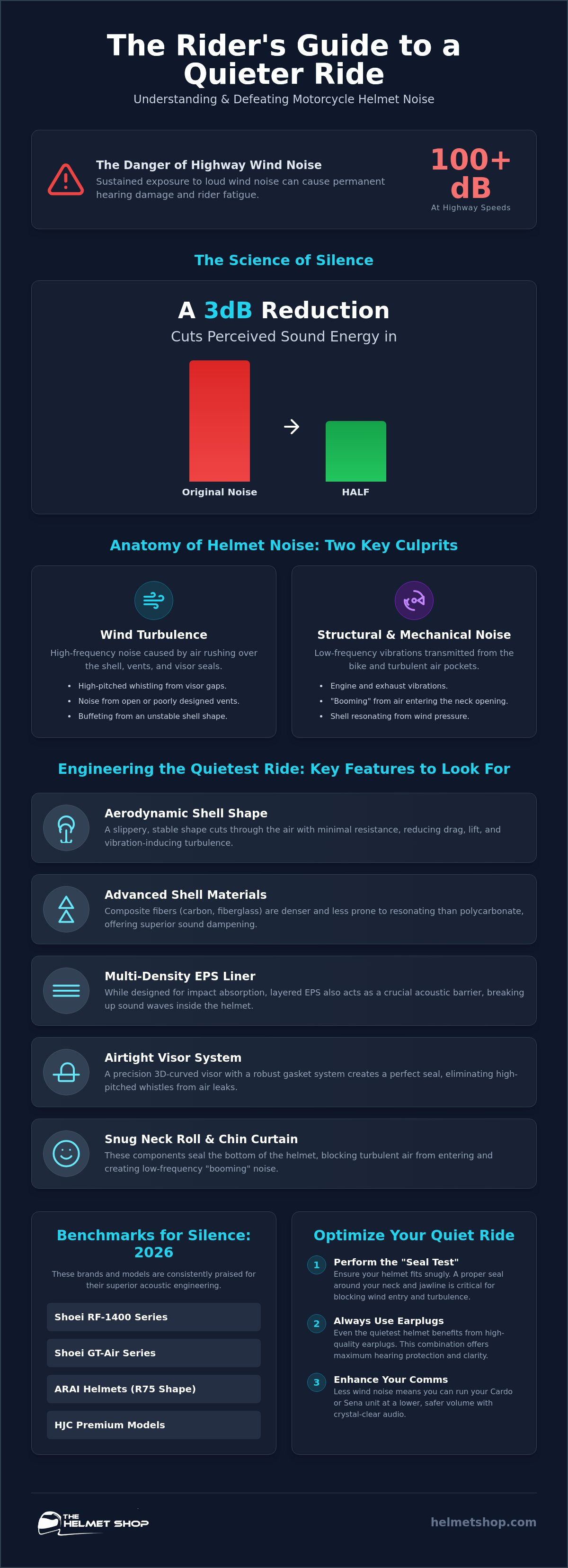
- Learn the science of helmet noise and how even a minor 3dB reduction can halve the sound energy reaching your ears.
- Identify the critical engineering features, such as aerodynamic shell shaping and multi-density EPS liners, found in the quietest motorcycle helmets.
- Discover why the Shoei RF-1400 and GT-Air series remain the benchmarks for silent, high-performance riding in 2026.
- Use the "Seal Test" to ensure your neck roll and head shape work together to eliminate wind gaps and turbulence.
- Access a curated selection of DOT and SNELL certified helmets from trusted brands like Shoei, Arai, and HJC.
The Science of Silence: Understanding Motorcycle Helmet Noise
Noise in a motorcycle helmet isn't just a single sound. It's a complex mix of wind turbulence rushing over the shell and mechanical vibrations from your bike. While manufacturers strive to build the quietest motorcycle helmets, no helmet is truly silent. Instead, they're optimized to manage airflow and dampen specific frequencies that cause fatigue. A standard motorcycle helmet acts as your primary sound barrier, but its effectiveness depends on how well it manages these different acoustic inputs.
Sound is measured on a logarithmic scale. A small change in decibels (dB) results in a massive difference in sound energy. For riders, a 3dB reduction actually halves the noise energy reaching your ears. Highway wind noise often exceeds 100dB. This level is high enough to cause hearing loss if you're exposed for long periods. Choosing a helmet with superior acoustic engineering is a proactive step toward protecting your health and staying focused on the road.
To see how these noise factors are tested in real-world conditions, watch this helpful video:
Wind Turbulence vs. Mechanical Noise
Wind turbulence creates high-frequency whistling as air hits vents or visor seams. If a visor doesn't seal perfectly against the eyeport, air leaks in and creates localized pressure drops. Mechanical noise is different; it consists of low-frequency vibrations from your engine and exhaust. The loudest noise often comes from the "booming" effect at the base of the helmet. This happens when air enters through the neck opening and creates a vortex under your chin.
Why Hearing Protection Still Matters
The quietest motorcycle helmets work best when paired with high-quality earplugs. This combination creates a synergy that filters out harmful wind roar while allowing you to hear important ambient sounds. Effective acoustic management also makes your bluetooth motorcycle headsets more effective. When you aren't fighting 100dB of wind noise, you can keep your intercom volume lower. You'll hear GPS directions and music with much better clarity. Reducing this acoustic load directly lowers rider fatigue, keeping you alert on every ride.
Engineering the Quietest Ride: Key Features to Look For
The pursuit of the quietest motorcycle helmets involves a meticulous balance of physics and material science. Manufacturers don't just guess where noise comes from. They use wind tunnels to identify high-pressure zones that cause whistling and low-pressure areas that create booming. A quiet ride depends on a shell that cuts through the air with minimal resistance. When a shell is aerodynamic, it reduces both drag and lift. This prevents the helmet from vibrating against your head at high speeds, which is a major source of low-frequency fatigue.
Sound management continues beneath the surface. Modern helmets use multi-density Expanded Polystyrene (EPS) liners. These liners are primarily designed to manage impact energy, but they also serve as an acoustic barrier. A scientific study on helmet noise attenuation confirms that internal materials play a vital role in how sound waves are absorbed before they reach the ear canal. High-quality liners break up sound waves rather than letting them bounce around inside the helmet cavity.
Shell Materials and Sound Dampening
The material of the shell significantly impacts its acoustic profile. Composite fibers, such as carbon fiber or fiberglass, generally offer better sound attenuation than polycarbonate. These materials are denser and less prone to resonating like a bell when hit by wind. Shell size also matters. Premium brands produce multiple shell sizes for a single model to ensure the helmet isn't unnecessarily bulky. A smaller, properly scaled shell has less surface area to catch the wind. Designs like the Arai R75 shape promote smooth airflow by eliminating sharp edges that cause turbulence.
Visor Sealing and Gasket Technology
The visor is often the weakest link in noise management. Even a tiny gap in the seal can create a high-pitched whistle. To combat this, elite manufacturers use 3D curved visors that provide a more uniform contact point against the gasket. Many use spring-loaded base plates. These plates pull the visor inward as it closes, creating a literal airtight seal. While cracking your visor for a bit of fresh air is tempting, it remains the primary source of cockpit noise. If you value silence, look for helmets with adjustable visor tensioners that allow you to fine-tune the seal over time.
The Role of the Neck Roll and Chin Curtain
Many riders overlook the bottom of the helmet, but this is where the most significant noise reduction happens. A thick, plush neck roll that makes 360-degree contact with your skin prevents air from rushing up into the ear pockets. Similarly, a chin curtain blocks turbulent air coming from the engine and chest area. These components act as a final acoustic gatekeeper. If you're ready to experience this level of engineering, you can explore our curated selection of premium helmets designed for maximum silence.
Top Quietest Motorcycle Helmets of 2026
The market for the quietest motorcycle helmets is highly competitive in 2026. Manufacturers now use advanced acoustic simulations to refine every vent and gasket. While several brands offer noise reduction, Shoei and Arai continue to lead the industry through rigorous wind tunnel testing. These brands focus on reducing the high-frequency whistling that causes rider fatigue during long highway stints.
The Shoei RF-1400 remains the industry benchmark for full-face performance. It features a compact, aerodynamic shell designed specifically to reduce wind resistance. Its vortex generators on the visor help pull air away from the eyeport. This significantly lowers noise levels near the ears. For riders who need an integrated sun shield, the Shoei GT-Air 3 offers a silent ride without the bulk often associated with internal visors. This model demonstrates why shoei helmets are a worthy investment for serious tourers.
Arai takes a different approach with the Quantic and Contour-X. These models prioritize high-speed stability. Their smooth, round shell design allows air to flow uninterrupted. This shape prevents the "buffeting" sound common in more angular helmets. HJC also competes strongly in this space. The hjc helmets RPHA series provides premium performance and excellent acoustic dampening at a competitive value.
The Best Quiet Modular Helmets
The Shoei Neotec 3 has redefined expectations for modular silence. It matches the performance of many premium full-face models through precision engineering. It utilizes a stainless steel 360-degree pivot locking system. This pulls the chin bar tight against the shell to eliminate gaps. The HJC RPHA 91 uses a similar specialized pivot system to reduce wind drag. Modern modulars are no longer the "loud" alternative. They're now viable options for long-distance touring.
Premium Full-Face Contenders for Touring
Acoustic comfort in touring helmets depends on the weight-to-noise ratio. Lightweight carbon fiber models from the HJC RPHA series reduce neck strain during long days. Arai’s internal airflow management ensures that noise increase is minimal even with vents open. The Shoei RF-1400 continues to dominate highway testing. Its neck roll design creates a consistent seal regardless of your riding position. These models represent the pinnacle of quiet performance for the 2026 season.
Optimizing Your Helmet for Maximum Noise Reduction
Buying one of the quietest motorcycle helmets is only the first step. To achieve a truly silent ride, you must ensure the helmet integrates perfectly with your head and your bike. Even a premium shell will roar if wind finds a way inside. The most common entry point for noise is the gap between your neck and the helmet's base. Perform a "Seal Test" by checking for 360-degree contact between your skin and the neck roll. If you can easily slide a finger into that space, wind turbulence will follow, creating a loud "booming" effect.
Your head shape is the most overlooked factor in acoustic comfort. Manufacturers design helmets for Intermediate Oval or Long Oval profiles. If you wear an Intermediate Oval helmet on a Long Oval head, you'll likely have gaps at the temples. These voids allow sound to resonate and amplify. Ensuring a match between your anatomy and the helmet's internal shape prevents these noise-leaking gaps. Additionally, keep your visor gaskets lubricated with silicone oil. Dry gaskets become brittle and fail to create an airtight seal, which leads to high-pitched whistling at highway speeds.
External factors also influence how much noise you hear. Your motorcycle's windshield height can either help or hurt. If the windshield directs a blast of air right at the base of your helmet, the noise level will spike. Adjust your screen so the "clean" air hits the top of the helmet or clears it entirely. This simple adjustment reduces the workload on your helmet's aerodynamic features.
The Role of Proper Fitment
A snug fit is essential for noise reduction. While some riders prefer a loose fit for comfort, a loose helmet actually increases internal resonance. The padding should press firmly against your cheeks and jaw to dampen vibrations. If you feel "hot spots" on your forehead, the fit is wrong. However, if you have gaps near your ears, you need thicker cheek pads. Closing these acoustic gaps prevents wind from circulating inside the ear pockets and keeps your ride much quieter.
Accessories that Muffle the Roar
Small additions can make a massive difference in decibel levels. Installing a larger chin curtain blocks air rising from the engine and chest area. Many riders also find success with specialized neck sleeves that tighten the seal at the bottom. Your other motorcycle gear plays a role too. High-collar jackets act as a fairing for your neck, smoothing out turbulent air before it reaches the helmet's base. If you are ready to upgrade your setup, shop our full inventory of helmets and accessories today to find your perfect match.
Why Choose The Helmet Shop for Your Quietest Ride?
Selecting the right gear requires more than just looking at a spec sheet. At The Helmet Shop, we act as your reliable guide through the complex world of acoustic engineering. We've carefully curated a selection of the quietest motorcycle helmets from industry leaders like Shoei, Arai, and HJC. Our focus remains on high standards and proven performance. We don't just stock every helmet available; we choose the ones that meet our rigorous criteria for noise reduction and safety. This curated approach ensures that every option in our inventory is a dependable choice for your next ride.
Trust is built on reliability. That's why we're committed to providing only the highest-rated DOT and SNELL equipment. We understand that a quiet ride is a safer ride. When you aren't distracted by wind roar, you can focus on the road ahead. Our staff consists of seasoned industry veterans who know the nuances of long-distance touring comfort. Whether you're crossing state lines or commuting across town, we provide the expertise needed to manage your acoustic environment effectively. We've helped thousands of riders find the perfect balance between protection and peace of mind.
Beyond the helmets themselves, we maintain a deep inventory of specialized accessories for noise management. If the standard cheek pads don't provide the perfect seal mentioned in our earlier sections, we have the components to fix it. We stock various sizes of neck rolls, chin curtains, and breath guards designed specifically for the brands we carry. This allows you to customize your helmet into a truly silent sanctuary. We believe that a helmet should fit your life as well as it fits your head. Our inventory is designed to be a one-stop resource for riders who refuse to compromise on their hearing.
Expert Guidance on Premium Brands
We focus heavily on Shoei and Arai for riders who prioritize pure acoustic performance. These brands spend years in wind tunnels to perfect their shell shapes and gasket seals. For the performance-focused commuter, our selection of HJC models offers an excellent balance of value and silence. Choosing the right motorcycle helmet ventilation setup is also critical. Our team helps you find a configuration that keeps you cool without introducing the high-pitched whistling often found in lesser designs. We understand how different vent positions interact with your bike's fairing to create or eliminate noise.
Find Your Perfect Fit
Our broad national selection includes the latest full-face and modular helmets. You'll find direct access to 2026 models featuring advanced sound-dampening technology and multi-density liners. We make it easy to compare the latest features across the top brands in the US market. Our goal is to ensure you never have to compromise on comfort or clarity during your journey. You can shop our collection of Shoei Helmets online today. Experience the difference that expert curation and a commitment to quality can make for your silent ride.
Elevate Your Ride with Premium Acoustic Performance
A quiet ride is within reach when you combine advanced technology with a precision fit. You now understand that the quietest motorcycle helmets are those that master the balance of aerodynamic shell shaping and airtight gasket seals. By prioritizing brands like Shoei, Arai, and HJC, you're investing in decades of wind tunnel research and acoustic innovation. Remember that your helmet's performance also depends on regular maintenance and a snug neck roll to block out turbulent air.
As an authorized dealer for Shoei, Arai, and HJC, The Helmet Shop provides expert national support to help you find your ideal match. Our premium 2026 inventory is stocked with the latest models designed to protect your hearing and reduce rider fatigue. Don't let wind noise distract you from the road ahead. Clear communication and physical comfort are essential for every long-distance tourer.
Browse the Quietest Shoei and Arai Helmets at The Helmet Shop and experience the difference of a truly silent ride. We look forward to helping you find the perfect gear for your next adventure.
Frequently Asked Questions
What is the quietest motorcycle helmet brand in 2026?
Shoei and Arai are widely considered the leaders for the quietest motorcycle helmets in 2026. These brands invest heavily in wind tunnel testing to refine shell aerodynamics and visor seals. Models like the Shoei RF-1400 and the Arai Quantic consistently outperform competitors in noise reduction tests. While individual fit plays a role, these premium manufacturers offer the most consistent acoustic performance across their entire product lines.
Are modular helmets louder than full-face helmets?
Historically, modular helmets were louder due to the additional seams and pivot mechanisms. However, 2026 models like the Shoei Neotec 3 have closed this gap significantly. Advanced stainless steel locking systems and improved gaskets now create seals that rival full-face models. While a one-piece shell is technically superior for sound dampening, high-end modulars are now quiet enough for long-distance touring without excessive wind roar or buffeting.
Can I make my current motorcycle helmet quieter?
You can improve your helmet's acoustic profile by adding a chin curtain or a thicker neck roll to block air from entering the bottom. Ensuring a proper visor seal is also vital. Use silicone lubricant on the rubber gaskets to keep them soft and airtight. If your helmet has empty ear pockets, adding foam inserts or upgrading to thicker cheek pads can reduce internal resonance and wind turbulence effectively.
Do expensive helmets actually reduce more wind noise?
Premium helmets often reduce more noise because of the extensive research and development involved in their design. Expensive models utilize multi-density EPS liners and high-quality composite shells that absorb sound better than entry-level polycarbonate. You're also paying for precision-engineered visor mechanisms and plush interior materials that create a tighter seal around your neck. This investment directly results in a quieter and less fatiguing riding experience on the highway.
How does helmet shape affect wind noise on the highway?
Helmet shape is a primary factor in how wind interacts with your gear at highway speeds. A smooth, round shell allows air to flow over the surface with minimal resistance, which prevents the "buffeting" sound caused by turbulence. Angular designs or bulky vents can catch the wind and create localized pressure drops. These drops result in the low-frequency booming or high-frequency whistling that many riders find physically exhausting.
Does a chin curtain really help with noise reduction?
A chin curtain is one of the most effective tools for noise reduction because it blocks the primary entry point for turbulent air. Much of the noise you hear comes from air rushing up through the bottom of the helmet and swirling around the ear pockets. By sealing this gap, the curtain prevents the "vortex" effect inside the shell. This simple accessory can lower the decibel level inside your helmet by a noticeable margin.
Why does my helmet whistle at high speeds?
Whistling is usually caused by air escaping through a small gap in the visor seal or an improperly designed vent. Even a microscopic opening in the eyeport gasket can create a high-pitched sound as air is forced through at high speeds. Check your visor alignment and ensure the base plates are pulling the shield tight against the rubber. If the whistling persists, it might be due to air hitting an external accessory.
Are carbon fiber helmets quieter than composite ones?
Carbon fiber helmets are prized for their light weight, but they aren't always quieter than composite fiber models. In some cases, the thinness and rigidity of carbon fiber can actually cause more resonance or "ringing" from engine vibrations. Composite shells, which often use a blend of fiberglass and organic fibers, can be better at dampening sound waves. Quietness depends more on the aerodynamic design and internal padding than the shell material alone.


