

What if you could trade the claustrophobic squeeze of a full-face lid for a wide-angle view of the road without compromising on 2026 safety standards? Many riders find that traditional open face helmets can sometimes feel heavy or cause unnecessary neck strain during long trips. You want the freedom of the open road and a classic aesthetic, but you shouldn't have to sacrifice modern protection or deal with summer overheating. Finding the right 3/4 helmet means looking past the vintage paint to the engineering underneath.
Choosing between style and safety often feels like a difficult compromise. This guide will help you select a helmet that offers a perfect fit while meeting the latest ECE 22.06 benchmarks. You'll discover how to balance lightweight shells with long-range comfort and crystal-clear peripheral vision for city riding.
We will break down top-rated options from trusted brands like Shoei, Arai, and HJC. You'll also learn about integrating Mesh 2.0 communication tech from Sena and Cardo into your setup. By the end, you'll know exactly which low-profile, DOT-approved model suits your riding style and keeps you cool through every mile.
Key Takeaways
- Understand the unique advantages of open face helmets, including superior peripheral vision and maximum airflow for warm-weather riding.
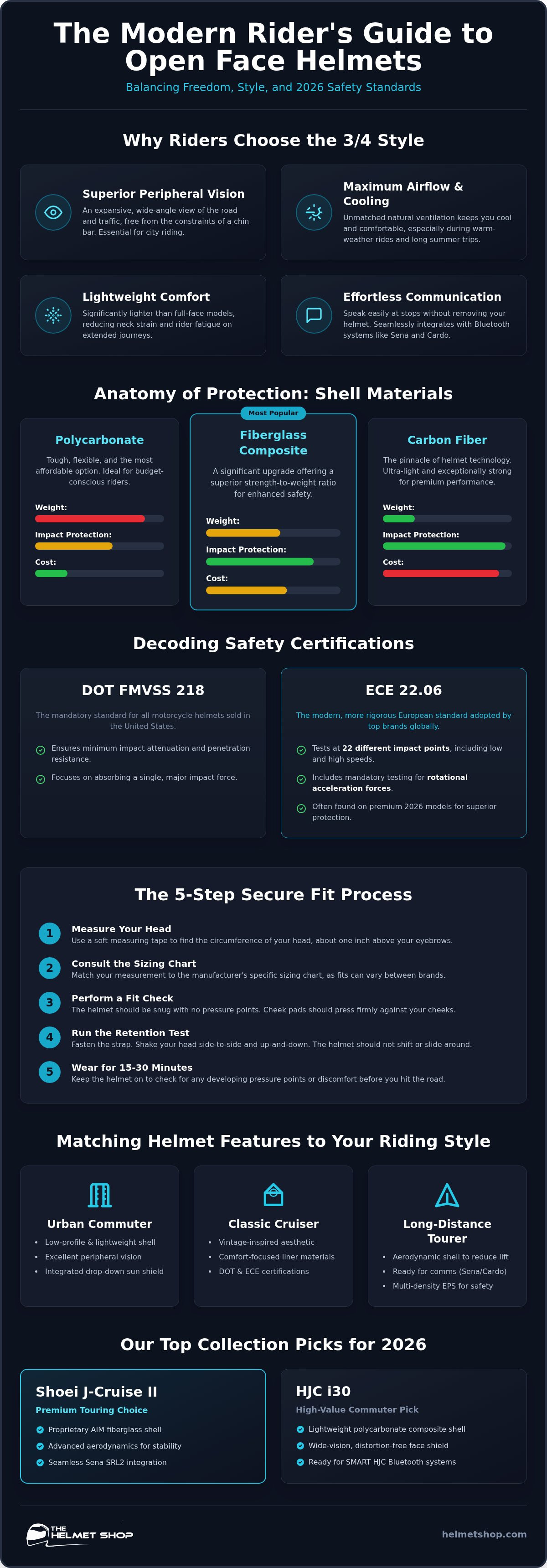
- Compare shell materials like polycarbonate, fiberglass, and ultra-light carbon fiber to find the right balance of weight and impact protection.
- Master a 5-step measuring process to ensure a secure fit and learn how to seamlessly integrate Bluetooth systems from Sena or Cardo.
- Identify the best helmet features for your specific environment, whether you are an urban commuter, a classic cruiser, or a long-distance tourer.
- Explore premium 2026 collection picks, ranging from the touring-focused Shoei J-Cruise II to the high-value HJC i30.
What is an Open Face Helmet? Defining the 3/4 Style
An open face helmet, commonly referred to as a 3/4 helmet, provides coverage for the top, sides, and back of the head. It leaves the face exposed, which is why many riders prefer it for its expansive field of view. When investigating What is an Open Face Helmet?, you'll find that this design sits in the middle ground of the safety spectrum. It offers significantly more protection for the cranium and temples than a half helmet while providing a level of sensory connection to the environment that full-face models can't match.
The primary appeal lies in the massive airflow and superior peripheral vision. You don't have a chin bar blocking your downward or side views, making it much easier to spot hazards in dense traffic or enjoy the scenery on a coastal road. This design also makes it easier for riders who wear glasses to put them on or take them off without struggling against tight internal padding. The 3/4 helmet represents the ideal balance for cruiser and urban riders seeking maximum visibility and weight reduction without sacrificing essential rear and side protection.
The Evolution of the 3/4 Helmet
The 3/4 design has come a long way from the early days of vintage leather caps and basic plastic shells. Modern open face helmets now utilize advanced materials like lightweight polycarbonate and multi-composite fiberglass. Brands such as Daytona have successfully modernized classic silhouettes, maintaining a vintage look while meeting strict DOT safety standards. Today's models often feature aerodynamic shell shapes that reduce wind lift at higher speeds. Many also include integrated, drop-down sun shields that eliminate the need for swapping tinted visors as the light changes. These modern touches ensure that "classic" doesn't have to mean "outdated."
Why Riders Choose Open Face Designs
Comfort and convenience are the driving forces behind this style. You'll find that communication becomes much simpler at red lights or gas stops because you don't have to shout through a chin bar or remove your gear. These helmets are also significantly lighter than their full-face counterparts, which helps reduce rider fatigue and neck strain during long days in the saddle. Temperature regulation is another major factor. Because the face is open, you get natural cooling that even the best vent systems struggle to replicate. For a deeper look at how air moves through different designs, check out our motorcycle helmet ventilation guide. This combination of visibility, weight savings, and cooling makes the 3/4 helmet a staple for many enthusiasts.
Key Features to Compare: Shell Materials and Safety Ratings
Safety starts with the outer shell. When you compare open face helmets, you'll typically find three primary materials. Polycarbonate is the most affordable option; it's tough and flexible, though often heavier. Fiberglass shells offer a significant upgrade in strength and weight reduction. For riders who prioritize the lightest possible gear, carbon fiber represents the pinnacle of shell technology. These materials aren't just about looks. They provide the first line of defense in an accident.
While the shell handles the initial impact, the internal liner does the heavy lifting. Modern premium helmets use a multi-density EPS (Expanded Polystyrene) liner. This isn't just a single block of foam. It consists of layers with different densities designed to absorb both low and high speed impact energy. The shell deflects energy while the liner manages the deceleration of the brain. You can browse our curated selection to see how these different materials affect weight and price.
Understanding Safety Standards: DOT vs. ECE
Every helmet sold for road use in the United States must meet DOT safety standards. This FMVSS 218 certification ensures the helmet meets minimum requirements for impact attenuation and penetration resistance. However, many 2026 models also carry the ECE 22.06 certification. This European standard is more modern and involves more rigorous testing, including rotational acceleration and 22 different impact points. Always look for these stickers on the back of the shell. Avoid "novelty" helmets that lack these certifications, as they offer almost no protection in a crash.
Advanced Shell Technology and Impact Absorption
Top manufacturers go beyond the basics to improve rider safety. Shoei, for example, uses a proprietary Advanced Integrated Matrix (AIM). This combines organic fibers and resin to create a shell that is incredibly strong yet remarkably light. Arai takes a different approach with their Arai R75 shape. This design focuses on a continuous, round curve that excels at "glancing off" obstacles during a slide. By redirecting kinetic energy rather than absorbing it all at once, these helmets provide an extra layer of protection. A multi-piece EPS liner further enhances this by placing specific foam densities exactly where they are needed most. This precision engineering is what separates entry-level gear from professional-grade protection.
Matching Your Helmet to Your Riding Style and Environment
The environment where you spend most of your time on two wheels should dictate your choice of gear. Open face helmets aren't a one-size-fits-all solution; they cater to specific needs across different riding disciplines. Whether you're navigating dense city traffic or cruising down a coastal highway, your helmet should align with your specific environmental demands. We generally categorize riders into three groups: the urban commuter, the classic cruiser, and the long-distance tourer.
The Urban Commuter: Visibility and Speed
Urban environments are chaotic and demand high situational awareness. Commuters benefit most from the wide field of view that 3/4 helmets provide, allowing for better monitoring of blind spots and sudden lane changes. HJC models are particularly popular for city use because they often feature quick-release straps and high-visibility paint options that help you stand out in traffic. These features make the daily grind safer and more convenient.
City streets are often filled with road debris, dust, and insects. A wide, clear visor is essential for eye protection while maintaining that open-air feel. Lightweight designs are also critical here. Frequent stop-and-go traffic leads to neck strain if your helmet is too heavy. By choosing a streamlined 3/4 model, you maintain the agility needed for urban maneuvering without the fatigue associated with bulkier gear.
The Classic Cruiser: Aesthetic Meets Modern Safety
Cruiser riders often prioritize a specific "retro" look that complements their machine. The Daytona Cruiser is a staple in this category, offering a low-profile design that avoids the "mushroom head" look often found in cheaper alternatives. For those seeking a vintage racing vibe, the Bell Custom 500 Apex provides a timeless silhouette. You can easily pair these helmets with goggles or snap-on bubble shields to complete the classic aesthetic.
It's vital to remember that "classic" doesn't mean "unsafe" when you're shopping at The Helmet Shop. Every model we curate meets rigorous standards. Referencing the NHTSA guide to choosing a helmet is a great way to ensure your vintage-style lid still provides the necessary impact protection. Modern materials ensure you get the look you want with the safety you need.
The Long-Distance Tourer: Comfort and Versatility
Touring requires gear that can adapt to changing conditions over hundreds of miles. If you're a long-distance rider, look for open face helmets with integrated flip-up visors and internal sun shields. These features allow you to adjust to shifting light levels without stopping to change goggles. High-end touring models from brands like Shoei or Arai focus on interior plushness and noise reduction. This ensures that the open design doesn't lead to excessive ear fatigue from constant wind blast during highway stretches.
Ensuring a Secure Fit and Integrating Modern Bluetooth Tech
A secure fit is the foundation of rider protection. While open face helmets offer unmatched freedom, they must stay firmly in place during an impact to do their job. Unlike full-face models, 3/4 shells lack a chin bar to help anchor the unit, making proper sizing even more critical. Measuring your head is the first step in this process. Use a flexible tailor's tape. Wrap it around the widest part of your skull, typically about one inch above your eyebrows. Repeat this measurement twice to ensure accuracy. Once you have your numbers, compare them against the size charts on our Open Face Helmets collection page.
Sizing and Head Shape: The Key to Stability
Head shape is just as important as circumference. Most manufacturers design for an Intermediate Oval shape, which is slightly longer front-to-back than side-to-side. If you have a Round Oval head, a standard helmet might feel tight on the sides while leaving gaps at the forehead. Avoid the temptation to buy a larger size to fix a specific pressure point. A loose helmet will lift and buffet at high speeds, causing significant neck strain. Perform a squeeze test once the helmet is on. Your cheek pads should be snug enough that your cheeks move when you wiggle the shell. If the helmet rotates freely without moving your skin, it is too big.
Bluetooth Communication in an Open Shell
Adding communication tech to open face helmets requires specific hardware. Because these designs lack a chin bar, you cannot use a standard wired button microphone. Instead, you must use a rigid boom microphone. These mics extend from the side of the shell to sit directly in front of your mouth. High-quality bluetooth motorcycle headsets from Sena and Cardo feature advanced noise cancellation. This technology is vital for filtering out the wind noise that is naturally higher in an open-shell design.
Mounting your device is usually straightforward. Most 3/4 helmets have a seam between the shell and the liner where a clamp can slide in. Position the unit on the left side so you can operate the controls with your non-throttle hand. Route the speaker wires carefully behind the comfort liner for a clean, professional look. Many modern helmets now include pre-cut speaker pockets to make this installation even easier. Modern intercoms allow for GPS navigation and music without compromising the open-air experience. Find the perfect Bluetooth-ready helmet for your next trip today.
The Best Open Face Helmets for 2026: Our Top Collection Picks
Selecting the right gear requires balancing your personal riding style with the engineering standards we discussed earlier. Our 2026 lineup features open face helmets designed to meet various budgets and performance needs. Every selection in our shop has been vetted for its safety profile and long-term durability. Whether you prioritize the latest ventilation systems or a low-profile aesthetic, these picks represent the best of the current market.
Premium Performance: The Shoei J-Cruise II
The Shoei J-Cruise II remains the gold standard for riders who demand touring-level comfort in a 3/4 design. It features the proprietary AIM+ shell, which uses a multi-ply matrix of organic fibers and resin for maximum strength and minimal weight. The integrated CJ-2 shield system provides a distortion-free view while the micro-ratchet chin strap allows for quick adjustments even with gloves on. This model is also specifically prepared for the SENA SRL2 communication system, allowing for a seamless, factory-fit installation. If you're curious about why this brand commands a higher price point, our Shoei investment guide explains the engineering behind the premium protection.
Best Value: HJC i30 and CS-5N Series
For riders seeking modern features without the premium price tag, the HJC i30 is a top contender. It utilizes a lightweight polycarbonate composite shell designed with advanced CAD technology to ensure a precise fit. The standout feature is the "ACS" Advanced Channeling Ventilation system. This setup flushes heat and humidity out of the helmet quickly, making it a favorite for summer riding. If you need a simple, reliable, and budget-friendly entry point, the HJC CS-5N offers a classic look with a thermoplastic shell and a plush, Nylex interior. We invite you to browse all 112+ models in our inventory to find the graphic and fit that matches your bike.
The Low-Profile Specialist: Daytona Cruiser
The Daytona Cruiser continues to lead the category for riders who want lightweight open face helmets with a low-profile design. It's engineered to avoid the bulky "mushroom" look while still maintaining full DOT compliance. This model is particularly popular with cruiser and custom riders who want a streamlined silhouette that doesn't compromise on shell integrity. It's the perfect choice for short hops and city riding where agility and style are the primary goals. By focusing on essential protection and a slim shell, Daytona provides a comfortable experience that feels almost like wearing no helmet at all.
To help you decide, consider these key differences between our top picks:
- Shoei J-Cruise II: Best for long-distance touring and integrated Bluetooth.
- HJC i30: Best for urban commuting with superior airflow.
- Daytona Cruiser: Best for a classic, low-profile aesthetic on cruisers.
- HJC CS-5N: Best for riders seeking a simple, high-value entry-level option.
Ready to Hit the Road with Modern Protection?
Finding the right balance between classic style and modern safety is the key to enjoying your time on two wheels. You now understand how shell materials like carbon fiber and multi-density EPS liners work together to provide elite protection. Whether you're navigating city streets or embarking on a long-distance tour, choosing open face helmets that match your specific environment ensures maximum comfort and visibility. Don't forget that a secure fit is non-negotiable for stability, particularly when you're integrating boom microphones for a Sena or Cardo Bluetooth setup.
The Helmet Shop is a trusted authority and an authorized dealer for premium brands like Shoei, Arai, and HJC. We ensure DOT-certified protection on all models and offer fast national shipping across the USA. Our curated selection takes the guesswork out of finding a high-quality lid that fits your head shape and your aesthetic. Shop the Full Collection of 112+ Open Face Helmets today to find your perfect match. Gear up with confidence and enjoy the freedom of the open road.
Frequently Asked Questions
Are open face helmets safe for highway riding?
Open face helmets are safe for highway use if they carry DOT or ECE 22.06 certifications. These ratings ensure the shell and liner can handle high-speed impacts. While you lose the chin protection of a full-face lid, you gain a massive field of vision that helps you spot lane-changing vehicles earlier. Premium brands like Shoei and Arai design their 3/4 shells with advanced aerodynamics to prevent lift and buffeting at 70 mph.
How should an open face helmet fit compared to a full-face?
Your open face helmet should fit snugly around the crown of your head without causing hot spots. The cheek pads must be tight enough to move your skin when you wiggle the helmet, just like a full-face model. Because there is no chin bar, some riders mistakenly buy a size too small to feel secure. Always follow the manufacturer size chart. A proper fit ensures the helmet doesn't rotate or lift at speed.
Can I install a Bluetooth headset in an open face helmet?
You can easily install a Bluetooth headset in most modern 3/4 shells. Brands like Sena and Cardo offer specific kits featuring rigid boom microphones. These mics are necessary because you don't have a chin bar to mount a standard wired button microphone. Many open face helmets now include deep speaker pockets carved into the EPS liner. This allows you to enjoy GPS turn-by-turn directions and music without the speakers pressing against your ears.
What is the difference between a 3/4 helmet and a half helmet?
A 3/4 helmet covers the top, sides, and back of your head, while a half helmet only covers the top crown. This extra coverage makes the 3/4 design significantly safer during side or rear impacts. open face helmets also provide better stability at high speeds because the shell wraps around your ears, preventing the wind from getting underneath and lifting the helmet. Half helmets are lighter but offer much less protection for the temporal regions.
Do open face helmets come with sun shields?
Many premium and mid-range 3/4 helmets feature integrated, drop-down sun shields. Models like the Shoei J-Cruise II and the HJC i30 include these internal visors, which you can operate with a simple slide lever on the side of the shell. This feature is a game-changer for riders who don't want to carry a second tinted visor or struggle with sunglasses. It allows you to adapt instantly to changing light conditions while keeping your eyes protected.
How often should I replace my open face motorcycle helmet?
You should replace your motorcycle helmet every five years from the date of purchase or immediately after any impact. The Expanded Polystyrene (EPS) liner is designed for one-time use. It crushes to absorb energy and won't bounce back. Over time, the resins and foams in the shell also degrade due to UV exposure and hair oils. Checking the manufacture date sticker inside the liner is the best way to track your helmet's lifespan.
Which open face helmet is best for riders who wear glasses?
Open face designs are excellent for riders who wear glasses because they lack the restrictive chin bar. This makes it much easier to slide your frames on after the helmet is in place. Brands like HJC and Shoei specifically design their comfort liners with glasses grooves or reduced padding near the temples. This prevents the helmet from pressing your glasses into the side of your head, ensuring comfort during long-distance rides without causing ear pain.
Are open face helmets louder than full-face models?
Open face designs are generally louder than full-face models because they don't seal around the neck and chin. Wind enters from the bottom, which can cause significant ear fatigue on long trips. However, premium manufacturers use acoustic engineering and plush neck rolls to minimize this turbulence. High-end open face helmets from Arai and Shoei are remarkably quiet. We always recommend wearing filtered earplugs to protect your hearing regardless of which helmet style you choose.


