

Table of Contents
- Why Women's Motorcycle Helmets Require Proper Fit
- How to Measure Head Size for a Helmet
- Helmet Types: Full-Face, Modular, and Half-Helmet Options
- DOT-Approved Motorcycle Helmets and Safety Standards
- Comfort Features That Matter for Long Rides
- Bluetooth Motorcycle Helmet Integration
- Testing Your Fit Before You Ride
- Helmet Maintenance and Replacement Timeline
- Frequently Asked Questions
Last Updated: September 26, 2026
Why Women's Motorcycle Helmets Require Proper Fit
Women's motorcycle helmets are not simply smaller versions of men's helmets. The difference goes deeper than size. Women's heads tend to have different proportions: a narrower chin, higher cheekbones, and a rounder overall shape compared to the intermediate oval or long oval head shapes that dominate standard helmet design. When a helmet doesn't match your actual head shape, it shifts during rides, creates pressure points, and compromises safety. A properly fitting women's motorcycle helmet stays centered, distributes impact energy evenly, and keeps you protected.
A loose helmet can rotate during an accident, meaning the impact protection designed for your forehead ends up protecting your ear instead. That's why women's motorcycle helmets matter: fit determines whether safety features actually work.
The good news: finding the right fit is straightforward once you understand your head shape and measure correctly. Below, we'll walk you through the exact process to find a women's motorcycle helmet that stays put and protects properly.
How to Measure Head Size for a Helmet
Use a soft measuring tape around your forehead half an inch above your eyebrows, wrap it around the back of your head at the widest point, and measure three times to confirm consistency. This determines your base helmet size: XS, S, M, L, XL, or XXL.
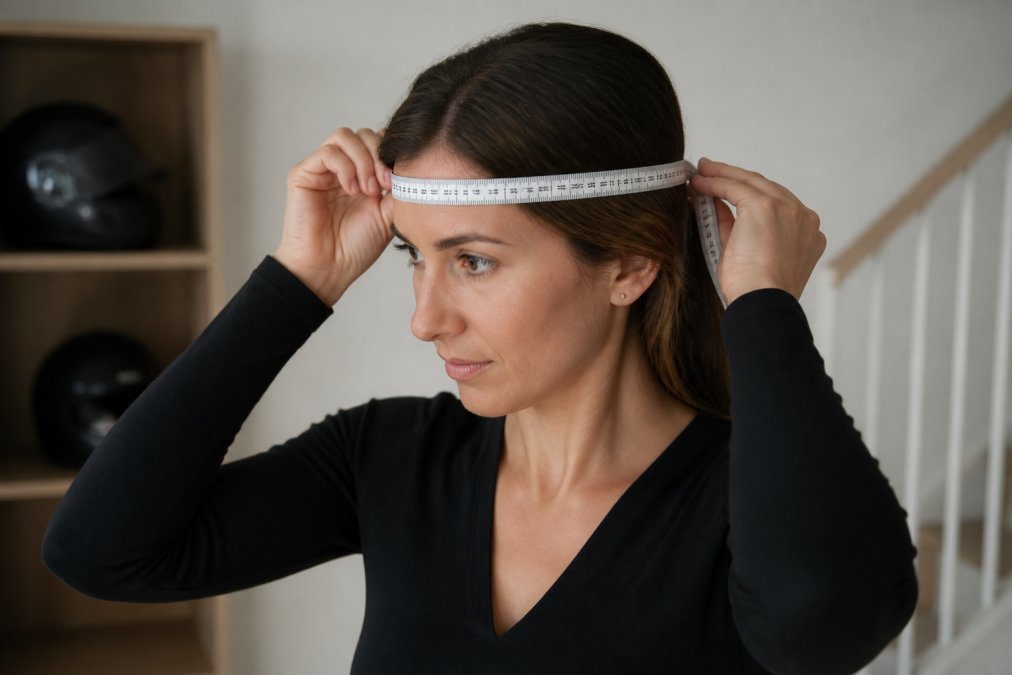
Size alone doesn't guarantee fit; head shape matters because two helmets in the same size can feel completely different.
Finding Your Head Shape Category
Helmet manufacturers use three primary head shape categories: oval, intermediate oval, and long oval. Most women fall into the oval or intermediate oval range, though some riders have long oval heads.
Oval heads are rounded front-to-back and side-to-side. If your face is roughly as wide as it is long with prominent cheekbones, you likely have an oval head.
Intermediate oval heads are slightly elongated front-to-back but fairly round side-to-side, the most common shape among women riders.
Long oval heads are noticeably longer front-to-back and narrower side-to-side.
To identify your shape, look at yourself head-on in a mirror: round face = oval, slightly stretched = intermediate oval, distinctly elongated = long oval. Helmet Shop's 30-day return policy lets you order multiple brands, test fit at home, and return what doesn't work.
Helmet Types: Full-Face, Modular, and Half-Helmet Options
Women's motorcycle helmets come in three primary styles, each with distinct safety profiles and practical trade-offs. Your choice depends on your riding style, commute distance, and weather conditions.
Full-Face Helmets for Maximum Protection
Full-face helmets cover your entire head, including chin and jaw, which are vulnerable in frontal impacts. The chin bar absorbs energy that would otherwise transfer to your face and neck.
For street riding or longer commutes, full-face helmets reduce wind noise and shield your face from rain, cold air, and debris. The trade-off is ventilation: they can feel warm in summer without multiple vents and good airflow.
The HJC C20 Probe Helmet delivers DOT and ECE 22.06 certified protection in a lightweight polycarbonate shell built for everyday street riders who want genuine HJC quality at a clear entry price. The Advanced Channeling Ventilation System keeps airflow moving on warm days, and the removable washable interior maintains comfort across regular riding seasons. At The Helmet Shop, the C20 is the no-nonsense entry full-face for riders who want trusted HJC manufacturing in a clean, practical helmet.

Modular Helmets for Versatility
Modular helmets flip the chin bar up, converting between full-face and open-face configurations. This flexibility appeals to riders who commute in varied conditions without carrying multiple helmets.
The trade-off is weight and complexity: modular helmets are heavier due to the hinged chin bar mechanism and have more moving parts requiring maintenance. For riders concerned about neck fatigue on long rides, the extra weight matters.
Modular helmets work best for mixed riding. For purely highway riding, a lightweight full-face helmet is more practical. For purely urban riding, a half-helmet reduces unnecessary weight.
Half-Helmets and Skull Caps
Half-helmets, also called skull caps, cover the top and back of your head but leave your face, chin, and jaw exposed. They're the lightest option with the best airflow and visibility, popular with cruiser riders and urban commuters.
Half-helmets don't protect your face, chin, or jaw in a forward impact. They meet DOT FMVSS 218 standard, which only requires top and back protection. Use them for low-speed urban riding; for highway riding or heavy traffic, a full-face helmet is safer.
The Daytona Skull Cap in Gloss Pink is the half helmet that proves DOT-certified protection and a slim, low-profile fit are not mutually exclusive. Carrying the distinction of being the smallest DOT-approved half shell helmet ever made, this lightweight shell comes in three shell sizes so the helmet actually fits your head correctly, rather than relying on excessive padding to make a single shell work for everyone. A dual-density EPS liner handles impact energy, a moisture-wicking interior keeps you comfortable, and the nylon Y-strap retention system with one-finger quick release keeps everything secure while making on-and-off effortless. Free head wrap and cloth drawstring bag included.
DOT-Approved Motorcycle Helmets and Safety Standards
Not all helmets are created equal when it comes to safety testing. Understanding the difference between DOT and ECE certification matters because these standards test impact protection differently.
DOT FMVSS 218 vs. ECE 22.06 Certification
DOT FMVSS 218 is the United States federal safety standard requiring impact tests at specific energy levels and penetration protection. DOT testing uses a flat anvil to simulate impact but doesn't capture rotational forces that occur in real crashes.
Comfort Features That Matter for Long Rides
A helmet that protects but causes pain becomes a helmet you won't wear regularly. For women riders doing commutes longer than 30 minutes, comfort features directly impact safety because discomfort leads to distraction and fatigue.
Ventilation, Weight, and Neck Fatigue
Ventilation keeps your head cool and prevents sweat buildup inside the helmet. Look for helmets with multiple intake vents (front and sides) and exhaust vents (top and rear). The HJC C20 Probe includes an Advanced Channeling Ventilation System designed to keep airflow moving. Proper ventilation reduces fogging on visors and makes warm-weather riding significantly more comfortable.
Managing Hair and Visor Compatibility
Long hair inside a helmet creates friction, tangling, and discomfort. Practical solutions include wearing your hair in a braid or bun before putting on the helmet. Some women wear a thin head wrap or silk cap liner inside the helmet to reduce friction. The Daytona Skull Cap includes a free head wrap with purchase, which is a practical touch for women riders managing longer hair.
Bluetooth Motorcycle Helmet Integration
Bluetooth communication systems let you stay connected while riding without taking your hands off the handlebars. Helmet Shop specializes in Bluetooth headsets and offers several helmets with Bluetooth systems pre-installed and ready to go. This integration eliminates the hassle of mounting aftermarket units and ensures the system is optimized for your specific helmet.
Testing Your Fit Before You Ride
A helmet that feels tight in the shop might feel comfortable after 20 minutes of riding as the padding settles. Conversely, a helmet that feels loose initially might shift during actual riding. The best test is wearing your helmet for 15-30 minutes at home before committing to it.
Helmet Maintenance and Replacement Timeline
A well-maintained helmet lasts longer and protects better. Clean the exterior regularly with mild soap and water. Remove the interior padding if it's removable and wash it separately. Air-dry everything completely before reassembling.
Frequently Asked Questions
How should a motorcycle helmet fit a woman's head?
A properly fitting women's motorcycle helmet should feel snug but not painfully tight. The helmet should sit level on your head, covering your forehead without tilting forward or backward. When you put on the helmet, your cheeks should feel gentle pressure from the cheek pads, and you should not be able to move the helmet side-to-side or front-to-back more than an inch. The chin strap should be snug enough that you can fit only one finger between the strap and your chin. Check the fit by shaking your head gently; the helmet should move with your head, not slide independently.
What does DOT-approved mean for motorcycle helmets?
DOT-approved means a helmet meets the U.S. Department of Transportation's FMVSS 218 safety standard. This certification requires helmets to pass impact tests, penetration tests, and retention system tests to ensure they protect your head in a crash. All DOT-approved helmets sold in the United States must display a DOT sticker on the back. ECE 22.06 is an alternative international standard that is stricter in some areas. Both certifications ensure your helmet provides genuine protection, not just a shell without proper impact absorption or retention.
What is the difference between full-face and modular helmets for women?
Full-face helmets offer complete protection with a fixed chin bar and full visor coverage, providing the most comprehensive protection and wind noise reduction. They are heavier and less convenient for frequent on-and-off situations. Modular helmets flip the chin bar up, allowing you to open the face while wearing the helmet, offering flexibility for city commuting or touring breaks. Modular helmets are typically heavier than full-face due to the hinge mechanism, but the convenience trade-off appeals to many riders. Half-helmets provide minimal coverage and are lighter, best for cruiser-style riding at lower speeds.
How often should I replace my motorcycle helmet?
Replace your helmet immediately after any significant impact or crash, even if there is no visible damage. For regular use without crashes, most manufacturers recommend replacing your helmet every 3 to 5 years because the EPS liner and shell materials degrade over time from UV exposure, temperature changes, and moisture absorption. Check your helmet's interior for signs of deterioration, padding breakdown, or liner damage. If you ride daily in harsh conditions or store your helmet in extreme temperatures, consider replacing it sooner. Inspect the shell, chin strap, and visor regularly for cracks or weakening.
Finding the right women's motorcycle helmet requires understanding your head shape, measuring accurately, and testing fit before committing. At Helmet Shop, we stock a wide range of helmets from brands like HJC, Daytona, and Bell, each engineered with different head shapes and riding styles in mind. Our 30-day return policy ensures you can test fit at home and return what doesn't work. Shop now and ride with confidence knowing your gear actually fits.


