

Did you know that a properly fitted helmet reduces the risk of a fatal head injury by approximately 42 percent, yet many riders are still wearing the wrong size? You have likely experienced the frustration of a helmet that lifts at highway speeds or causes a splitting headache after just an hour in the saddle. It is a common struggle for enthusiasts, especially when sizing seems to shift between a Shoei helmet and an Arai helmet. You deserve a piece of gear that remains rock-solid during a crash and stays comfortable during a long day of touring.
This motorcycle helmet size guide provides the professional techniques you need to master your fit for 2026. Bill Harbison and our expert team at The Helmet Shop believe safety is not just about the number on a sticker; it is about matching helmet architecture to your unique cranial geometry. We will show you how to measure your head accurately and select from our curated inventory of full face helmets and modular helmets with total confidence. You will learn how to identify your head shape and navigate the sizing nuances of premium brands like HJC helmets to ensure your next online order is perfect the first time.
Key Takeaways
- Master professional measurement techniques to establish a precise baseline for this motorcycle helmet size guide.
- Identify your specific head shape, such as Long Oval or Round Oval, to ensure Arai helmets or Shoei helmets provide a safe, uniform fit.
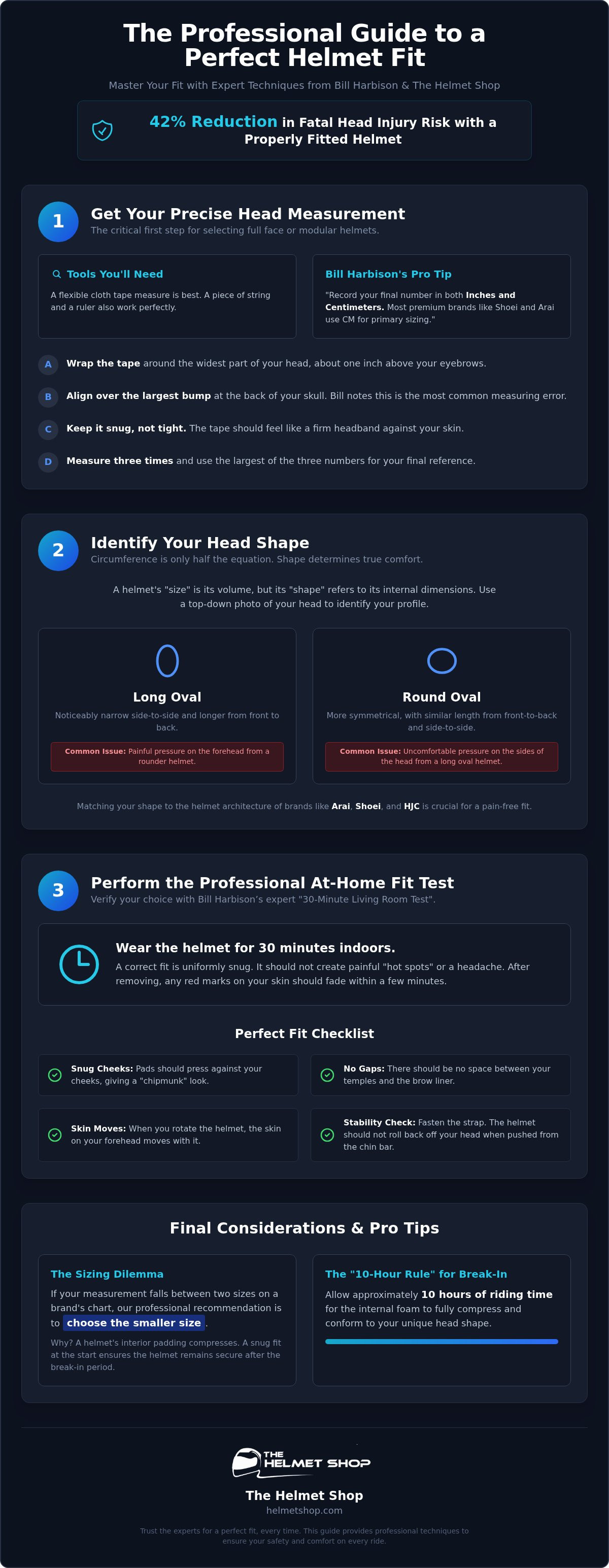
- Apply Bill Harbison’s expert "30-minute living room test" to verify that your new full face helmet offers a secure fit without painful pressure points.
- Navigate the unique shell architectures of brands like HJC helmets to select the correct model for your facial structure.
- Understand the "10-Hour Rule" for internal foam break-in so you can distinguish between a necessary snug fit and a helmet that is truly too small.
The Foundation of Safety: How to Measure for a Motorcycle Helmet
A precise measurement is the most critical step in your gear selection process. If your helmet is even slightly too large, it can shift or rotate during an accident. This movement prevents the energy-absorbing liner from doing its job correctly. To ensure you meet modern Motorcycle helmet safety standards, you must start with an accurate circumference of your head. A proper fit is the difference between a helmet that protects you and one that becomes a liability.
You only need a few simple tools to get started. A flexible cloth tape measure is the professional choice for accuracy. If you don't have one, use a piece of string and then measure that string against a standard ruler. Bill Harbison always recommends recording your final number in both inches and centimeters. Most premium manufacturers like Shoei and Arai use centimeters for their primary shell sizing. Having both values prevents confusion when you are comparing different brands.
Step-by-Step Measuring Technique
Achieving a consistent measurement requires a specific approach. Follow these steps to get a professional-grade result:
- Wrap the tape measure around the widest part of your head. This is typically about one inch above your eyebrows.
- Ensure the tape passes over the largest bump at the back of your skull. Bill Harbison notes that missing this point is the most common error leading to a poor fit.
- Keep the tape snug but not tight. It should feel like a firm headband.
- Take the measurement three times. Use the largest of the three numbers to ensure your modular helmet or full-face option doesn't create painful pressure points later.
Interpreting Your Numbers
Once you have your number, compare it to a brand-specific motorcycle helmet size guide. Sizing is not universal across the industry. A medium in HJC helmets might fit differently than a medium from another manufacturer. If your measurement falls exactly between two sizes on a chart, our professional recommendation is to choose the smaller size.
New riders often "size up" for comfort, but this is a mistake. A helmet's interior padding will compress over time. Starting with a slightly snug fit ensures the helmet remains secure after the break-in period. A loose helmet is a safety hazard that can lift at high speeds or fail you when you need it most. Trust the numbers you've recorded rather than how you think a size should feel.
Beyond the Number: Understanding Head Shapes and Architecture
Circumference is only half the equation. You might have the exact measurement from our motorcycle helmet size guide, but if the internal architecture doesn't match your skull's geometry, you'll never be comfortable. Bill Harbison frequently points out that a helmet's "size" refers to the volume of the shell, while the "shape" refers to the interior dimensions. This is why a size Medium in one brand can feel like a restrictive Small in another. To find a lid that stays secure without causing pain, you must identify your specific head profile.
You can identify your shape easily with a mirror test or a top-down photo. Have a friend photograph the top of your head with your hair flattened. You are looking for the ratio between the length of your head and the width. This step is a vital part of choosing the right helmet because it dictates which brands will actually work for you. Premium manufacturers like Shoei helmets and Arai helmets design their interior liners to cater to specific anatomical variations.
Long Oval vs. Round Oval
Long Oval heads are noticeably narrow from side to side and longer from front to back. If you have this shape and try to wear a rounder helmet, you'll experience the "forehead hot spot." This is a sharp, burning pressure point on your brow that usually appears after 20 minutes of riding. Conversely, Round Oval heads have nearly equal dimensions with wider temple areas. If a Round Oval rider wears a narrow helmet, they'll feel excessive pressure on the sides of their head, which can lead to tension headaches. Arai is one of the few brands that offers different models specifically sculpted for these two extremes.
The Intermediate Oval Standard
The Intermediate Oval is the most common head shape for riders in North America. It is slightly longer from front to back than it is wide. Most HJC helmets are built on this "universal" standard because it fits the widest range of people. If you find yourself between shapes, you can often customize the fit. Many full face helmets feature interchangeable cheek pads and center liners. These allow you to tighten or loosen specific areas without changing the shell size. If you're ready to see how these different shapes feel, you can browse our modular helmet selection to compare the latest interior designs.
The Professional Fit Test: Verifying Your Size at Home
Once you have followed our motorcycle helmet size guide, the real test begins when the box arrives at your door. A new helmet should feel like a firm handshake. It should be snug across your cheeks and brow without feeling like a vice. Bill Harbison often reminds customers that if a helmet is easy to put on the very first time, it's likely too large. You want that initial resistance because the internal liners will eventually conform to your unique facial structure.
Before you remove the tags or head out for a ride, perform the 30-minute living room test. Wear the helmet while watching television or reading. This duration is long enough for "hot spots" or pressure points to reveal themselves. While wearing it, check your eye port alignment. Your eyes should be centered vertically in the opening. If the top edge of the port obscures your vision when you're in a tucked riding position, the helmet is sitting too low. This alignment is vital for maintaining peripheral vision and overall safety.
The Movement and Roll-Off Tests
A secure fit means the helmet moves with you, not around you. Place your hands on the sides of the helmet and try to rotate it gently. Your skin and scalp should move with the liner. If the helmet slides freely over your hair, you need a smaller size. Next, perform the roll-off test. With the chin strap fastened snugly, reach over the back of the helmet and try to pull it forward off your head. A properly fitted full face helmet will stay locked in place. If it starts to peel off, it won't protect you during a tumble. This procedure is a cornerstone of the NHTSA helmet fitting guide for a reason.
Identifying Red Flags
You must learn to distinguish between a snug fit and actual pain. Snugness is expected, especially in high-performance Shoei helmets or Arai helmets. However, a sharp pain in the forehead or ears indicates a shape mismatch or a size that is too small. On the other end of the spectrum, look for signs of a loose fit. If you hear a distinct whistling sound or feel the helmet lifting at highway speeds, the shell is catching too much air. A loose helmet is dangerous. It can obscure your vision or even come off during an impact. If you're unsure about your fit, Bill Harbison suggests revisiting the motorcycle helmet size guide and checking the "Cheek Pad Pinch." You shouldn't be able to easily slide a finger between the padding and your face.
Brand-Specific Fitment: Shoei, Arai, and HJC Nuances
Even with a comprehensive motorcycle helmet size guide, understanding brand-specific nuances is essential for a perfect fit. Bill Harbison has observed that premium manufacturers often use different shell sizes to cover their size range. A brand using four shell sizes will provide a more proportional fit and better weight distribution than one using only two. This technical detail directly impacts how the helmet feels during a long day of riding. It ensures the helmet doesn't feel top-heavy or look oversized for your frame.
Shoei focuses on a balance of advanced aerodynamics and plush internal liners. Their helmets are designed to be quiet and stable at high speeds. In contrast, Arai prioritizes their R75 Shape. This philosophy dictates a consistently rounder, smoother shell designed to glance off obstacles during an impact. While both brands offer elite protection, their interior volumes differ significantly. Arai's focus on safety geometry often results in a shell that feels different than the more sculpted Shoei designs.
HJC provides a value-driven approach with consistent sizing across their entire lineup. Whether you are looking at HJC helmets in a full-face or modular configuration, the fitment remains remarkably predictable. This consistency is a major advantage if you're ordering online. You can trust that the internal dimensions won't shift wildly between different models in their catalog. This makes them an excellent choice for riders who want a reliable baseline for their gear collection.
Shoei vs. Arai Fitment Comparison
Shoei typically fits an Intermediate Oval head more deeply than Arai. Arai compensates for this with industry-leading micro-fitment options, including 5mm peel-away temple pads found in many Arai helmets. These allow you to fine-tune the fit without buying new liners. If you have a prominent jawline or high cheekbones, you may find that Shoei helmets offer the necessary clearance and contouring to prevent discomfort.
Modular vs. Full Face Sizing
You might notice that modular helmets often feel slightly wider at the base than their full-face counterparts. This is due to the mechanical hinge requirements of the chin bar. When testing a modular lid, ensure the chin bar doesn't interfere with your facial structure when locked in the downward position. Additionally, many modular models include internal sun shields. These mechanisms can sometimes reduce forehead room slightly, so revisit your motorcycle helmet size guide if you are on the edge of a size. If you are ready to upgrade your protection, shop our full face helmet collection for the most secure fit available.
The Break-In Period and Fine-Tuning Your Comfort
We follow the "10-Hour Rule" at The Helmet Shop. It typically takes about 10 hours of actual ride time for the expanded polystyrene (EPS) and comfort foam to settle and mold to your facial features. During this break-in period, the padding compresses in high-pressure areas. If you still feel minor discomfort after this window, don't assume you need a different size. Swapping to thinner or thicker cheek pads solves 90 percent of fitment issues without compromising the shell's integrity. However, if you experience a sharp, localized pain that doesn't subside, the internal shape is likely a mismatch for your head, and you should consider an exchange.
The comfort liner is designed to be resilient, but it needs time to adapt. Bill Harbison’s advice is to avoid judging a helmet's final fit in the first five minutes of wearing it. The heat from your skin helps the foam soften and contour to your skull. To keep these materials performing at their best, Bill recommends using professional helmet care products. Regular maintenance prevents sweat and oils from breaking down the foam prematurely, ensuring your custom-molded fit lasts for years rather than months.
Adding Tech Without Ruining Fit
Modern riders often want to integrate communication systems, but you must plan for this during the fitting process. When selecting your size, check for dedicated speaker pockets. These allow you to install Sena Bluetooth headsets or Cardo Bluetooth headsets without the speakers pressing painfully against your ears. Most premium helmets now include eyeglass channels as well. These are specific gaps in the padding that prevent your frames from being crushed against your temples. Finally, ensure you maintain a tight seal around the neck roll. A proper fit here is essential to reduce wind noise and prevent the "whistle" effect at highway speeds.
Secure Your Professional Fit for the Road Ahead
Finding the right gear is a commitment to your safety and riding enjoyment. By applying the techniques in this motorcycle helmet size guide, you've moved beyond guesswork and into the standard of professional fitment. Remember that a precise measurement is only your starting point. Matching your unique head shape to the right brand architecture is what eliminates those painful forehead hot spots. It ensures your helmet stays stable at speed. It's time to stop settling for gear that almost fits.
As an authorized dealer for premium brands, Bill Harbison and the team at The Helmet Shop act as your knowledgeable advisors. We've carefully selected our inventory to meet the highest standards of modern innovation. Whether you need a Shoei, an Arai, or a versatile HJC, we provide the expert fitment advice you need to ride with total confidence. Shop our professionally curated selection of Shoei, Arai, and HJC helmets today and enjoy free shipping on all orders over $49. Your perfect fit is waiting; we'll see you out on the road.
Frequently Asked Questions
Is a tighter motorcycle helmet safer than a loose one?
Yes, a snug fit is essential for maximum safety. A loose helmet can shift or lift during an impact, which prevents the internal liner from absorbing energy correctly. Bill Harbison emphasizes that your helmet should move with your skin, not slide over your hair. If you're choosing between two sizes in a motorcycle helmet size guide, the smaller, more secure option is generally the safer choice for high-speed riding.
How do I know if my motorcycle helmet is too small?
A helmet is too small if it causes sharp, persistent pain or leaves deep red marks on your brow after 15 minutes. While full face helmets should be snug, they shouldn't cause tension headaches or restrict your breathing. If you can't pull the helmet down fully or if the eye port sits too high above your eyebrows, you likely need to move up one size.
Do motorcycle helmet sizes run the same across all brands?
No, sizing is not universal across the industry. Each manufacturer uses its own proprietary molds and shell shapes. A Medium in Shoei helmets will fit differently than a Medium in HJC helmets. This is why Bill Harbison insists on checking brand-specific charts. Head shape is just as important as circumference, so always verify if a brand caters to round or intermediate oval profiles before purchasing.
What should I do if I wear glasses with my helmet?
Look for helmets with dedicated eyeglass channels in the padding. Many modern modular helmets feature these grooves to prevent your frames from pressing against your temples. When you use a motorcycle helmet size guide, ensure your frames don't lift the helmet off your brow. If your glasses don't fit comfortably, you might need to adjust the cheek pad thickness rather than changing the entire helmet size.
How often should I re-measure my head for a new helmet?
You should re-measure your head every time you purchase a new lid. Physical changes like weight fluctuations or even a different hairstyle can alter your circumference slightly. Bill Harbison recommends a fresh measurement to ensure you are selecting the correct shell size for current conditions. Since helmet technology and internal liner materials evolve, relying on a measurement from several years ago can lead to a poor and potentially unsafe fit.
Can I change the inner padding to make a helmet fit better?
Yes, most premium brands allow you to swap internal components to customize your comfort. If the shell size is correct but the fit feels slightly off, you can install thinner or thicker cheek pads. This is a common technique at The Helmet Shop to customize Arai helmets for unique facial structures. It's a professional way to fine-tune comfort without compromising the safety standards of the original liner.
What is the 'hot spot' riders talk about in helmet fitment?
A hot spot is a localized pressure point, usually on the forehead or the back of the head. It occurs when your head shape doesn't match the helmet's internal architecture. For example, a round head in a long oval shell will feel excessive pressure on the sides. Bill Harbison advises that if a hot spot doesn't disappear after the break-in period, the helmet shape is wrong for your specific anatomy.
Does head shape change as you get older or change hair styles?
While your actual skull shape remains constant, the soft tissue and hair volume around it can change. Significant weight loss or gain can affect how cheek pads sit against your jawline. Additionally, moving from very long hair to a buzzed cut will definitely impact how a open face helmet feels. Always consult a motorcycle helmet size guide and re-verify your fit after any major physical or grooming changes.


