

For years, many riders believed that choosing a modular helmet meant sacrificing safety for convenience. In 2026, that compromise is officially dead. If you've ever struggled with neck strain from a heavy flip-up mechanism or felt the frustration of trying to fit glasses inside a tight shell, you aren't alone. You want the flexibility of an open-face design for a quick breath of air, but you shouldn't have to tolerate excessive wind noise at highway speeds to get it.
In this guide, you'll discover how to choose the perfect modular motorcycle helmets that balance full-face protection with modern convenience. Bill Harbison and the team at The Helmet Shop have carefully curated this year's inventory to ensure every rider finds a lightweight, quiet solution. We'll preview the top models from Shoei Helmets and HJC Helmets, look at integrated sun shields, and discuss how to integrate Sena or Cardo systems for a truly premium experience. From ECE 22.06 ratings to the best modular helmets for long-distance touring, we have the expertise to guide your choice.
Key Takeaways
- Learn how modern modular motorcycle helmets provide a hybrid solution that balances full-face safety with the convenience of a flip-up chin bar.
- Understand the critical importance of ECE 22.06 and P/J dual homologation, safety standards that Bill Harbison insists upon for maximum protection.
- Compare weight and comfort factors to find a lid from Shoei Helmets that eliminates neck strain and fits glasses comfortably.
- Discover how to streamline your ride with integrated Sena Bluetooth Headsets for clear communication and navigation.
- Access the curated inventory of Modular Helmets at The Helmet Shop to find a high-performance fit for your next tour.
Understanding the Modular Motorcycle Helmet: Versatility Reimagined
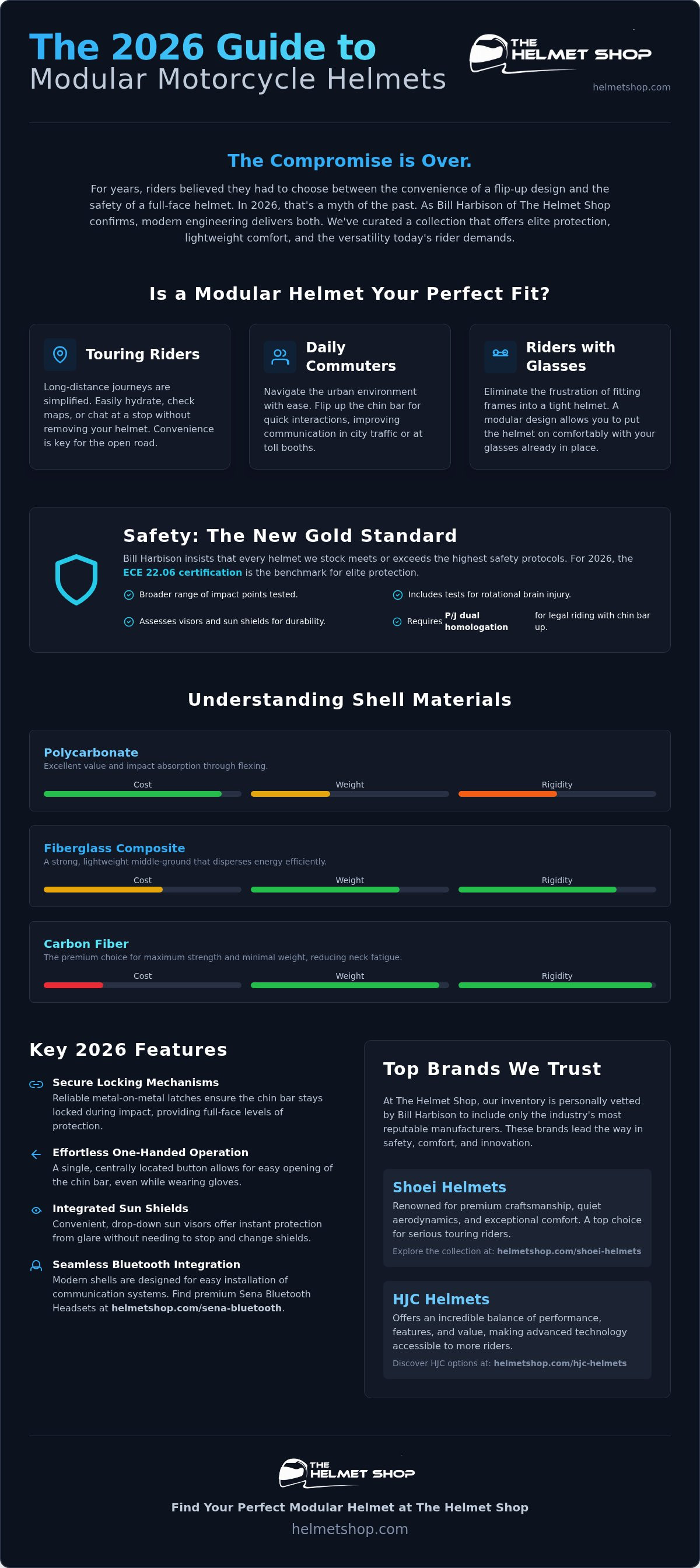
A modular helmet represents the ultimate hybrid in head protection. It blends the structural security of full face helmets with the open-air convenience of a traditional open-face design. The defining feature is the chin bar. It pivots upward on a dedicated hinge, allowing you to expose your face without removing the entire unit. Bill Harbison often emphasizes that versatility shouldn't come at the cost of shell integrity. At The Helmet Shop, we prioritize modular motorcycle helmets that maintain a rigid, protective structure while offering the freedom riders crave during stops.
The Mechanics of the Flip-Up Chin Bar
Precision engineering drives the 2026 lineup. Modern locking mechanisms rely on stainless steel, metal-on-metal latches. These components provide a secure, tactile engagement that stays locked during impact. You'll find that one-handed operation is now the industry standard across our inventory. A single central button allows you to lift the chin bar effortlessly, even while wearing thick motorcycle gear. Aerodynamics have also seen a massive overhaul. Leading manufacturers like Shoei Helmets and HJC Helmets have refined their shell shapes to reduce drag and wind buffeting. This makes the helmet feel lighter and significantly quieter when the chin bar is locked in the down position. The result is a more stable ride at highway speeds.
Who Should Choose a Modular Helmet?
These lids cater to specific riding styles where flexibility is a priority. They solve many of the common frustrations found with fixed-chin designs.
- Touring Riders: If you're crossing state lines on a long haul, you'll appreciate being able to hydrate or check a map at a gas station without the hassle of unbuckling.
- Daily Commuters: Navigating city traffic often requires quick communication. Flipping the bar up to speak to a parking attendant or a fellow rider is a seamless process.
- Riders with Glasses: Traditional full-face entries can be incredibly tight. A modular design allows you to put the helmet on with your frames already in place, preventing bent temples or skin irritation.
Our curated selection of modular helmets focuses on these real-world needs. We ensure every model we stock meets rigorous safety standards while delivering the functional benefits that make your ride better. Whether you're a veteran tourer or a new commuter, the modular design offers a level of adaptability that is hard to beat.
Evaluating Safety and Performance in 2026 Modular Models
There's an old myth that modular designs are inherently weaker than their full-face counterparts. In 2026, that simply isn't true. Modern engineering has revolutionized the structural integrity of the flip-up shell. Bill Harbison personally vets our inventory to ensure every model we carry meets the highest standards of impact protection. When you browse our collection of modular motorcycle helmets, you're looking at gear that has passed rigorous testing protocols designed to protect you in real-world scenarios.
National safety standards are the baseline for any rider. While every helmet we sell is DOT approved, the ECE 22.06 certification is the new gold standard for 2026. This updated European protocol involves more impact points and higher speed tests than previous versions. It also includes specific checks for rotational brain injuries. Choosing a helmet with these ratings means you're investing in the most advanced safety technology available today. We don't settle for "good enough" at The Helmet Shop, and neither should you.
Impact Protection and Shell Materials
The shell is your first line of defense. Polycarbonate shells are popular for their affordability and ability to flex under pressure. Fiberglass offers a stronger, more rigid middle ground that disperses energy efficiently. For those who prioritize weight reduction, carbon fiber is the premier choice. It's incredibly light, which significantly reduces neck fatigue on long rides. Inside the shell, we look for Multi-Density EPS liners. These foam layers are tuned to absorb energy at both high and low speeds. Dual homologation, often referred to as P/J certification, is the legal standard that guarantees a helmet is safe for use with the chin bar in both the open and closed positions.
Wind Noise and Aerodynamics
Silence isn't just about comfort; it's a safety feature. Excessive wind noise leads to rider fatigue and hearing loss over time. The 2026 models from Shoei Helmets and HJC Helmets utilize plush neck rolls and thick chin curtains to seal out turbulent air. Aerodynamics also play a massive role in noise reduction. Visor seals must be airtight to prevent that annoying high-pitched whistling at highway speeds. For more details on how these designs manage airflow, take a look at our Motorcycle Helmet Ventilation Guide. If you’re ready to upgrade your protection, explore our full range of modular motorcycle helmets to find your perfect fit.
Modular vs. Full Face: Making the Right Choice for Your Ride
Deciding between full face helmets and modular motorcycle helmets often comes down to your specific riding environment. While a traditional full-face shell offers a single, solid piece of protection, modern modulars have closed the safety gap significantly. For most street riders and tourers, the slight difference in shell continuity is outweighed by the massive gains in daily utility. You're no longer choosing between safety and comfort; you're choosing the tool that best fits your journey.
The safety debate has shifted as engineering has improved. While a full-face lid remains the standard for track racing due to its rigid chin bar, a high-quality modular provides comparable protection for highway and urban use. Bill Harbison and our team focus on models that maintain strict locking standards, ensuring the chin bar stays secure when it matters most. If you're wondering about the long-term value of a high-end lid, this Shoei Helmets Investment Guide explains why premium protection is a smart move for serious riders.
The Convenience Factor for Touring
Modulars act as the "Swiss Army Knife" for cross-country touring. You don't have to struggle with your gear at every fuel stop or social interaction. The ability to flip up the chin bar makes checking maps, taking photos, or speaking with a riding partner effortless. Most 2026 modular motorcycle helmets also feature an integrated internal drop-down sun shield. This feature is a game-changer for long days in the saddle. It allows you to adapt to changing light conditions instantly without fumbling for sunglasses or stopping to swap visors.
Weight and Balance Considerations
Weight distribution is where these two styles differ most. Because of the hinge and locking hardware, modulars can have a different center of gravity compared to fixed shells. When the chin bar is raised, the weight shifts upward and back, which can cause strain if left open for long periods. Bill Harbison recommends specific lightweight models from brands like HJC Helmets for riders sensitive to neck fatigue. To keep your neck fresh during 500-mile days, keep the helmet locked in the down position at speed and only use the flip-up feature during stops or slow-speed maneuvers. This keeps the weight balanced and your focus on the road ahead.
Comfort, Tech, and Integrated Communication
Comfort in 2026 is defined by more than just soft foam. Modern modular motorcycle helmets feature advanced interior liners with superior moisture-wicking properties. These technical fabrics pull sweat away from your skin and dry rapidly, keeping you cool during intense summer tours. Bill Harbison insists on a "glasses-friendly" design for every premium model we stock. Specialized channels in the temple area prevent frames from pressing against your head. This eliminates the skin irritation and bent temples that often plague riders who wear corrective lenses or sunglasses.
Technology integration is where the modular design truly shines. Many riders worry that adding a communication system will compromise the flip-up mechanism. Bill Harbison personally recommends testing the flip-up action after installing any headset to ensure zero interference. A snagging cable or a bulky mount can ruin the convenience of a modular shell. Our team ensures that every installation maintains the smooth, one-handed operation you expect from a high-end lid.
Bluetooth Integration: Sena vs. Cardo
Choosing between Sena Bluetooth Headsets and Cardo often depends on your specific riding group. Sena's Mesh 2.0 technology allows for near-instant connections with large groups, making it a favorite for touring clubs. If you prefer a Cardo Bluetooth Headset, mounting requires a bit more precision. You must place the unit carefully to avoid blocking the hinge movement of the chin bar. For a deep dive into compatibility, our Bluetooth Headset Buyer’s Guide provides the specific tech specs you need to make an informed choice.
The Importance of a Proper Fit
A helmet is only safe if it fits correctly. The "snug but comfortable" rule is your primary guide. The helmet should move with your skin when you wiggle it, but it shouldn't cause pain. Check for localized pressure points on your forehead and temples. These small hot spots will become unbearable after an hour on the road. Most modular motorcycle helmets from Shoei Helmets and HJC Helmets offer interchangeable cheek pads. This allows you to customize the fit to your specific face shape, ensuring the helmet remains stable at highway speeds. If you're ready to experience a custom-feeling fit, browse our curated selection of modular helmets today.
Investing in Quality: Finding Your Modular Helmet at The Helmet Shop
Selecting the right headgear is a long term investment in your safety and comfort. At The Helmet Shop, we don't just sell products; we offer solutions tailored to your specific riding style. Our curated selection of Modular Helmets includes only the brands that have proven their worth on the road. Bill Harbison leads our team with a focus on high quality standards, ensuring that every 2026 model we stock meets the rigorous ECE 22.06 requirements we've discussed throughout this guide.
For riders who demand the absolute best, Shoei Helmets remain the gold standard. Their precision engineering and superior materials provide a level of silence and stability that is unmatched in the industry. If you're looking for high performance without the premium price tag, HJC Helmets offer incredible value. They provide modern safety features and sleek designs that cater to mid range budgets without compromising on shell integrity. We've selected these brands because they consistently deliver on the promise of protection and durability.
Why Shop with Bill Harbison?
Bill Harbison has spent decades in the industry, building a reputation for reliability and expertise. Every product recommendation comes from a deep understanding of what riders actually need. We provide a national reach with reliable shipping standards, making it easy for riders across the country to access top tier gear. Our focus remains on your satisfaction and maintaining high quality riding standards. We treat every order with the professional care you'd expect from a seasoned veteran of the motorcycle community. You aren't just a customer; you're a fellow enthusiast who deserves the best protection available.
Your Next Steps to a Safer Ride
It's time to review your current gear. Look for comfort gaps, worn out liners, or outdated safety ratings. If your current lid is over five years old or lacks the latest ECE 22.06 certification, it's time for an upgrade. We invite you to browse our 2026 collection to see the latest innovations in modular motorcycle helmets. For a broader look at all available options, our Complete Helmet Guide covers everything from safety ratings to the newest tech integrations. Don't wait for a failure to happen. Invest in your protection today and experience the difference that a professional grade helmet makes on every mile of your journey.
Elevate Your Ride with the Next Generation of Protection
Choosing the right gear shouldn't be a compromise. You've seen how the 2026 lineup of modular motorcycle helmets delivers the rigorous safety of ECE 22.06 alongside the mechanical precision required for long-distance touring. Whether you prioritize the premium silence of Shoei Helmets or the high-performance value of HJC Helmets, the right choice is about finding a lid that fits your specific needs and face shape. Integrating a Sena Bluetooth Headset ensures you stay connected without losing the convenience of a flip-up design.
Bill Harbison and our team at The Helmet Shop are here to act as your reliable guide. As an authorized dealer for the industry's top brands, we provide expert curation and reliable national shipping on all premium gear. It's time to retire your old equipment and invest in modern innovation that protects you on every mile. We invite you to Shop Our Curated Collection of 2026 Modular Helmets and experience the difference of professional-grade equipment. Your next adventure is waiting, and we're ready to help you ride with total confidence.
Frequently Asked Questions
Is a modular helmet as safe as a full-face helmet?
High-quality modular motorcycle helmets are just as safe as full-face models for street use when they carry the ECE 22.06 certification. Bill Harbison ensures our inventory features metal-on-metal locking mechanisms that stay secure during impact. While track racers still prefer one-piece full face helmets, modern modulars provide excellent protection for highway touring. Always ensure the chin bar is fully clicked into the locked position before you start your ride.
Can I ride with the chin bar up on my modular helmet?
You can only ride with the chin bar up if your helmet has P/J dual homologation. This specific rating confirms the helmet was safety tested in both the open and closed positions. Bill Harbison recommends keeping the bar down at highway speeds to maintain aerodynamics and face protection. Use the open position for low-speed maneuvers or when stopped. Browse our modular helmets to find models designed for legal dual-position use.
Are modular helmets noisier than full-face models?
Traditionally, modular designs were louder, but 2026 models have solved this with better seals. Premium brands like Shoei Helmets use thick neck rolls and airtight visor gaskets to block wind noise. While a single-piece shell is naturally quieter, the gap is now minimal. Proper fitment is the biggest factor in noise reduction. A snug helmet prevents air from entering through the base, which keeps your ride much more peaceful.
What is the best modular helmet for riders who wear glasses?
The best options feature "glasses-friendly" interior padding with recessed channels for the temple arms. These channels prevent your frames from pressing against your head during long rides. Bill Harbison has curated several HJC Helmets and Shoei models that specifically cater to riders with corrective lenses. This design prevents bent frames and skin irritation. Always check the interior liner for these grooves to ensure you can slide your glasses in easily.
How do I install a Bluetooth headset in a modular helmet?
Start by removing the interior cheek pads to access the speaker pockets. Most 2026 Sena Bluetooth Headsets are designed to fit into pre-molded cavities. You must route the microphone wire carefully so it doesn't get pinched by the chin bar hinge. Bill Harbison advises riders to cycle the flip-up mechanism several times after installation. This confirms that the unit or wires don't interfere with the helmet's mechanical movement or locking security.
Do modular helmets weigh more than standard full-face helmets?
Modular designs typically weigh more than standard full-face helmets because of the hinge and locking hardware. This extra weight can lead to neck fatigue if the helmet isn't well-balanced. However, many 2026 modular motorcycle helmets use carbon fiber or advanced composites to keep the weight manageable. Bill Harbison selects models with optimized centers of gravity to minimize the feel of the extra ounces. Choosing a lightweight shell helps maintain comfort during cross-country tours.
What safety ratings should I look for in a 2026 modular helmet?
You should prioritize the ECE 22.06 rating, which is the most rigorous safety standard for 2026. This test includes rotational impact checks and higher speed testing than the standard DOT requirement. Also, look for the P/J dual homologation if you plan to ride with the chin bar raised. Bill Harbison focuses on stocking modular helmets that meet these global standards. These ratings provide the best confirmation that your gear will perform when needed.
How often should I replace my modular motorcycle helmet?
Most manufacturers recommend replacing your helmet every five years or immediately after any impact. The protective EPS liner inside the shell degrades over time and loses its ability to absorb energy. Even if the exterior looks fine, internal materials can become brittle. Bill Harbison suggests checking your manufacture date regularly. If you've dropped your lid on a hard surface, don't take the risk. It's time to browse our latest collection for a safe replacement.


