

Can you really get full-face safety levels from a helmet that leaves your face open to the breeze? Many riders believe they have to choose between the raw freedom of the road and the rigorous protection of a closed shell. It's a common struggle to find open face motorcycle helmets that don't become deafeningly loud above 50mph or feel flimsy during a long tour. You want the classic aesthetic, but you don't want to compromise on your physical security.
You shouldn't have to sacrifice your peace of mind for a vintage look. We agree that the best gear should offer both uncompromising style and the latest in impact technology. This expert guide will show you how to master the balance of heritage design and modern engineering. You'll learn how to identify models that meet the strict new ECE 22.06 safety standards while accommodating prescription glasses comfortably.
We'll preview the top 2026 releases from industry leaders like Shoei, Arai, and HJC. We also explore how to integrate advanced Mesh 2.0 communication systems without the need for a bulky chin bar. From the new Shoei J-Cruise 3 to the HJC RPHA 31, we've curated the best options to keep you safe, connected, and stylish on every ride.
Key Takeaways
- Understand why open face motorcycle helmets are the premier choice for riders who prioritize maximum peripheral vision and unrestricted airflow.
- Learn the critical differences between standard DOT compliance and the rigorous new ECE 22.06 testing for rotational impacts.
- Compare premium flagship models from Shoei and Arai to identify which internal sun shields and ventilation systems best suit your needs.
- Discover how to successfully integrate advanced Bluetooth communication systems using specialized boom microphones for crystal-clear communication.
- Identify why sourcing from The Helmet Shop ensures you get a curated selection of the latest safety tech and expert support.
Table of Contents
What defines an Open Face Motorcycle Helmet in 2026?
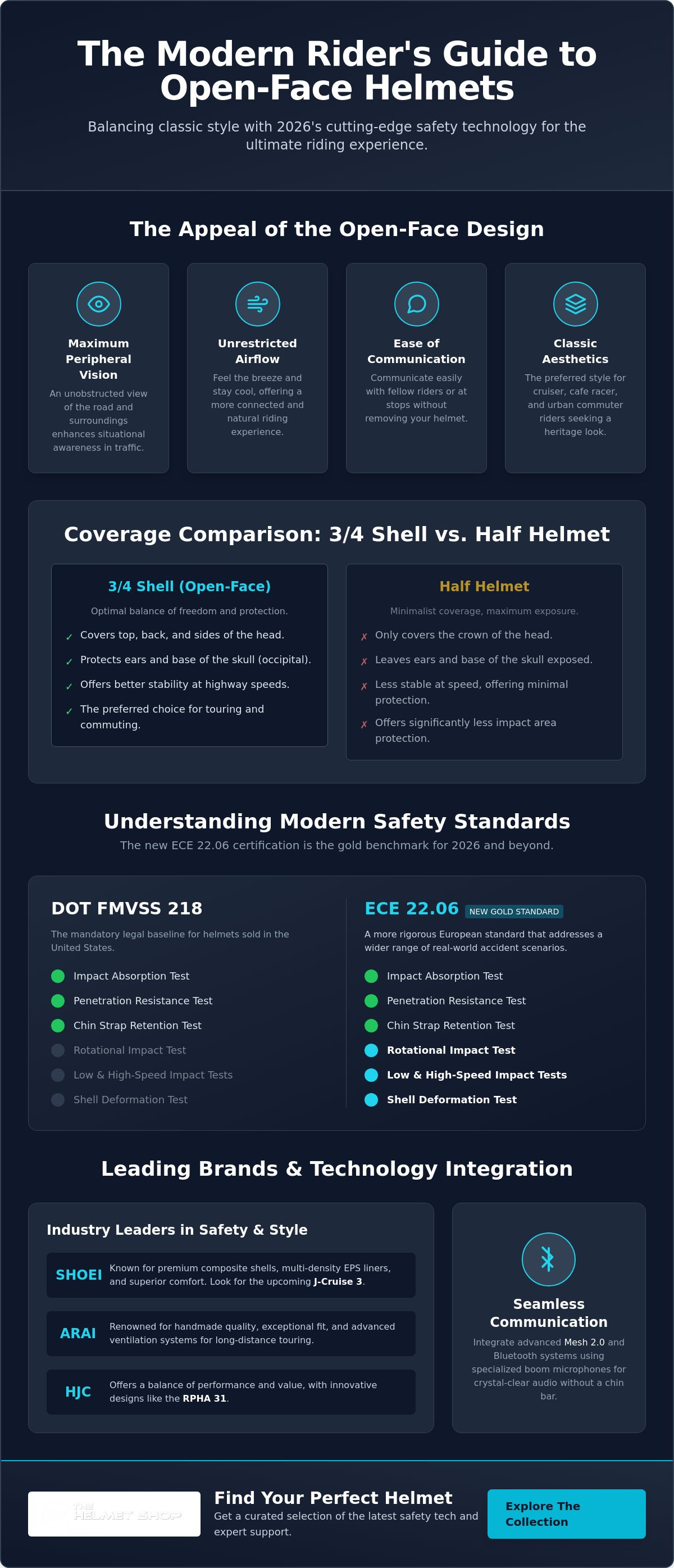
An open face helmet is a specific design that covers the top, sides, and back of the rider's head. Unlike full-face options, it omits the chin bar to provide a completely unobstructed view of the road. Understanding What defines an Open Face Motorcycle Helmet is the first step in selecting gear that fits your riding style. These 3/4 shells are primarily chosen for their massive peripheral vision and natural airflow. They've evolved significantly from the basic retro buckets of the past into high-tech composite tools engineered for stability and impact management.
Cruiser riders and cafe racers often prefer this style for its classic aesthetic and connection to the environment. Urban commuters also benefit from the ease of communication and increased situational awareness in heavy traffic. Modern manufacturing has transformed these helmets from simple stylistic choices into sophisticated safety equipment that doesn't feel heavy or restrictive.
To see how these designs perform in real-world conditions, watch this helpful video:
The 3/4 Shell vs. Half Helmets
Safety remains a priority even when seeking a more open feel. The critical difference between a 3/4 shell and a half helmet lies in temporal and occipital coverage. While a half-shell only covers the crown, open face motorcycle helmets protect the ears and the base of the skull. This extra coverage makes them the preferred choice for touring. They offer better stability at highway speeds and significantly more protection during an impact. The 3/4 shell represents the optimal balance of rider freedom and impact area protection.
Modern Materials: Composite vs. Polycarbonate
Shell construction determines both the weight and the safety profile of your gear. Modern 2026 designs utilize fiberglass and carbon fiber composites to reduce weight. This reduction is vital for preventing neck fatigue during long hours in the saddle. High-quality models also feature multi-density EPS liners. These liners are engineered to absorb energy across different impact speeds. You can learn more about how these materials function by reading Shoei Helmets: Why Premium Protection is a Worthy Investment. Polycarbonate remains a budget-friendly option, but composite shells offer superior strength-to-weight ratios for serious enthusiasts.
Safety Standards: Understanding DOT and ECE 22.06
Safety shouldn't be an afterthought when you're choosing your gear. When you evaluate Safety Standards: Understanding DOT, it's clear that the FMVSS 218 standard is the mandatory legal baseline in the United States. It ensures a minimum level of impact absorption and penetration resistance for all helmets on the road. However, for 2026, the industry has shifted toward the ECE 22.06 standard as the new gold benchmark. This more rigorous testing protocol includes assessments for rotational acceleration and low-speed impacts. These are critical because many real-world accidents involve oblique forces that older standards didn't fully address.
A persistent myth suggests that open face motorcycle helmets can't be highly protective. This simply isn't true when looking at premium manufacturing. Modern 3/4 helmets must pass specific "shell deformation" tests to earn their certifications. These tests ensure the shell remains rigid and doesn't collapse under lateral pressure. High-end brands use advanced fiber composites to provide exceptional protection for the top, back, and sides of the head. If you want a helmet that meets these elite safety requirements, you can find a carefully selected range at The Helmet Shop.
Impact Zones and the Face Shield
Modern 3/4 designs often include full-length face shields that serve as more than just wind protection. These shields must meet strict shatter-proof requirements to protect your eyes from road debris and heavy rain. When you're inspecting a potential purchase, always look for reinforced chin strap retention systems. A high-quality D-ring or micro-metric buckle ensures the helmet stays locked in the correct position during an impact. These retention systems are tested to withstand extreme pulling forces, keeping the protective EPS liner exactly where it's needed most.
Visibility as an Active Safety Feature
Passive safety helps you survive a crash, but active safety helps you avoid one entirely. Open face motorcycle helmets provide nearly 180-degree peripheral vision, which is a massive advantage in dense traffic. This wide field of view allows you to identify merging vehicles or road hazards much sooner than you might in a more restrictive full-face shell. Many riders also find that the reduced sense of claustrophobia helps them stay calm and focused on the road ahead. Situational awareness is the open face helmet’s greatest safety asset. It allows for a more intuitive connection to your environment, making every ride both more enjoyable and significantly safer.
Premium Open Face Brands: Shoei, Arai, and HJC
Selecting from top-tier manufacturers ensures you're getting more than just a brand name. You're investing in years of wind-tunnel testing and advanced shell development. While all legal helmets in the United States must meet NHTSA helmet safety standards, premium brands often exceed these baselines with proprietary technology. Choosing high-end open face motorcycle helmets requires an understanding of how different manufacturers approach rider comfort and shell geometry.
The Shoei J-Cruise II leads the market in aerodynamics and integrated sun shield technology. Its sun shield is optically correct and drops down without reducing the thickness of the internal EPS liner. This engineering feat maintains a high level of impact protection while providing convenience in changing light conditions. It's a stable, quiet option for riders who spend significant time at highway speeds.
Arai takes a different path with the Ram-X. This model focuses on the R75 shape philosophy, which emphasizes a smooth, continuous shell curve to maximize "glancing-off" capabilities. Its ventilation system is borrowed directly from Arai's professional racing full-face models, making it the coolest-wearing helmet in the category. For riders who want high-value performance and modern ECE 22.06 certification, the HJC i31 is an excellent choice. If you prefer the most lightweight and low-profile DOT options available, Daytona helmets provide a minimalist design that avoids the bulky look of traditional shells.
Head Shape and Fitment Philosophy
Fitment is just as critical as the shell material itself. Arai typically designs for an Intermediate Oval head shape, which is slightly longer front-to-back than it is side-to-side. Shoei fitment often feels more snug in the temple area for certain riders. Most premium models feature replaceable cheek pads and liners. These components allow you to customize the internal pressure for a secure, comfortable seal that doesn't cause hot spots. For detailed instructions on finding your specific measurements, consult our Motorcycle Helmet Size Guide: How to Measure and Find the Perfect Fit.
The Best Open Face Helmets for Touring
The best open face motorcycle helmets for touring include specialized features to reduce physical strain over long distances. Look for integrated aero-spoilers and thick neck rolls that work together to minimize lift and wind buffeting. Premium models are significantly quieter than entry-level options because they use denser gaskets and better-fitting shields. These details prevent wind from whistling through the helmet at speed. For a deeper look at selecting gear for your next trip, see our Best Motorcycle Helmet for Touring: The 2026 Long-Distance Guide.
Bluetooth Integration and Shield Technology
Modern communication technology has evolved to fit the unique architecture of 3/4 shells. Unlike full-face helmets that use small wired microphones, open face motorcycle helmets require a "boom microphone." This is a flexible, sturdy arm that extends from the base of the unit to sit directly in front of the rider's mouth. This setup ensures your voice remains clear even without a chin bar to block the wind. Leading brands like Sena and Cardo have perfected clamp-on mounts that fit securely to the side of these shells without interfering with the neck roll.
We are also seeing a rise in "integrated" systems where the battery and wiring are hidden within pre-molded cavities in the helmet shell. The Shoei J-Cruise 3 is a prime example, specifically designed for the Sena SRL-Mesh system to provide a seamless look. These integrated designs maintain the helmet's aerodynamic profile and prevent wind whistling. Beyond audio, shield technology has seen massive improvements. Integrated sun shields are now a standard expectation. These internal visors allow you to adapt to changing light conditions instantly with the flick of a lever. Under the new ECE 22.06 standards, these sun shields are tested for impact resistance and optical clarity to ensure they don't compromise your safety.
Managing Wind Noise and Audio Clarity
Speaker pockets are a standard feature in premium helmets. These deep recesses in the EPS liner allow speakers to sit flush against the shell, preventing them from pressing painfully against your ears. While high-end audio is a major draw, we always recommend wearing earplugs. They filter out high-frequency wind noise, which actually makes it easier to hear your music and intercom at highway speeds. For a detailed look at the latest tech, check out our Bluetooth Motorcycle Headsets: The Ultimate Buyer’s Guide for 2026. You can find these communication-ready systems and compatible helmets at The Helmet Shop.
Eyeglasses and Comfort Grooves
Riders with prescription frames often find that open face motorcycle helmets are the easiest style to use daily. You don't have to struggle to slide your frames into a tight eyeport. Brands like Shoei and HJC include dedicated "glasses grooves" in their cheek pads. These channels prevent the temples of your glasses from being crushed against your head. When testing a new helmet, ensure the temples of your glasses don't lift the helmet off your brow. If the helmet moves when you put on your glasses, the fit isn't correct. This simple check ensures both your vision and your protection remain stable throughout your ride.
Choosing Your Open Face Helmet at The Helmet Shop
Buying open face motorcycle helmets requires more than just picking a style or a color. General marketplaces often flood their listings with low-quality "novelty" shells that offer zero impact protection. Choosing a specialized retailer like The Helmet Shop ensures you're browsing a curated selection of gear that meets or exceeds federal safety requirements. We focus on premium brands like Shoei, Arai, and HJC because they invest in the research and development necessary to protect riders in 2026. Every helmet in our inventory is selected for its reliability and performance standards.
As we've discussed throughout this guide, the transition to ECE 22.06 is the most significant safety update in recent years. We prioritize stocking models with this rating because it provides a measurable increase in protection for rotational and low-speed impacts. Beyond the helmet itself, there is a distinct synergy in pairing your gear with high-performance apparel. We carry Tourmaster touring jackets and Cortech gear that complement the airflow and ergonomics of a 3/4 shell. This approach creates a cohesive safety profile that protects you from both impacts and the elements.
Expert Support for National Riders
Finding the perfect fit shouldn't be a guessing game. Our team of experts provides dedicated phone support to help riders across the United States navigate the nuances of different shell geometries. Whether you're deciding between an Arai Intermediate Oval or a Shoei fit, we can guide you through the measurement process to ensure your helmet stays secure at speed. We understand that premium gear is a significant investment. That's why we utilize professional packaging and reliable shipping methods to ensure your order arrives in pristine condition. We only offer high-quality factory finishes that are built to withstand years of UV exposure and road debris.
Complete Your Riding Profile
Safety is a comprehensive system. While your helmet is the most critical component, it works best when paired with leather gloves and armored jackets. This combination ensures that your extremities and torso are protected against abrasion if you ever leave the bike. Modern 3/4 helmets are designed to work with high-collared jackets without causing interference or restricted movement. For a complete checklist of what you need for a safe season, read our Motorcycle Gear Guide: Essential Protection for Every Rider in 2026. Once you're ready to upgrade your gear, Browse our full collection of open face motorcycle helmets today!
Ready for the Open Road?
Modern riding requires a balance of heritage style and cutting-edge safety. You've seen how the latest open face motorcycle helmets utilize advanced shell materials and multi-density liners to meet the rigorous ECE 22.06 standards. Whether you prioritize the aerodynamic precision of Shoei or the handcrafted fitment of Arai, your gear should work as hard as you do. Situational awareness remains your best defense. The wide field of view provided by a 3/4 shell is simply unmatched for urban navigation and scenic touring.
Finding the right fit shouldn't be a challenge. We are an authorized dealer for Shoei, ARAI, and HJC, and we maintain a comprehensive inventory of DOT and ECE 22.06 approved gear. Our team provides expert fitment advice to national customers to ensure you get the correct size the first time. Explore the best open face motorcycle helmets at The Helmet Shop and find the perfect match for your riding profile. We're here to help you ride with confidence, safety, and unmistakable style.
Frequently Asked Questions
Are open face motorcycle helmets safe for highway riding?
Yes, open face motorcycle helmets are safe for highway use if they carry a DOT or ECE 22.06 certification. These ratings ensure the shell can withstand significant impact forces and penetration. While they don't protect the chin, they offer a wider field of view that helps you spot hazards earlier. This increased situational awareness is a proactive safety feature that many highway riders value for navigating dense traffic.
What is the difference between a 3/4 helmet and a half helmet?
The primary difference lies in the level of physical coverage provided to the rider's head. A 3/4 helmet covers the top, sides, and back of the head, including the ears. A half helmet only covers the crown. This makes the 3/4 design much safer for highway riding, as it protects the temporal and occipital regions. The extra material also provides better stability and reduces wind buffeting at higher speeds.
Can I install a Bluetooth headset in an open face helmet?
You can definitely install a Bluetooth headset in an open face helmet. You'll simply need to use a boom microphone instead of a wired button mic. Most modern 3/4 shells come with pre-cut speaker pockets in the EPS liner to accommodate high-quality audio drivers. This allows you to stay connected for navigation or group rides without compromising the comfort or the fit of the helmet's interior padding.
Which open face helmet is the quietest at high speeds?
The quietest models are those designed with integrated aerodynamics and full-length face shields. Premium helmets use thick neck rolls and dense foam gaskets to seal out wind noise. Choosing a helmet that fits your head shape perfectly is also vital. A loose fit allows wind to enter the shell, which creates turbulence and noise. Using earplugs remains the best way to protect your hearing during long rides.
Do open face helmets work well for riders with glasses?
Yes, these helmets are incredibly convenient for riders who wear prescription glasses or sunglasses. The open design allows you to put your glasses on after the helmet is already secured. Many manufacturers now include dedicated channels in the cheek pads to accommodate the temples of your frames. This prevents the glasses from being pressed into your skin, ensuring long-distance comfort without needing to modify the helmet's internal padding.
What does ECE 22.06 mean for open face helmets?
ECE 22.06 is the current European safety standard that requires more rigorous testing than previous versions. For open face motorcycle helmets, this certification means the shell has been tested for rotational impacts and multiple impact points. It's a more comprehensive look at how a helmet protects the brain during complex accidents. Choosing a 22.06-rated helmet ensures you're benefiting from the latest advancements in impact-absorbing liner technology and shell construction.
How should an open face helmet fit compared to a full-face?
The fit should be snug and secure without causing painful pressure points. Unlike a full-face helmet, an open face design relies heavily on the crown and cheek pads for stability. It shouldn't move when you shake your head. Ensure the helmet sits low enough to cover your forehead without obstructing your vision. A proper fit is essential for both safety and noise reduction when you're traveling at highway speeds.
Are Shoei and Arai open face helmets worth the premium price?
Yes, the investment is justified by the use of advanced materials like carbon fiber and complex fiberglass composites. These materials are stronger and lighter than the polycarbonate used in budget helmets. You're also paying for superior ventilation systems and high-quality interior liners that won't degrade quickly. When you consider the five-year replacement cycle for helmets, the daily cost of a premium Shoei or Arai is small for maximum comfort.


