

The most expensive carbon-fiber helmet on the shelf is practically useless if it doesn't stay exactly where it belongs during a crash. Many riders struggle with painful pressure points on long trips or worry that a loose shell won't protect them when it matters most. Using a professional motorcycle helmet size guide is the first step toward safety, but the numbers on the tape measure are only the beginning of the process.
We know that returning an ill-fitting helmet is a major hassle you want to avoid. You deserve a helmet that feels like a second skin, providing both peace of mind and all-day comfort. This guide provides the exact steps to measure your head accurately and verify fitment before you commit to a purchase.
You'll learn how to identify your unique head shape, understand how different brands like Shoei, Arai, and HJC vary in their sizing, and master the "break-in" period. We'll also cover the specific checks to ensure your gear meets the latest safety standards, such as ECE 22.06 or SNELL M2020D. By the end of this article, you'll have the confidence to choose a size that fits perfectly right out of the box.
Key Takeaways
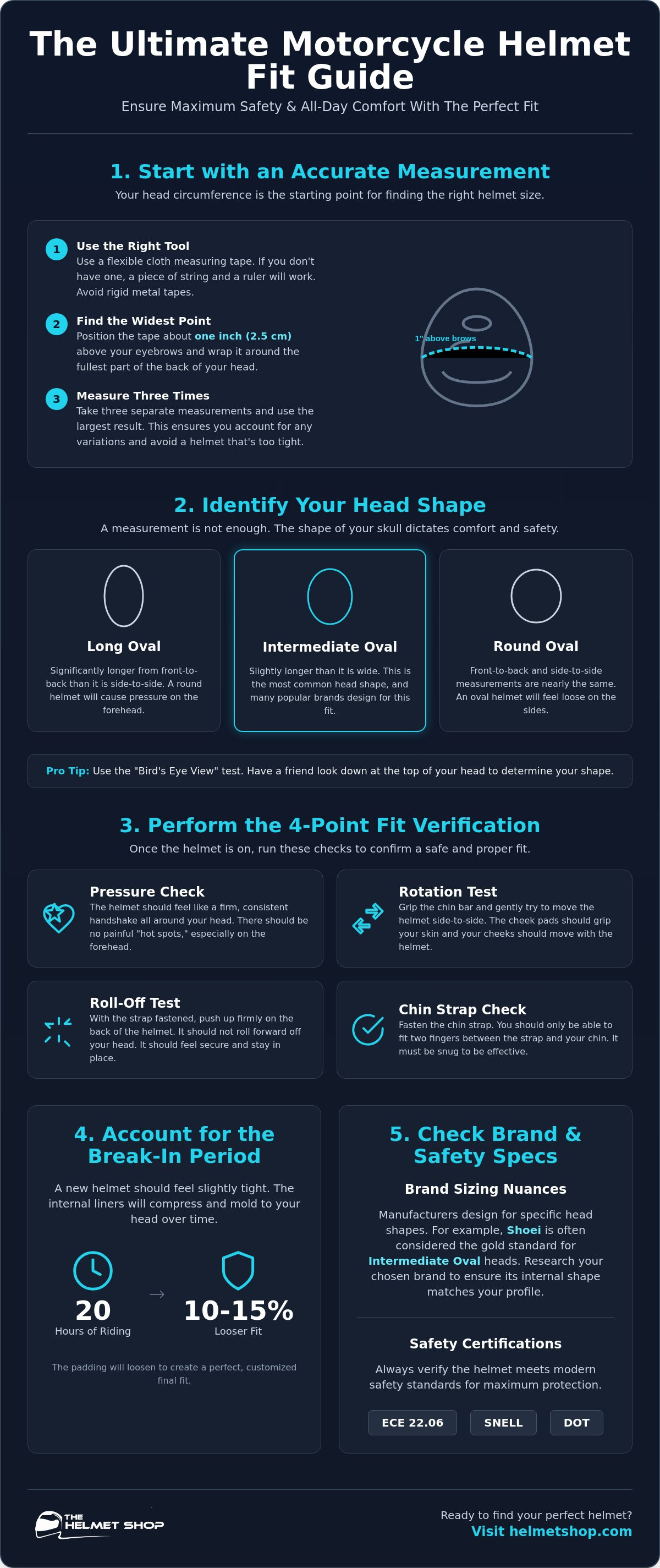
- Measure your head circumference using a flexible cloth tape positioned exactly one inch above your eyebrows for the most accurate baseline.
- Identify whether you have a long oval or round head shape, as sizing charts alone do not account for the specific contour of your skull.
- Follow this motorcycle helmet size guide to master the 4-point fit verification protocol, ensuring the shell feels like a firm, consistent handshake.
- Understand the fitment nuances of premium brands like Shoei, ARAI, and HJC to select a model that aligns with your unique physical profile.
- Account for the 20-hour break-in period, where internal liners typically loosen by 10-15% to create a customized final fit.
How to Measure Your Head for a Motorcycle Helmet
Precision is the foundation of safety. A helmet that is too loose can shift during an impact, while one that is too tight creates distracting pain. To find your ideal match, you need a precise starting point. This Motorcycle helmet overview highlights how modern design and materials rely on a snug fit to manage impact energy correctly. If your measurements are off by even a few millimeters, the protective capabilities of the gear are compromised.
To visualize the measurement process before you begin, watch this expert walkthrough:
Start with a flexible cloth measuring tape. Position it roughly one inch above your eyebrows, which is typically the widest part of your forehead. Wrap the tape around the back of your skull, ensuring it passes over the most prominent point at the rear. Don't pull the tape too tight; it should sit comfortably against your skin without digging in. Repeat this process three times. It's common to get slightly different numbers, so record the largest result to ensure you don't end up with a helmet that causes painful hot spots during long rides.
Tools You Need for Accurate Measurement
Cloth tapes are the gold standard because they contour to the unique curves of your head. Metal tapes are designed for flat surfaces and often provide an inflated, inaccurate reading. If you don't have a cloth tape, use a piece of string or a shoelace. Mark the string where it overlaps, then lay it flat against a standard ruler to find your number. Ask a friend to assist you if possible. They can see the back of your head to ensure the tape isn't twisted or sagging, which is a frequent cause of sizing errors.
Recording Your Measurements in Centimeters and Inches
Most major manufacturers use centimeters as their primary metric because it offers more precision than inches. When you consult a motorcycle helmet size guide, you'll notice that size brackets are often very narrow. If you measure in inches, multiply that number by 2.54 to get the centimeter equivalent. Many premium brands from Europe or Japan rely solely on metric sizing for their shell production. The circumference of your head at its widest point is the single most critical data point for determining your correct shell size.
Identifying Your Head Shape: Oval vs. Round
Most riders assume that a simple circumference measurement is enough. It isn't. Standard sizing charts provided by a motorcycle helmet size guide focus on the distance around your head, but they ignore the actual geometry of your skull. If you have a "Long Oval" head and buy a "Round Oval" helmet, you'll experience painful pressure on your forehead while having too much space at the temples. This mismatch leads to "hot spots," which are localized areas of intense pain that usually appear after 30 to 60 minutes of riding. Consulting a motorcycle helmet size guide is only the first step; identifying your shape is what prevents long-term discomfort.
The 'Bird's Eye View' Test
To find your shape, perform the "Bird's Eye View" test. Have a friend look down at the top of your head while your hair is flattened. Alternatively, take a top-down photo of yourself. A Long Oval head is noticeably longer from the forehead to the back than it is from ear to ear. Intermediate Ovals are the most common shape in North America, featuring a slightly longer front-to-back profile. Round Ovals are almost equal in both directions. Recognizing these nuances helps you avoid the frustration of returning gear that looked perfect on paper. Shoei helmets are often the gold standard for intermediate ovals, providing a balanced fit that accommodates a wide range of riders.
Why Head Shape Dictates Brand Choice
Manufacturers often design their internal shells for specific shapes to maximize safety. Using a helmet that matches your shape ensures the EPS liner makes consistent contact with your skull. Organizations like the Snell Memorial Foundation emphasize that proper fitment is essential for a helmet to meet its safety potential during an impact. If the shell doesn't match your head, the EPS liner can't distribute energy evenly. This gap in contact can cause the helmet to rotate during a slide. Some riders with very specific needs may require specialized fitment models or "Big Head" categories to find comfort. If you're struggling to find a match, explore our professional helmet collection to find a shell shape that truly works for you. Don't settle for a fit that pinches or wobbles. Your safety depends on a shell that mirrors your unique physical profile.
The 4-Point Fit Verification Protocol
Once you've used a motorcycle helmet size guide to select a shell, you must verify the physical fit. Numbers on a chart are an excellent starting point, but they don't account for the unique contours of your face. A proper fit ensures the helmet remains stable at high speeds and provides maximum protection during an impact. Use this four-point protocol to confirm your choice is correct before you hit the road.
- The Snugness Test: Your helmet should feel like a firm, consistent handshake across your entire head. There should be no gaps between the liner and your temples or forehead.
- The Eyeport Check: Place your hands on the sides of the helmet and wiggle it gently. Your eyebrows and the skin on your forehead should move with the helmet. If the helmet slides freely over your skin, it's too large.
- The Roll Test: Fasten the chin strap securely. Reach around to the back of the helmet and try to pull it forward off your head. A correctly sized helmet will not move significantly.
- The Chin Strap Rule: Tighten the strap until it's snug against your jaw. You should be able to fit no more than two fingers between the strap and your neck. This ensures the helmet stays in place without restricting your breathing.
Following these steps aligns with the NHTSA Helmet Fitment Guide, which emphasizes that a helmet only works if it stays exactly where it belongs. Verification is the only way to bridge the gap between a sizing chart and real-world safety.
The 15-Minute Pressure Test
Don't take your first ride immediately after unboxing your gear. Wear the helmet around your house for at least 15 minutes. This duration is long enough for "hot spots" to reveal themselves. You're looking for a snug fit, not a painful one. If you feel a sharp, localized pressure on your forehead or the back of your skull, you likely have a shape mismatch rather than a size issue. A properly sized helmet might feel tight initially, but it should never cause a headache or leave deep red marks on your skin.
Verifying the Cheek Pad Fit
New helmets often cause a "chipmunk cheek" effect. This is actually a sign of a good fit. The cheek pads should push your cheeks up slightly, ensuring the helmet doesn't rotate during a slide. If the cheek pads feel too tight but the rest of the helmet is perfect, many manufacturers offer thinner replacement pads. This allows you to customize the fit without compromising the safety of the shell size. Also, ensure there is enough clearance in the ear pockets for your bluetooth motorcycle headsets. A cramped ear pocket can lead to significant discomfort on long touring rides.
Brand-Specific Sizing Nuances: Shoei, ARAI, and HJC
A universal "Medium" doesn't exist in the world of head protection. While a motorcycle helmet size guide provides the numerical baseline, each manufacturer follows a distinct design philosophy that alters the final fit. Understanding these brand-specific nuances is the key to finding a shell that feels like it was custom-molded for your skull. Most premium brands invest heavily in research to optimize their internal shapes for specific regional demographics.
- Shoei: This brand is the industry benchmark for a consistent intermediate oval fit. Their helmets feature high-quality, plush liners that provide a luxurious feel while maintaining a firm grip on the rider's head.
- ARAI: Known for their R75 shape, ARAI focuses on a continuous convex curve to enhance glancing-off capabilities. They are unique because they offer multiple interior fitment options, allowing riders to swap cheek pads and liners to achieve a micro-fit.
- HJC: These helmets often provide a slightly more generous fit, particularly in their mid-range models. If you find premium racing helmets too restrictive, HJC typically offers a roomier internal volume.
- Daytona: If you prefer open-face or half-helmet styles, Daytona focuses on lightweight, low-profile fitment. Their designs aim to eliminate the "mushroom head" look while maintaining safety standards.
Why You Might Be a Medium in Shoei but a Large in HJC
Shell sizes are the most expensive part of helmet manufacturing. Premium brands often use four or five different shell sizes across a single model range, while budget brands might only use two. This means a "Medium" in one brand might use a smaller, lighter shell with a thinner liner, while another brand uses a larger shell with extra padding. The thickness of the comfort liner significantly impacts your perceived size. You can dive deeper into these manufacturing differences in our motorcycle gear guide to see how brands compare across their entire product lines.
Sizing for Different Helmet Styles
The style of the helmet also dictates how the size feels on your head. Modular helmets have a hinge mechanism that can make the side pods feel slightly wider or looser than a dedicated full-face racing model. If you're looking for the best motorcycle helmet for touring, you'll want a fit that prioritizes long-distance comfort without being loose enough to catch the wind. Off-road and dual sport helmets often have more aggressive cheek pads to keep the helmet stable during high-intensity riding on rough terrain. Ready to find your perfect match? Shop our full inventory of premium helmets to find the exact brand and style that fits your riding needs.
Troubleshooting Your Fit: When to Size Up or Down
A new helmet often feels uncomfortably tight during the first few minutes. This is a common point of confusion for riders using a motorcycle helmet size guide for the first time. You must account for the break-in period. High-quality comfort liners are designed to compress and mold to your specific facial structure over time. You can expect your helmet to loosen by approximately 10-15% after about 20 hours of actual riding time. If a helmet feels "perfect" and roomy the moment you put it on, it will likely be dangerously loose once the foam settles.
Recognizing the signs of a dangerously large helmet is critical for your safety. If the shell wobbles when you shake your head or lifts significantly at highway speeds, the fit is incorrect. You should not be able to slide your pinky finger between the forehead liner and your skin. A loose helmet doesn't just cause noise and buffeting. It fails to manage impact energy correctly because the head can move inside the shell during a crash. If you have already opted for the correct shell size but still feel minor gaps, you can often fine-tune the fitment by installing thicker or thinner interior liners provided by the manufacturer.
The 'In-Between' Size Dilemma
If your head measurement falls exactly between two sizes on a motorcycle helmet size guide, the general rule is to choose the smaller size. It's much easier to manage a slightly tight helmet that will eventually break in than it is to fix a shell that is too large. If the smaller size is just a bit too snug, wearing a thin silk balaclava can help the helmet slide on more easily while protecting the liner. Many premium brands also offer optional "summer" or "winter" liners of varying thicknesses. These allow you to bridge the gap between standard sizes without compromising the integrity of the shell.
When the Fit Cannot Be Fixed
There are times when no amount of troubleshooting will make a helmet work. If you experience sharp, localized pain on your forehead or temples within ten minutes, the internal shape is likely a mismatch for your skull. Never attempt to modify the EPS foam liner by crushing or sanding it down to create more room. This destroys the helmet's ability to absorb impact and voids all safety certifications. Always perform a final check to ensure your chosen size and model meet current DOT or ECE 22.06 standards. If the shape is fundamentally wrong, it's better to switch brands than to risk your safety with a modified or poorly fitted shell.
Secure Your Perfect Fit for the Road Ahead
Finding the right helmet is a technical process that requires more than just a tape measure. You now have the tools to identify your unique head shape and apply the 4-point verification protocol to any shell you consider. This motorcycle helmet size guide has provided the framework you need to move from guessing to knowing. Remember that the initial snugness is a sign of a high-quality liner that will mold to your face over the first 20 hours of use.
Since 1994, we've provided expert fitment advice to help riders find gear that balances maximum safety with all-day comfort. We are an authorized dealer for industry leaders like Shoei, ARAI, and HJC, ensuring you have access to the best technology in the market. Our national shipping and easy exchange policies take the risk out of your purchase, so you can focus on the ride instead of the return label.
Browse our full selection of premium helmets with guaranteed fitment support today. Your next journey deserves the confidence of a helmet that fits like a second skin. Stay safe and enjoy every mile.
Frequently Asked Questions
Is a motorcycle helmet supposed to be tight on your cheeks?
Yes, your helmet should provide firm pressure against your cheeks. This is often called the "chipmunk cheek" effect, and it ensures the shell won't rotate during a slide or at high speeds. While the pressure feels intense initially, these pads are designed to compress and mold to your face. If you can speak perfectly without biting your cheeks, the fit is likely too loose for safety.
How do I know if my motorcycle helmet is too big?
A helmet is too big if it moves independently of your skin when you shake your head. You should perform the eyeport check by wiggling the shell; your eyebrows and forehead skin must move with the helmet. If you can slide your fingers easily between the liner and your forehead, the shell is too large. A loose helmet is dangerous because it cannot manage impact energy correctly.
What happens if I wear a motorcycle helmet that is too small?
Wearing a helmet that is too small creates localized pressure points that lead to severe headaches and rider fatigue. It can restrict blood flow and cause painful "hot spots" on your forehead or temples. Beyond the physical discomfort, a cramped fit makes it difficult to focus on the road. If the shell is fundamentally too small, the EPS liner cannot sit correctly to protect your skull.
Do different helmet brands have different sizing standards?
Yes, sizing varies significantly between manufacturers because they use different shell molds and internal geometries. A Medium in a Shoei helmet might feel completely different than a Medium from HJC or ARAI. This is why consulting a brand-specific motorcycle helmet size guide is essential before you buy. Each brand targets different head shapes, such as intermediate oval or round oval, which affects the final perceived size.
Can I change the size of my helmet by changing the pads?
You can fine-tune the fit with different pads, but you cannot change the actual shell size. Most premium manufacturers offer optional cheek pads and comfort liners in various thicknesses to customize the internal volume. This allows you to achieve a more precise fit for your facial structure. However, if the hard EPS liner is pressing against your skull, swapping pads won't solve the underlying size issue.
How much will a motorcycle helmet loosen up over time?
Most helmets loosen by approximately 10% to 15% after the initial break-in period. This process typically takes about 20 hours of actual riding time as the foam liners compress to match your facial structure. You should choose a helmet that feels slightly too snug when it is brand new. If it feels perfectly comfortable on day one, it will likely become too loose once it breaks in.
Should I size up if I wear glasses under my helmet?
No, you should not size up just to accommodate your glasses. Choosing a larger shell compromises your safety by creating a loose fit that can shift during an impact. Instead, look for helmets specifically designed with "eyeglass channels" in the comfort liner. Brands like HJC and Shoei often include these features. A properly sized helmet with these channels will hold your glasses securely without pressing the frames into your temples.
How do I measure my head without a flexible measuring tape?
You can use a piece of string or a long shoelace to find your head circumference. Wrap the string around your head about one inch above your eyebrows, then mark the point where it overlaps. Lay the string flat against a standard ruler or a metal tape measure to find the length in centimeters. This simple method provides the baseline data needed to use a motorcycle helmet size guide effectively.


