

Table of Contents
- Why a Long Oval Helmet Changes Everything
- How to Measure Head Shape for Helmet Sizing at Home
- Motorcycle Helmet Pressure Points: How to Identify Hot Spots
- DOT and Snell Safety Standards: What Fit Has to Do With Protection
- Long Oval Helmets Worth Trying: Arai Signet-X
- Long Oval Helmet Fit Checklist: Snug, Stable, No Pressure
- Frequently Asked Questions
Last Updated: September 14, 2026
Why a Long Oval Helmet Changes Everything
If you've ever pulled off a motorcycle helmet for long oval head shape after twenty minutes with red marks above your temples, you don't have a "tough head", you have the wrong internal shape. A motorcycle helmet for long oval head shape solves a specific geometry problem: your skull is longer front-to-back and narrower side-to-side than the average rider's, and most helmets are built for the average rider. This guide covers confirming your shape, measuring it at home, and matching it to a shell that fits.
Long oval describes a head whose front-to-back length is noticeably greater than its width, with a narrower temple region and a more pronounced forehead, the profile most poorly served by mass-market helmet design.
Long Oval vs. Intermediate Oval vs. Round Oval
Helmet makers build to three internal shapes. Intermediate oval is the most common, sitting between round and long. Round oval suits heads with roughly equal width and length. Long oval fits narrow heads with a prominent forehead.
Get this wrong and no amount of sizing up or down will fix it: a larger shell in the wrong shape slides around, and a smaller one presses in all the wrong places. Shape comes first, size second.
Why Standard Helmets Create Temple and Forehead Pressure
The EPS liner is the foam layer between the comfort liner and the shell, and its contour decides where pressure lands. On an intermediate-oval helmet, the liner's side walls sit closer together than a long oval rider's head can tolerate, producing temple pressure that builds into a headache and forehead pressure where the liner's front curve meets a pronounced brow.
This isn't a comfort issue you can break in. EPS doesn't soften to your head, it compresses on impact, not on wear. If it hurts in the shop, it will hurt on the highway.
How to Measure Head Shape for Helmet Sizing at Home
You can identify your head shape in about five minutes with a soft tape measure, a mirror, and a bar of soap. How to measure head shape for helmet sizing comes down to two numbers: circumference picks your size, and the length-to-width ratio picks your shape.
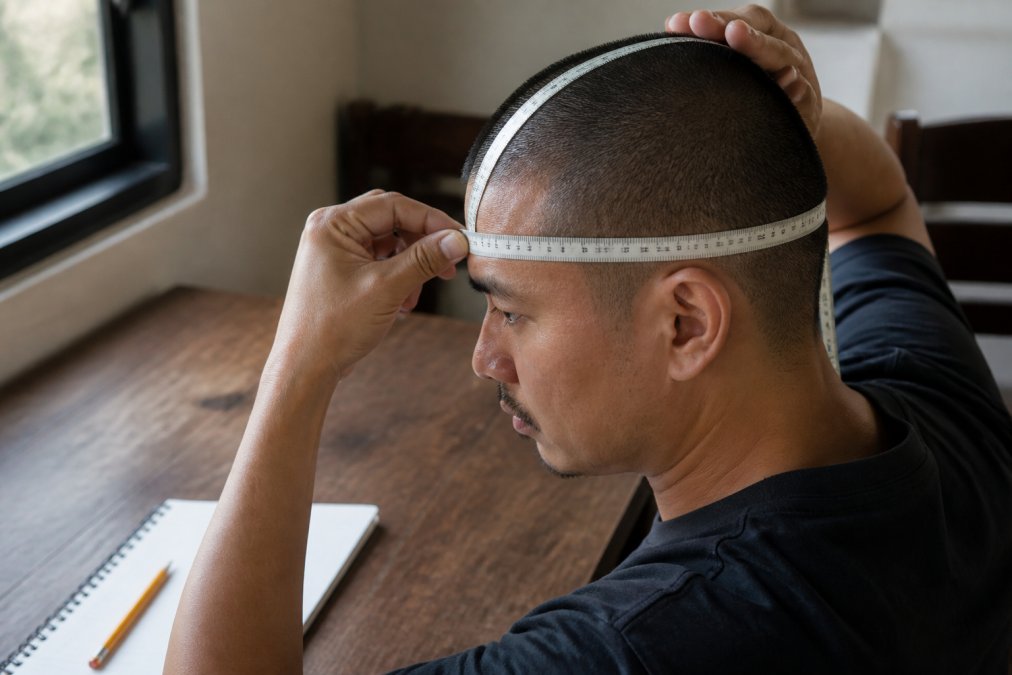
Step 1: Circumference
Wrap the tape around your head at the widest point, roughly one inch above your eyebrows and around the largest part of the back of your skull. Keep it level, measure three times, and use the largest number. That figure maps to a manufacturer's sizing chart.
Step 2: Length and Width
Run the tape from your forehead hairline straight back over the crown to the most prominent point of your skull, that's your length. Then measure ear-to-ear across the top of your head for your width. Write both down.
Step 3: The Ratio Test
Divide length by width. Long oval riders commonly land around 1.2 or higher, intermediate oval closer to 1.1, and round oval near 1.0. These are working thresholds, not lab measurements, but they separate the three profiles cleanly enough to shop by.
Step 4: The Mirror Test (Self-Diagnosis Without a Tape)
Stand in front of a mirror and look straight down at the top of your head. An egg pointing forward means long oval, a circle means round, and somewhere between means intermediate. A second check: compare temple-to-temple width against forehead-to-crown length, when length wins by a clear margin, shop long oval first.
Step 5: The Soap Trace (The Most Reliable At-Home Method)
Stand over a sink or a sheet of dark paper. Wet a bar of soap and rub it lightly across your forehead hairline, both temples, and the widest point of the back of your skull. Press your head straight down onto a mirror or sheet of paper, hold for two seconds, and lift straight up. You now have a soap outline of your skull's widest points.
Measure the outline: front mark to back mark is your length, and the distance between temple marks is your width. Compare them as you did with the tape. The soap trace removes hair, tape slip, and guesswork, making it the closest thing to a fit profile you can produce at home.
Once you have your ratio, stop guessing at sizes. A long oval ratio points you toward shells built with more front-to-back room and less side-to-side room, the geometry that eliminates temple pressure before you ever put a helmet on.
Motorcycle Helmet Pressure Points: How to Identify Hot Spots
Motorcycle helmet pressure points are localized areas where the liner presses harder than the surrounding surface. They show up as sharp, focused discomfort rather than an even snug feel, and they are the clearest signal that your shell shape is wrong. On a long oval head, they cluster at the temples, the forehead brow line, and the crown just behind the hairline. Eliminating these painful hotspots requires a precise understanding of your cranial dimensions, which begins by taking accurate head measurements to ensure the internal padding aligns perfectly with your specific bone structure.
Here is how to find them without buying first:
- Wear the helmet for a full 15 to 20 minutes, not 30 seconds
- Press two fingers against the temples and forehead and note where resistance feels hardest
- Check for a red mark within 30 minutes of removal
- Move your jaw side to side; a hot spot at the crown usually reveals itself here
- Put your glasses on after the helmet is fastened and note where the temples press against the liner
A snug fit should feel even across the crown, temples, and cheeks. Pressure that concentrates in one spot means the liner contour does not match your cranial structure.
The Glasses Problem Long Oval Riders Know Too Well
If you wear prescription glasses, you've probably felt a helmet pinch your temples through the frames. Long oval riders tend to have narrower faces, and most intermediate-oval liners push the glasses arms inward until the frames lift off your nose or dig into your head.
Three fixes work, in order of preference:
- Choose a shell with a deeper brow channel. More front-to-back room at the brow lets the glasses arms sit flat against your temples instead of riding up the liner.
- Look for cut cheek pads. Some liners are molded with a channel at the top of the cheek pad specifically to let glasses arms pass through, a design feature, not a modification, and worth asking about before you buy.
- Consider a helmet with a removable or adjustable liner. If the cheek pad is the problem, a thinner pad in that zone can open up the space your frames need without changing shell size.
Riders often blame their glasses for a bad fit when the real issue is the liner contour. Test with the glasses on, not off.
Interchangeable Liners: Converting an Intermediate Oval to Fit a Long Oval
This is the most useful trick for long oval riders who cannot find a shell in their size. Many helmets ship with interchangeable cheek pads in multiple thicknesses, and some brands offer peel-away liner layers that let you remove foam in specific zones.
The mechanism is simple: if your head is long oval and the shell is intermediate oval, pressure lands on the sides. A thinner cheek pad or peeled-away side layer relieves that pressure without loosening the crown or back of the skull, the zones that keep the helmet stable.
What you cannot do is stretch a shell that is too short front-to-back. Liner swaps fix side pressure, not length. If the forehead is the problem, you need a different shell, not a different pad.
Weight, Wind Noise, and Neck Fatigue
A helmet that fits correctly doesn't need to be over-tightened to stay stable, which matters on long rides. An over-tightened helmet transfers wind buffeting into your neck muscles, and by hour three of a highway ride that shows up as fatigue and a stiff jaw.
Shell shape matters too: a long oval shell that matches your skull sits lower and more evenly, reducing lift at speed and cutting the low-frequency wind noise from a shell riding high on the crown. On long rides, fit is a fatigue issue, and fatigue is a safety issue.
DOT and Snell Safety Standards: What Fit Has to Do With Protection
A helmet only protects you if it stays in place. DOT and Snell safety standards test impact absorption and retention, but a poorly fitted helmet can fail you in a real crash even when it passes every lab test.
DOT certification comes from the federal standard for motorcycle helmets, which sets minimum impact and penetration requirements. Snell certification is stricter and adds its own testing protocols, including retention system strength. You can read the specifics at the NHTSA motorcycle helmet guidance and through the Snell Memorial Foundation standards.
The connection to fit is mechanical: a helmet that shifts on impact can expose the wrong part of your skull to the force, and a loose chin strap lets the shell rotate. Helmet retention depends on the shell sitting low and even, exactly what a correct long oval fit delivers.
Long Oval Helmets Worth Trying: Arai Signet-X
The Arai Signet-X is the clearest long oval answer in the current market. Arai built it by increasing the EPS liner's front-to-back space and decreasing side-to-side space, precisely the geometry a narrow head with a pronounced forehead needs.

It's available in two finishes at Helmet Shop: the Arai Signet-X in solid color at $809.95, and the Arai Signet-X US Flag at $959.95. Both use Arai's Variable Axis System shield mechanism, which moves the pivot point outward so the shield follows the shell's curve, and a VAS latch that holds the shield closed against unexpected opening.

Coming from an intermediate-oval helmet, expect the Signet-X to feel different immediately: no temple squeeze, more room at the brow, and a crown that sits flat instead of riding high.
Interchangeable Liners, Glasses Fit, and Weight for Long Oval Riders
Three things separate a long oval helmet from a compromise:
- Interchangeable liner systems. Arai's peel-away liner layers let you fine-tune thickness in specific zones, so you can relieve a single pressure point without changing shell size.
- Glasses compatibility. Long oval riders often have narrower faces, and a helmet with a deeper brow channel and cut cheek pads lets temples pass through without pinching. The Signet-X's facial contour works for most prescription frames.
- Weight and aerodynamics. A helmet that fits correctly doesn't need to be over-tightened to stay stable, which means less neck fatigue on long rides. Arai's shell shaping also cuts lift at highway speed.
Motorcycle Safety Foundation rider resources recommends replacing a helmet after five years of regular use or after any impact, regardless of appearance.
Long Oval Helmet Fit Checklist: Snug, Stable, No Pressure
Run this checklist before committing to any helmet. It takes two minutes and saves you a return.
| Check | What Passes | What Fails |
|---|---|---|
| Crown contact | Even pressure across the top | One spot digging in |
| Temple pressure | Light, uniform contact | Sharp ache within 15 min |
| Forehead | No red line at the brow | Band mark after removal |
| Cheek pads | Firm, touching inside cheeks | Loose or painfully tight |
| Chin strap | Snug under jaw, one finger gap | Slips or chokes |
| Rotation test | Skin moves with the helmet | Helmet twists freely |
| Glasses | Temples pass without pressure | Frames pinch or lift helmet |
Helmet Shop stocks the long oval shells and the Bluetooth-ready setups that pair with them, with free shipping on orders over $49 and a 30-day return policy so you can test fit at home.
Finding a helmet that fits a long oval head has always meant fighting the average, but that's changing as more riders measure their own shape instead of guessing at sizes. Helmet Shop carries the Arai Signet-X in both finishes, along with Sena and Cardo communication systems that install cleanly into cheek pad pockets, plus HJC and Shoei options across the range. Measure your head, check the chart, and order the shape that matches your skull. Get started with Helmet Shop and ride without the headache.
Frequently Asked Questions
How do I know if I have a long oval head shape?
Measure your head's circumference with a soft tape, then measure front-to-back length and side-to-side width. If your length is noticeably greater than your width and standard helmets press hard on your forehead or temples while leaving space at the sides, you likely have a long oval head shape. Riders with this shape often describe a narrow, elongated cranial structure that needs a long oval helmet rather than a round or intermediate oval fit.
Are Arai helmets good for long oval head shapes?
Yes. The Arai Signet-X is built specifically for long oval riders. Arai increased the EPS liner space front to back and reduced it side to side, which suits a narrow head with a more pronounced forehead. It also uses the Variable Axis System shield mechanism and a VAS latch that helps keep the shield securely closed. It is one of the clearest long oval fits you can buy without a custom liner.
Can I use comfort liners to adjust a motorcycle helmet for a long oval head?
Sometimes. Interchangeable liner systems and thicker or thinner cheek pads can shift pressure slightly, but they cannot turn a round oval shell into a long oval shell. If your forehead or temples ache after 20 minutes, a liner swap usually will not fix it. The shell profile and EPS density have to match your head shape first. Start with a long oval helmet, then fine-tune with liners if needed.
Why do long oval heads get pressure points in standard helmets?
Most helmets are built on an intermediate oval last, which is wider side to side than a long oval head. When you pull that shell over a narrow, elongated head, the EPS liner compresses at the forehead and temples first. Those two spots become hot spots, and after 30 to 60 minutes they turn into real pain. The fix is a shell and liner contoured for a long oval, not a looser size.


