

Table of Contents
- Why Glasses Change Your Helmet Size Decision
- How to Measure Your Head for a Motorcycle Helmet
- Understanding Head Shape Before You Choose a Size
- Step-by-Step: Checking Your Glasses Fit Inside a Helmet
- How to Wear Glasses with a Full-Face Helmet
- Motorcycle Helmet Fit Guide: Safety Checks and Adjustments
- Booking Your Fitting: Next Steps With Helmet Shop
- Frequently Asked Questions
Last Updated: November 4, 2026
Why Glasses Change Your Helmet Size Decision
Glasses change how a helmet fits, and that is why the size you wear in a shop can feel wrong once your frames go on, so learning how to choose helmet size for glasses matters before you ride. The helmet looks right, but the arms of the glasses press against the liner, and the edge of the lenses sits in the wrong spot.
Here is the key point: you choose a helmet size based on your head, then check how your glasses sit inside it. You should not pick a larger size just to make room for your frames. A helmet that is too big moves around in a crash, and that is a safety problem.
- Choose the size that fits your head snugly without pressure points.
- Check the glasses fit after you settle on the size.
- Consider a model with extra eyewear room if your frames are thick.
In the sections below, we walk through how to measure your head, understand head shape, and check your glasses fit before you buy.
How to Measure Your Head for a Motorcycle Helmet
Measuring your head takes about two minutes and needs only a soft tape measure. Wrap the tape around the widest part of your head, about one inch above your eyebrows and ears. Follow our step-by-step guide to measuring your head for the full process, including common mistakes to avoid. Keep the tape level and snug, but not tight enough to dent your skin.
Write the number down in centimeters or inches. Then compare it to the size chart for the helmet brand you want. Sizes vary by manufacturer, so never assume a size from another brand matches.
Common measuring mistakes to avoid:
- Measuring over a hat or thick hair that adds bulk
- Pulling the tape too tight
- Measuring at the wrong height, such as across the eyebrows only
Once you have the number, you know where to start.
Understanding Head Shape Before You Choose a Size
Head circumference tells you the size, but head shape tells you the fit, and for glasses wearers, shape decides whether the temples sit flat or dig in. Read our sizing guide for big and unusual head shapes if your profile falls outside the common ovals.
Most helmets are built on one of three general profiles:
- Round oval. The head is close to circular when viewed from above. Riders with this shape often feel side pressure in narrow shells.
- Intermediate oval. The most common profile, slightly longer front-to-back than side-to-side. Most major brands build their mainstream shells around this shape.
- Long oval. The head is noticeably longer front-to-back. Riders with this shape often feel forehead and back-of-head pressure in rounder shells.
You can get a rough read on your own profile without special tools. Look straight down at your head in a mirror, or have someone trace the outline of your head on paper while you look straight ahead. Compare the front-to-back length to the side-to-side width.
Why this matters for glasses: a shell that is too narrow for your head pushes the liner inward at the temples, exactly where your glasses arms run. That pressure stacks: the liner presses the temple arm into your skin, and after 20 minutes you feel it behind the ear.
Brands build on different lasts, so the same nominal size can feel different across makers.
Watch out: don't size up to escape temple pressure. A larger shell moves the liner away from your head, which reduces the very contact that keeps the helmet stable, and a loose helmet can rotate in a crash. Fix shape mismatch by changing model or brand, not by changing size.
Once you know your profile, note it before you shop. It narrows the field faster than any size chart and makes the glasses-fit check in the next section far more likely to succeed on the first try.
Step-by-Step: Checking Your Glasses Fit Inside a Helmet
Once you have a helmet that fits your head, check it with your glasses on. This is the step most riders skip, and it is the one that decides whether you can actually ride with your frames in place. Once the fit feels right with your frames in place, use the same careful approach when checking how your helmet works with the rest of your motocross protective gear.
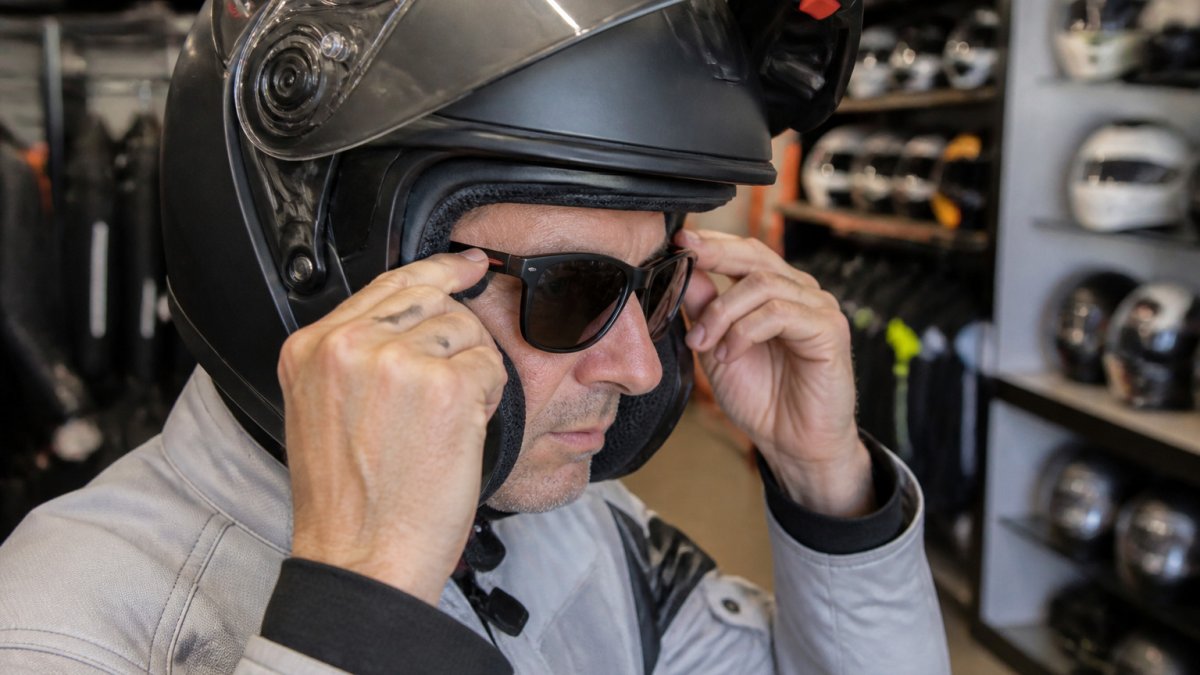
- Put your glasses on first. Wear them the way you ride, arms seated behind the ears, frame sitting where it normally sits on your nose.
- Put the helmet on. Fasten the chin strap snugly. If the helmet has a modular chin bar, flip it up first so the eye port opens wide and the frame doesn't catch.
- Check the temples. The arms should sit flat against the liner without being pushed inward or upward. Run a fingertip along each arm from the hinge to behind your ear. You want light, even contact, not a hard pinch and not a gap that lets the frame rattle.
- Look for pressure points. Sharp pain at the temples, behind the ears, or across the bridge of the nose means a problem. Dull, even pressure that fades after a few minutes is normal break-in.
- Shake your head gently. The glasses should stay seated on your nose and the helmet should not shift independently of your head. If the frame slides down your nose, the liner is pushing the arms down.
- Check your field of view. The top edge of the frame should sit below your sight line, and the eye-port rim should not clip the top of your lenses. Look left, right, up, and down through the port.
- Check the seal at speed. At a stop you can't feel wind. On a test ride or with a fan in front of you, confirm the frame doesn't vibrate against the liner and that no air channel pushes the arms into your temples.
What the symptoms tell you:
- Temple pressure that builds over 15 minutes usually means the liner is too narrow at the sides for your head shape, not that the size is wrong. Try a different brand's shell before you try a different size.
- Arms pushed up behind the ears often means the liner is too deep at the base of the skull. A shallower cheek-pad or a different interior shape can fix it.
- Frame slides down the nose points to downward pressure from the brow liner. Check that the helmet sits level; a helmet tilted back will press the brow onto the frame.
- Lenses fog or sit too close to the port is a ventilation and eye-port geometry issue, not a fit issue. A wider eye port or a model with a breath guard helps.
Adjustments that are safe: you can swap cheek pads and liners to the thickness the manufacturer offers for that shell, and you can adjust the retention system so the dial or ratchet holds the shell steady without over-tightening. Those changes are designed into the helmet.
HJC i91 Modular Helmet - Solid →
Watch out: never trim, cut, or compress liner foam to make room for glasses, and never remove the chin strap or alter the retention system beyond its intended adjustment range. Those changes can compromise the helmet's ability to stay on in a crash and may void its certification.
When adjustments can't fix it: if pressure persists after a cheek-pad swap and a retention adjustment, the shell shape is wrong for your head or your frames are too thick for that eye port. That is the point to exchange the helmet or switch to a model with more eyewear room, not to force the fit.
!Rider in a showroom trying on a modular helmet with prescription glasses in place, adjusting the temple arms under the liner, soft store lighting, a mirror in the background
The table below sums up the common glasses-fit symptoms and what each one usually points to.
| Symptom | Likely cause | Fix |
|---|---|---|
| Temple pressure after 15 minutes | Liner too narrow at the sides | Try a different brand's shell |
| Arms pushed up behind the ears | Liner too deep at the base of the skull | Try a shallower cheek pad or different interior |
| Frame slides down the nose | Downward pressure from brow liner | Check the helmet sits level |
| Lenses fog or sit too close to the port | Ventilation and eye-port geometry | Wider eye port or a breath guard |
How to Wear Glasses with a Full-Face Helmet
Full-face helmets are the most common choice for riders who wear glasses, but they need a little extra care. Compare modular helmets that are comfortable for glasses wearers if you want an easier on-and-off option. The eye port is smaller than on an open-face model, so frames can catch on the edge when you put the helmet on or take it off.
Put your glasses on before the helmet, not after. Then lift the helmet straight up and down over your head to avoid bending the temples. Taking the helmet off with your glasses on takes a few tries to get right.
Some riders find that contact lenses are easier to live with under a full-face helmet. This is a personal choice. Ask your eye care professional what works best for your eyes and riding habits.
Motorcycle Helmet Fit Guide: Safety Checks and Adjustments
A helmet that fits well protects you better. Before every ride, check that the helmet sits level on your head. It should not rock forward, back, or side to side when you shake your head.
Test the chin strap as well. It should be snug enough that you cannot pull the helmet off with your hands. Check the liner, too. Liners pack down over time, so a helmet that fit well last year may feel loose now.
Quick safety checks:
- The helmet sits level and does not move
- The chin strap is snug and fastened
- No pressure points remain after 15 minutes of wear
- The shell shows no cracks, deep scratches, or damage
Replace a helmet after any crash, even if it looks fine.
Booking Your Fitting: Next Steps With Helmet Shop
Now you know how to measure, check head shape, and test your glasses fit. The next step is to confirm your size with a fitting. Our team can help you compare models, including the HJC i91 Modular Helmet - Solid, which features a 3D contour design that is comfortable and secure even if you wear glasses.

If you want Bluetooth too, ask about helmets sold with headsets already installed. Once you choose, you can shop helmets at Helmet Shop and ride with a fit you can trust.
Frequently Asked Questions
Should you size up in a motorcycle helmet if you wear glasses?
Usually not. Glasses add bulk at the temples and bridge, so the first question is whether the helmet feels snug everywhere else with your glasses on. If the helmet is comfortable with glasses in place and the cheek pads sit flat against your face, your normal size is likely right. If the temple arms create pressure points or the helmet lifts off your brow when you try it on with glasses, try the next size up in the same model, since shell shape and liner thickness vary by brand.
How do you measure your head for a motorcycle helmet?
Wrap a soft tape measure around your head about one inch above your eyebrows and ears, keeping it level at the back. Note the measurement in inches and compare it to the size chart for the specific helmet model, because sizing differs by brand. Measure twice to confirm. Keep in mind that a measurement tells you where to start, not the final answer, so always check fit with your glasses on before you ride.
Can you wear prescription glasses with a motorcycle helmet?
Yes. Many riders wear prescription glasses under a helmet. Choose glasses with slim temple arms that sit flat against the head and avoid thick frames that push the liner outward. Put the glasses on before you put the helmet on, adjust the helmet so the cheek pads and crown feel secure, and confirm that the frame does not press on your temples or nose bridge at any point.
How should a motorcycle helmet fit with glasses on?
The helmet should feel snug across the cheeks and forehead with your glasses in place, without pressure points at the temples or bridge of the nose. Your glasses should sit level and not shift when you move your head. The helmet should not rock forward or back, and it should stay put when you shake your head. If it does not meet these checks, try a different shell shape or size.


