

Last Updated: November 1, 2026
Quick Summary
To fix helmet pressure points fast, first find out where the pressure sits. Forehead pain usually means the shell shape or crown depth is wrong or the retention system is pulling down, while cheek pain usually means the cheek pads are too thick or compressed. Loosen the strap, re-test, and then swap pads or change helmet shape as needed.
- Measure your head about one inch above your eyebrows and check the manufacturer's sizing chart.
- A hot spot that appears within 10 minutes and never fades points to shell shape or crown depth.
- Loosen the retention system and re-test before blaming the padding.
- Cheek pads are replaceable comfort parts, but EPS impact foam is not and should never be refoamed.
- Replace the whole helmet after any crash, or if the shell or EPS foam is cracked or crushed.
Table of Contents
- Why Your Helmet Presses on Your Forehead or Cheeks
- Check Your Motorcycle Helmet Fit Guide Measurements First
- Diagnose Motorcycle Helmet Pressure on Forehead Hot Spots
- Step-by-Step: Adjusting Cheek Pads to Relieve Pressure
- Motorcycle Helmet Cheek Pad Sizing: Choosing the Right Thickness
- Common Mistakes That Make Pressure Points Worse
- When to Replace a Motorcycle Helmet Instead of Adjusting It
- Booking a Fit Check or Ordering Replacement Pads
- Frequently Asked Questions
Why Your Helmet Presses on Your Forehead or Cheeks
A helmet that hurts is a helmet you stop wearing. Helmet pressure points usually come from a few predictable causes, and most of them can be fixed in an afternoon. The fix depends on where the pressure sits. Pain at the forehead often points to a shell that sits too low or too narrow. Pain at the cheeks usually means the cheek pads are too thick or compressed.
Whatever brand you ride, the steps below will help you find and relieve the source of the pressure. Start with the fit before you buy new padding.
Check Your Motorcycle Helmet Fit Guide Measurements First
Measure your head before you change anything. Wrap a soft tape measure around the widest part of your head, about one inch above your eyebrows. Compare that number to the manufacturer's sizing chart, since sizing differs between brands.
- Measure in centimeters or inches, whichever the chart uses
- Note whether you have a long oval or round head shape
- Check the size chart for the exact helmet model you own
Diagnose Motorcycle Helmet Pressure on Forehead Hot Spots
Forehead pressure is rarely one problem. It is usually one of four mechanisms, and each has a different fix. Before you buy pads or a new helmet, identify which one you are dealing with.
1. Shell shape mismatch. A helmet built for a round head will press at the forehead and temples on a long-oval head, and vice versa. This is the most common cause of a hot spot that appears within the first ten minutes and never fades. No pad swap fixes a shell that is the wrong shape, you need a different model or brand with a different internal profile.
2. Crown depth too shallow. If the top of your head contacts the EPS liner before the pads fully seat, the helmet sits high and drives the brow line down onto your forehead. Test it: press the helmet straight down with the strap loose. If the crown bottoms out immediately, the internal depth is wrong for you.
3. Brow line sitting too low. Some shells have a low front opening. If the front edge rests on your brow rather than just above it, the helmet is either the wrong size or the wrong shape for your face length.
4. Retention system pulling down. A chin strap or dial fit system that is over-tightened pulls the shell down and forward, concentrating load on the forehead. Loosen the retention system first, then re-test before blaming the padding.
Run this diagnostic sequence in order:
- Put the helmet on with the chin strap unfastened and the retention dial backed off. Note where it touches.
- Fasten the strap to normal riding tension. Note whether the pressure moves or intensifies.
- Wear it for 15 minutes indoors. A hot spot that appears in under 10 minutes points to shell shape or crown depth; one that builds over 15-20 minutes points to padding or retention.
- Press two fingers between your forehead and the front liner. If you cannot slide them in at all, the front is too tight; if there is a visible gap, the helmet is too loose and may be sliding down.
Once you know which mechanism you are dealing with, the fix follows: pad thickness for padding-driven pressure, a different shell shape for shape-driven pressure, and retention adjustment for strap-driven pressure. The cheek pad section below covers the padding fix in detail.
The four common causes of forehead pressure, and the fix for each, are summarised below.
| Cause | What it looks like | Fix |
|---|---|---|
| Shell shape mismatch | Hot spot within 10 minutes that never fades | Try a different model or brand with another internal profile |
| Crown depth too shallow | Crown bottoms out immediately when pressed down | Choose a helmet with the right internal depth |
| Brow line sitting too low | Front edge rests on the brow | Check size and shape for your face length |
| Retention pulling down | Pressure moves or intensifies when strap is fastened | Loosen the retention system and re-test |
Step-by-Step: Adjusting Cheek Pads to Relieve Pressure
Cheek pads cause most of the discomfort people describe as helmet pressure points. Follow these steps to test and adjust them.
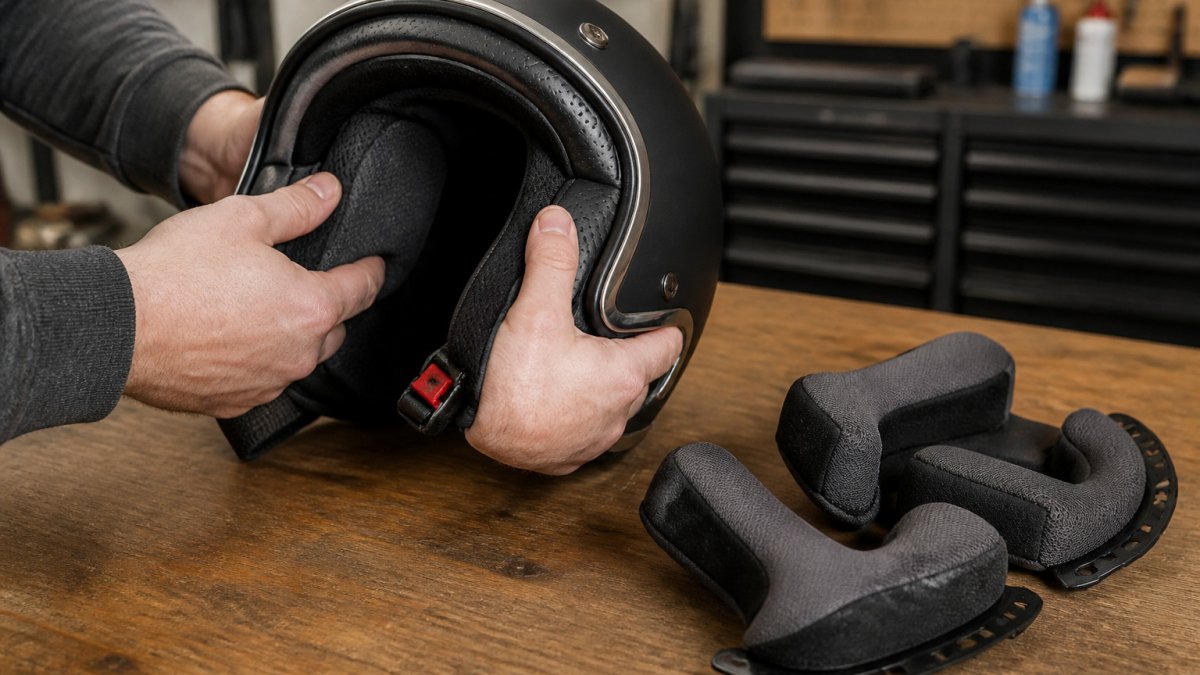
- Remove the helmet liner and locate the cheek pads on each side.
- Press the pads with your thumb. If they feel flat and hard, they are worn out.
- Check whether the pads sit flush against your cheeks when the helmet is on.
- Swap in thinner or thicker pads if the fit is off. Many models use a thickness rating printed on the pad.
- Refit the liner and wear the helmet for 15 minutes around the house before riding.
Replacement pads for the HJC RPHA 91 and RPHA 91 Carbon are available from Helmet Shop. The RPHA 91 Cheek Pad is a genuine HJC OEM part designed for those models. Confirm your helmet model before ordering.

Motorcycle Helmet Cheek Pad Sizing: Choosing the Right Thickness
Cheek pad thickness controls how snug the helmet feels at the sides. Thicker pads tighten the fit. Thinner pads loosen it.
- Thicker pads (around 37 to 42 mm): Suit riders who want a snugger feel
- Standard pads (around 34 mm): A common thickness for the RPHA 91 range
- Thinner pads (around 27 mm): Suit riders whose faces feel compressed
Choose the thickness that removes the pressure without leaving gaps. If the helmet moves when you shake your head, go thicker. If the pads press hard against your cheekbones, go thinner.
Common Mistakes That Make Pressure Points Worse
Many riders make the problem worse without realizing it. Avoid these errors:
- Tightening the chin strap too much. A tight strap pushes the helmet down on the forehead.
- Wearing a thick cap or bandana under the helmet. Extra layers change the fit.
- Buying a size up to "fix" pressure. A helmet that is too big can shift and cause its own problems.
- Ignoring the first few rides. Padding compresses slightly with use, so give it time before deciding.
Watch out: a helmet that causes a headache, numbness, or pain that lasts after you take it off should be checked by a professional fitter before you ride again.
When to Replace a Motorcycle Helmet Instead of Adjusting It
Most pressure-point advice stops at "try new pads." The harder question is which parts you can safely replace and which damage means the whole helmet is done. Getting this wrong is a safety issue, not a comfort issue.
Comfort liners vs. impact foam. Your helmet has two distinct layers inside the shell. The comfort liner, cheek pads, crown pad, and any removable fabric, is replaceable. It compresses, absorbs sweat, and wears out, and swapping it is normal maintenance. The EPS foam (expanded polystyrene) is the impact-absorbing layer. It is not a wear item you replace; once it is crushed, cracked, or has absorbed a hard impact, the helmet's protective capacity is compromised and the helmet should be retired. Never try to "refoam" a helmet or buy third-party EPS inserts.
Pad replacement schedule by use. Comfort pads do not have a fixed calendar life, but riding frequency and conditions drive wear:
- Daily commuting, year-round: inspect pads every 3-4 months; expect to replace cheek pads roughly every 12-18 months.
- Weekend riding, mild climate: inspect every 6 months; replacement typically every 2-3 years.
- Hot, humid climate or heavy sweating: inspect every 2 months; pads can flatten in under a year because sweat and heat break down foam and fabric.
- Frequent washing: washing extends freshness but accelerates foam breakdown if done aggressively, see the care notes below.
Inspect pads like this. Remove the liner and cheek pads. Squeeze each pad between thumb and forefinger. A healthy pad springs back within a second; a worn pad stays compressed or feels hard at the edges. Check the attachment points, velcro that no longer grips, cracked plastic tabs, or stretched elastic mean the pad will shift while riding and create new pressure points. Confirm any replacement pad is listed for your exact helmet model and shell size; pads are not interchangeable across sizes.
Material-safe cleaning. Hand-wash removable pads in cool water with a mild, non-detergent soap. Avoid hot water, bleach, fabric softener, and machine drying, heat distorts foam and shrinks fabric. Rinse thoroughly, press out water with a towel (do not wring), and air-dry away from direct sunlight. Clean the EPS liner only with a damp cloth and mild soap; never soak it or scrub it, because the foam is fragile and not designed to be re-wetted.
Replace the whole helmet if you see:
- Cracks, dents, or deep gouges in the outer shell
- EPS foam that is crushed, cracked, or no longer springs back
- Any helmet involved in a crash or a hard drop onto a hard surface
- Persistent pressure after trying multiple pad thicknesses and confirming the shell shape is correct
Check the manufacturer's guidance for your model regarding crash replacement and service life, since heat, sweat, and sunlight degrade materials over time. Check the manufacture date inside the helmet and follow the specific guidance for your model. If you are unsure whether a helmet is still serviceable, treat it as retired, the cost of a new helmet is small compared with the risk.
Booking a Fit Check or Ordering Replacement Pads
If you have tried the steps above and the pressure remains, you have two good options. You can order replacement pads for your current helmet, or you can compare helmets with a different shell shape. Helmet Shop carries brands including HJC, Shoei, Arai, and Daytona, so you can compare shell designs and fit options in one place.
Confirm your helmet model and measurement before you order. Once you know your size and head shape, shop the range at Helmet Shop.
Frequently Asked Questions
How often should you change helmet padding?
Helmet padding does not have a fixed date, but it should be checked regularly, especially for riders who commute daily or ride in hot, humid weather. Compressed, flattened, or sweat-stained cheek pads lose their ability to hold the helmet snugly and often create pressure points before they look obviously worn. If the pads no longer spring back, smell persistently, or leave the helmet loose, replace them. Genuine replacement parts such as the RPHA 91 Cheek Pad from Helmet Shop are available for the HJC RPHA 91 and RPHA 91 Carbon.
Is a 10-year-old helmet still safe to use?
Age alone is a reason to take a helmet seriously. Shell materials and foam can degrade from sun exposure, heat, sweat, and general wear, even if the helmet looks fine. Check the manufacturer's guidance for your model on replacement timing, and replace any helmet that has been dropped or involved in a crash. Check the manufacturer's guidance for your model, and inspect the shell and liner for cracks or compression before you decide whether it is still worth wearing.
Should a motorcycle helmet feel tight on your cheeks?
A new helmet should feel snug across the cheeks and firm all the way around, with no gaps when you shake your head. That snugness should not create sharp pressure or pain. If the cheek pads press so hard that your face feels numb or sore after a short ride, the cheek pad thickness may be wrong for your face. Compare the fit against the sizing chart, and consider a different pad thickness before assuming the helmet size is wrong.


