

Table of Contents
- Why Arai Helmets Stand Out
- Arai Helmets and Motorcycle Helmet Safety Ratings
- Shell Construction and Impact Energy Management
- Motorcycle Helmet Fitment Guide: Finding Your Arai
- How to Measure Head Size for Motorcycle Helmet Fit
- Arai Helmet Models for Every Riding Style
- Long-Term Maintenance and Care for Arai Helmets
- Visor and Shield Technology
- Frequently Asked Questions
Last Updated: September 19, 2026
Why Arai Helmets Stand Out
Arai helmets deliver measurable protection through handcrafted engineering focused on shell integrity and impact energy management. The Variable Axis System (VAS) shield mechanism lowers the pivot point by an average of 24 mm across the temple area, creating a smoother shell surface that reduces impact energy transfer during crashes.
What sets arai helmets apart is their commitment to head shape compatibility. Arai designs models around specific head profiles: round oval for wider heads, long oval for narrower foreheads, and intermediate oval for the majority of riders. This approach addresses the poor fit that leads riders to abandon safety gear or settle for uncomfortable compromises.

At The Helmet Shop, we stock the full range of Arai models because this attention to fitment and protection philosophy aligns with our commitment to rider safety. When you're choosing protective gear that could save your life, the engineering details matter. This same rigorous standard for structural integrity remains equally vital when selecting protective motocross gear for younger riders who require the highest level of impact management.
Arai Helmets and Motorcycle Helmet Safety Ratings
DOT and Snell M2020 certifications confirm minimum impact protection, but arai helmets often exceed these thresholds through advanced shell design and liner construction. The key difference lies in how the helmet manages energy during impact, not just whether it passes a test.
Arai's multi-density EPS liner construction varies foam densities by zone: denser foam in the forehead area (which receives the most impact force) and softer foam in the crown and rear for comfort without sacrificing protection.
Peripherally Belted construction adds reinforcement around the helmet's perimeter without adding weight, maintaining shell rigidity in the critical temple area and reducing the likelihood of shell deformation during impact.
Snell M2020 certification indicates rigorous testing beyond DOT standards, including multiple impact tests, penetration resistance, and retention system strength. If you're serious about safety, prioritize Snell certification over DOT-only helmets.
Shell Construction and Impact Energy Management
Arai uses Peripherally Belted construction combined with super fiber reinforcement, creating shells that are lightweight and rigid. A rigid shell deflects impact forces away from your head rather than absorbing them through deformation.
The Corsair-X uses PB-SNC² laminate construction, a multi-layer composite that prevents brittleness while maintaining rigidity for effective glance-off ability. The smooth shell surface deflects angled impacts rather than catching them, reducing rotational forces on your neck.
The rounded shell profile manages airflow and reduces buffeting at highway speeds. The Contour-X features an aerodynamic rear spoiler designed to smooth airflow and reduce fatigue during long rides, manufactured thin enough to crush away on impact without compromising protection.
Arai routes ventilation air through dedicated channels without creating stress points that compromise impact protection. The QVF three-position intake ducts and QVR exhaust system on the Quantum-X and Signet-X models balance airflow efficiency with shell integrity.
Motorcycle Helmet Fitment Guide: Finding Your Arai
Fitment is critical for both comfort and safety. A helmet that shifts during riding reduces protection effectiveness and becomes unbearable on long rides. Arai addresses this through head shape-specific designs rather than relying on adjustable padding alone.
Head Shape Compatibility
Round oval helmets suit riders whose heads are wider than they are front-to-back. The Quantum-X exemplifies this design, ideal for riders who've struggled with side pressure in other helmets.

Long oval helmets accommodate riders with narrow heads and pronounced foreheads. The Signet-X was engineered specifically for this head shape, valuable for riders who've previously settled for open-face helmets due to poor full-face fitment.
Intermediate oval helmets fit the majority of head shapes. The Classic-V and Contour-X use this profile, making them accessible starting points for uncertain riders.
How to Measure Head Size for Motorcycle Helmet Fit
Measure your head with a soft measuring tape positioned around the widest part, typically about one inch above your eyebrows.
Measure at the forehead, sides, and back of your head. If measurements vary by more than half an inch, order the smaller size and use additional padding. A helmet should feel snug when you first put it on, not painful or loose.
Perform the "head shake test": grasp the helmet at the front and rear and shake it side-to-side. Your head should move with the helmet without slipping.
Arai Helmet Models for Every Riding Style
Arai manufactures helmets for distinct riding applications, and choosing the right model requires understanding your primary use case. Each model optimizes different features based on how and where you ride.
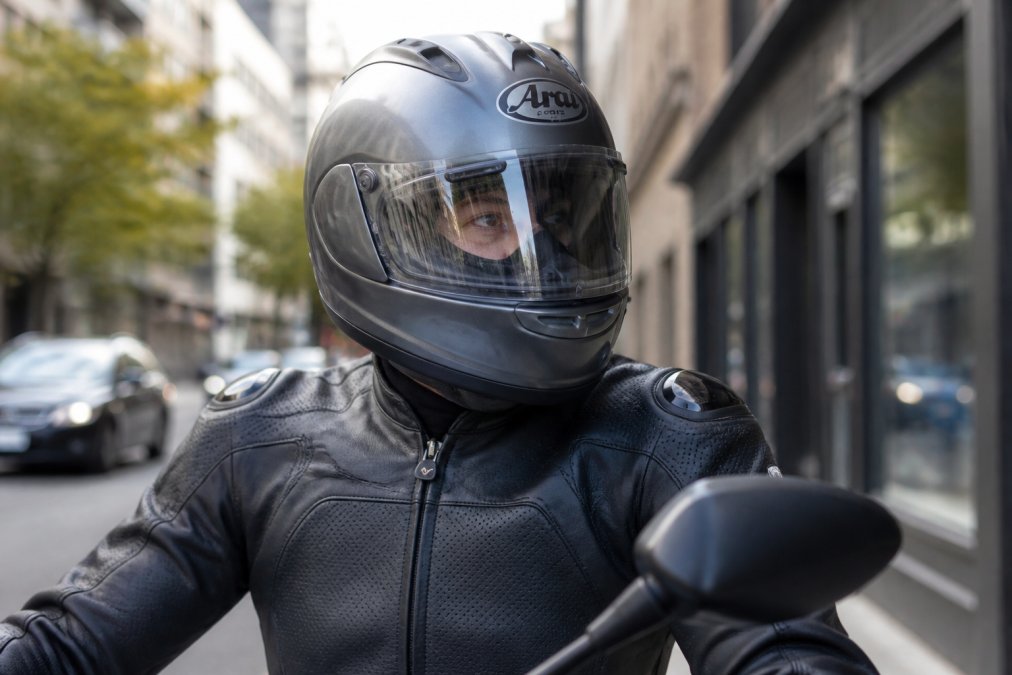
Full-Face Street and Touring Helmets
The Corsair-X is Arai's flagship full-face helmet, trusted by MotoGP riders and serious sport riders. The VAS shield mechanism provides smooth operation, and the VAS Max-V (BV) Shield is standard to provide visibility in all seasons and for all types of riding.

Adventure and Dual-Sport Helmets
The Arai XD-5 is purpose-built for riders who spend meaningful time on both pavement and dirt. The peak is designed for more effective ventilation, increased high speed flow-through performance, greater range of adjustability for blocking the sun, and is more resistant to buffeting, all of which leads to an overall more comfortable riding experience. The AR spoiler contributes to reducing fatigue from turbulent air throughout long rides, and works to draw out hot air from the crown area.
Open-Face and Classic Styles
The Arai Classic-V celebrates timeless motorcycle culture for riders who prefer the open, connected feeling of a 3/4 helmet. The intermediate oval shape fits the majority of head shapes, and the hidden ventilation system pulls air through forehead channels while exhausting through rear Venturi ports. The vintage aesthetic complements classic motorcycles.
| Model | Head Shape | Best For | Starting Price |
|---|---|---|---|
| Corsair-X | Round/Intermediate | Sport and performance | $989.95 |
| Quantum-X | Round Oval | All-day street and touring | $809.95 |
| Signet-X | Long Oval | Long-oval head shapes | $809.95 |
| Contour-X | Intermediate | Everyday street riding | $839.95 |
| XD-5 | Intermediate | Adventure and dual-sport | $939.95 |
| Classic-V | Intermediate | Classic and cruiser | $539.95 |
Long-Term Maintenance and Care for Arai Helmets
A well-maintained Arai helmet will perform reliably for several years of regular use. After that timeframe, even if the helmet hasn't been in a crash, the EPS liner begins to lose its protective properties due to material fatigue. Replacement becomes prudent for safety-conscious riders.
Visor and Shield Technology
The shield is your primary interaction with the helmet during every ride. Arai's Variable Axis System (VAS) represents a significant advancement in shield mechanism design. Rather than using a fixed pivot point, the VAS mechanism incorporates a moving pivot point that allows the shield to open and close smoothly even with the lower mounting position. This lower position creates a smoother shell profile in the critical temple area, which improves glance-off ability during impacts.
Frequently Asked Questions
What safety certifications do Arai helmets meet?
Arai helmets carry DOT (Department of Transportation) certification as standard. Many models, including the Corsair-X and Signet-X, also meet Snell M2020 standards, which exceed DOT requirements. Snell certification involves rigorous testing for impact absorption, shell rigidity, and peripheral vision. These dual certifications mean your Arai helmet has passed both federal safety minimums and independent, higher-standard crash testing protocols.
How should an Arai helmet fit compared to other brands?
Arai helmets are known for precise fitment based on head shape rather than just size. The brand offers round oval, long oval, and intermediate oval profiles. Your helmet should feel snug but not painful when you first put it on, the liner will compress slightly with wear. Check that cheek pads contact your face evenly, the helmet doesn't shift when you move your head, and you can fit one finger between the helmet and your forehead. This snug initial fit is normal for Arai and ensures better protection during an impact.
Are Arai helmets worth the investment for daily riders?
Yes, especially for commuters prioritizing safety and comfort. Arai helmets feature multi-density EPS liners, handcrafted composite shells, and ventilation systems designed for all-day wear. Models like the Quantum-X ($809.95) and Contour-X ($839.95) balance premium protection with everyday usability. The fully removable, washable interiors and odor-resistant liners keep your helmet fresh during repeated daily use. While the upfront cost is higher than budget options, the durability and long-term comfort justify the investment for riders logging regular miles.
Do Arai helmets come with Bluetooth compatibility?
Arai helmets are designed to accept Bluetooth communication systems, but the systems are sold separately. Models like the Contour-X feature flat sides and pre-drilled mounting points that make installing aftermarket Bluetooth headsets straightforward without compromising shell integrity or protection. The Helmet Shop stocks Sena and Cardo communication systems that integrate cleanly with Arai helmets. This modular approach lets you choose your preferred communication brand rather than being locked into a single option.
What is the actual lifespan of an Arai helmet, and how often should I replace it?
An Arai helmet typically lasts 3-5 years with regular use, though this depends on exposure to UV light, heat, and storage conditions. The EPS foam liner degrades over time even without crashes, reducing its ability to absorb impact energy. If you've been in a crash, even a minor one, replace your helmet immediately, as internal damage may not be visible. For daily commuters, plan to replace your helmet every 3-4 years. Genuine replacement interior pads (like the EP IV pad at $58.95) can extend comfort and fit during this period, but they don't restore the protective properties of an aged shell.


