

Last Updated: October 25, 2026
Quick Summary
The safest motorcycle helmet is a full-face helmet with ECE 22.06, FIM, or Snell certification that fits correctly to your head shape and size. Full-face helmets provide the highest protection because the chin bar shields your lower face and jaw from impact, and proper fit ensures the helmet stays in place during a crash to absorb energy as designed.
- Full-face helmets protect your entire head, face, and jaw; modular helmets provide comparable protection only when the chin bar is closed and secured.
- A correctly fitted helmet should resist rolling forward or backward when the chin strap is fastened and should not expose your forehead or skull base.
- ECE 22.06 and Snell M2025D certifications test rotational impact and multiple shell locations, going beyond the DOT legal minimum.
- Replace your helmet every 5-7 years or immediately after any significant impact, as foam liner degradation reduces protection over time.
- Shell material and liner density matter: carbon fiber shells with multi-density EPS foam distribute impact force more efficiently than polycarbonate with single-density foam.
Table of Contents
- What Makes a Motorcycle Helmet Safe
- Full-Face vs. Modular Helmet Safety
- Understanding Motorcycle Helmet Safety Ratings
- How Should a Motorcycle Helmet Fit
- Shell Materials and Impact Protection
- When to Replace a Motorcycle Helmet
- Finding Your Perfect Helmet at Helmet Shop
- Frequently Asked Questions
What Makes a Motorcycle Helmet Safe
A motorcycle helmet is safe when its layers work together: a hard outer shell that distributes force, a thick inner foam liner that absorbs shock, and a secure retention system that keeps it on your head in a crash.
Protective performance depends on three factors: staying in place, absorbing impact energy, and covering vulnerable areas. Full-face helmets excel at all three; open-face helmets sacrifice facial protection; modular helmets sit in between.
Full-Face vs. Modular Helmet Safety
Full-face helmets provide the highest level of protection because they cover your entire head, face, and jaw. The chin bar is the critical difference: it shields your lower face and jaw from impact, which open-face helmets cannot do.
Modular helmets offer a practical middle ground with a flip-up chin bar. When closed and secured, a quality modular helmet provides protection comparable to a full-face helmet, though the hinge adds complexity and potential weak points if not engineered well.
motorcycle helmet safety research from the Insurance Institute for Highway Safety shows that facial injuries are among the most common and severe in motorcycle accidents.
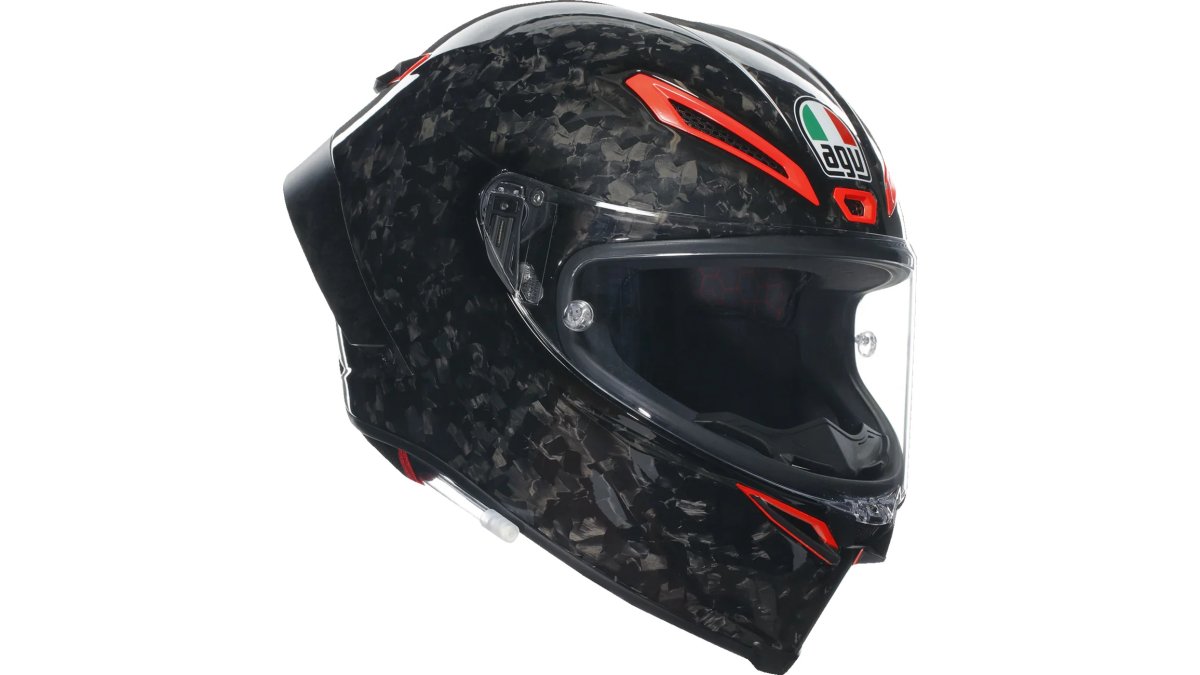
Consider your riding style. For hours on the highway or aggressive riding, a full-face helmet like the AGV Pista GP RR Carbonio Forgiato Helmet or ARAI Corsair-X provides maximum protection.

Understanding Motorcycle Helmet Safety Ratings
Helmet safety labels are not interchangeable. Each certification answers a different question, and understanding what a label does and does not establish is the only way to compare helmets on evidence rather than marketing.
DOT: The Legal Minimum
Any helmet sold for on-road use in the United States must carry DOT certification under Federal Motor Vehicle Safety Standard 218 (FMVSS 218), administered by the National Highway Traffic Safety Administration, which requires impact attenuation, penetration resistance, and retention system testing. DOT establishes a federal baseline for impact absorption, shell penetration, and strap strength, but not rotational-impact performance or independent verification, compliance is self-certified by the manufacturer, with NHTSA auditing after the fact.
ECE 22.06: A Broader Test Regime
ECE 22.06 is the current United Nations Economic Commission for Europe regulation for protective helmets. It is more demanding than FMVSS 218: it tests impact at more shell locations, includes an oblique rotational impact test, requires testing with the visor fitted, and adds modular chin-bar retention requirements and a broader range of impact speeds. It establishes a wider test envelope than DOT but does not establish real-world outcomes, durability, or comfort, noise, and fit.
FIM Homologation: Racing-Grade
FIM (Fédération Internationale de Motocyclisme) homologation is the racing standard used for competition. FIM FRHPhe-01 and FRHPhe-02 protocols include oblique impact and more impact points than DOT or ECE, and are required for competitors in sanctioned racing. FIM is the most stringent certification commonly available on street-legal helmets, but also the narrowest in scope: it is designed around racing crash profiles, not commuting or touring.
Snell M2025D: Voluntary Independent Testing
The Snell Memorial Foundation is a private, nonprofit testing organization. Snell M2025D is its current motorcycle standard, and it is voluntary, manufacturers submit helmets and pay for certification. Snell testing is independent of the manufacturer, a meaningful difference from DOT self-certification, and M2025D includes a dual-certification pathway for helmets that also meet ECE requirements.
What Independent Ratings Do and Do Not Tell You
Independent testing programs, Snell, FIM, or consumer-facing rating systems, provide evidence beyond regulatory compliance, but they are not interchangeable. Each weights impact locations, speeds, and rotational forces differently, so compare helmets within the same program and check the test date and methodology version.
| Certification | Administered By | What It Tests | What It Does Not Establish |
|---|---|---|---|
| DOT (FMVSS 218) | NHTSA (self-certified by manufacturer) | Impact attenuation, penetration, retention | Rotational impact, visor-in-place, independent pre-market verification |
| ECE 22.06 | UN ECE (third-party testing) | Impact at multiple points, oblique/rotational impact, visor fitted, modular chin bar | Real-world outcomes, comfort, noise, durability |
| FIM FRHPhe-01/02 | FIM (third-party testing) | Race-profile impact, oblique impact, broad impact points | Commuting/touring crash profiles |
| Snell M2025D | Snell Memorial Foundation (independent, voluntary) | High-energy impact, penetration, retention | Universal comparability with other programs |
Read the label as a statement of what was tested, not a guarantee of how the helmet will perform in your specific crash.
How Should a Motorcycle Helmet Fit
Fit is not a comfort preference, it is a safety variable. A helmet that shifts on your head during impact cannot absorb energy as designed, because the liner and shell move relative to your skull instead of compressing against it. The certification label tells you the helmet passed a test on a standardized headform; fit determines whether it performs anywhere near that standard on your head.
Step 1: Measure Before You Try On
Use a soft measuring tape around the widest part of your head, roughly one inch above your eyebrows and around the widest point at the back. Size charts are not standardized across brands, a medium in one brand can fit like a large in another, so always start from the brand's own chart.
Step 2: Check Head Shape, Not Just Size
Helmets are built around internal head-shape profiles: round oval, intermediate oval, and long oval. If your head is long and narrow and the helmet is built for a round oval, no size will fit correctly, a larger size will be loose front-to-back, and a smaller size will create pressure at the forehead and crown. The Shoei RF-SR 2 Full Face Motorcycle Helmet and Shoei X-15 Cross Logo Full Face Helmet are built on intermediate-oval profiles, which suit a large share of riders.


Step 3: The Pressure-Point Check
Put the helmet on and leave it in place for several minutes. You should feel even, firm contact across the forehead, crown, and cheeks, not sharp pressure at any single point. Pressure at the forehead or temples usually means the shell shape is wrong, not the size. Pressure at the cheeks is normal and should ease as the pads break in.
Step 4: The Roll-Off Test
Fasten the chin strap and try to roll the helmet forward off your head (toward your face) and backward (toward your neck). A correctly fitted helmet should resist both movements and should not expose your forehead or the base of your skull. If it rolls forward easily, the shell is too large or the shape is wrong.
Step 5: Cheek-Pad Contact
Your cheeks should be pressed inward by the cheek pads, enough that your face feels slightly compressed and biting your cheek is difficult. Cheek pads are the most commonly replaced fit component, and many brands offer alternate thicknesses: a thicker pad fixes loose cheeks, a thinner pad eases painful tightness. Cheek-pad contact is what keeps the helmet from rotating on your head in an oblique impact.
AGV Pista GP RR Carbonio Forgiato Helmet →
Step 6: Retention-Strap Adjustment
Retention systems vary: double-D rings, micrometric ratchets, and quick-release buckles. Regardless of type, the strap should sit snug against the underside of your jaw with no more than a finger's width of slack, and the buckle should sit centered under the chin. Test it by opening your mouth wide, you should feel the strap pull slightly against your jaw.
Why Fit Failures Matter in Real Crashes
A helmet that passes DOT or ECE on a standardized headform can still fail you if it is loose on your head.
Trying on multiple brands and shapes is the only reliable way to find your fit. If you cannot try a helmet in person, order from a retailer that lets you exchange sizes, and repeat the roll-off and cheek-pad checks as soon as it arrives.
Shell Materials and Impact Protection
The outer shell of a motorcycle helmet is typically made from polycarbonate, fiberglass, or carbon fiber, each with different protection characteristics and durability.
Polycarbonate shells are durable and affordable, resisting cracking under impact and absorbing energy effectively.
Fiberglass shells offer better impact distribution than polycarbonate.
Carbon fiber shells are the strongest and lightest option, distributing impact force more efficiently and reducing the energy that reaches your head. The AGV Pista GP RR Carbonio Forgiato Helmet uses a 100% extreme carbon shell engineered for maximum protection.
Beneath the outer shell is the impact-absorbing liner, typically expanded polystyrene (EPS) foam.
When to Replace a Motorcycle Helmet
Most motorcycle helmets should be replaced every 5-7 years, even without a crash. The foam liner degrades over time, losing its ability to absorb impact energy as UV exposure, temperature changes, and regular wear break down the materials.
Replace your helmet immediately after any significant impact, even if the damage isn't visible.
Signs your helmet needs replacement include visible shell cracks, compressed or cracked foam, loose or damaged chin straps, or a visor that won't stay in place.
Store your helmet in a cool, dry place away from direct sunlight. Don't leave it in a hot car or garage for extended periods.
Finding Your Perfect Helmet at Helmet Shop
Choosing the safest motorcycle helmet means matching the right helmet to your head shape, riding style, and protection priorities.
If you're a commuter prioritizing daily comfort with serious protection, the Shoei RF-SR 2 Full Face Motorcycle Helmet delivers both.
For riders who demand the absolute highest protection, the AGV Pista GP RR Carbonio Forgiato Helmet represents the peak of helmet engineering.
The ARAI Corsair-X offers a balanced approach: excellent protection and proven durability.
Frequently Asked Questions
What is the difference between DOT and ECE 22.06 certifications for a motorcycle helmet?
DOT (Department of Transportation) is the U.S. safety standard, while ECE 22.06 is the European standard. Both require helmets to pass impact, penetration, and retention tests. ECE 22.06 includes rotational impact testing, which DOT does not. Many helmets carry both certifications. Neither is objectively 'better', both ensure the helmet meets rigorous safety requirements. Check the label inside your helmet to see which standards it meets.
Are full-face motorcycle helmets safer than modular helmets?
Full-face helmets offer complete facial and chin protection in a single rigid structure, which provides consistent crash protection. Modular helmets (flip-front) offer similar safety when the chin bar is locked down, but the hinge mechanism creates a potential weak point. In real crashes, full-face helmets typically perform slightly better due to their integrated design. Your riding style and comfort matter too, a full-face helmet you wear consistently is safer than a modular helmet left at home.
How often should I replace my motorcycle helmet?
Replace your helmet immediately after any significant crash, even if it looks undamaged. For daily use without crashes, replace it every 3-5 years. The EPS liner degrades over time from UV exposure, sweat, and general wear. If you notice cracks in the shell, damaged padding, or a loose chin strap, replace it sooner. Inspect your helmet regularly for visible damage or deterioration, especially if you ride frequently.
Does helmet fit really affect how well it protects me in a crash?
Yes, fit is critical to real-world protection. A loose helmet can shift during impact, leaving your head partially unprotected. A snug fit keeps the helmet in place and ensures the impact-absorbing liner contacts your head evenly. The chin strap must be secure so the helmet stays on during a crash. A helmet that's too tight causes discomfort and fatigue, which leads riders to skip wearing it. Proper fit means the helmet feels snug but not painful, you should barely be able to fit one finger under the chin strap.
The safest motorcycle helmet is the one that fits your head properly, meets rigorous safety certifications, and matches your riding style. Whether you choose a full-face helmet for maximum protection or a modular helmet for versatility, prioritize fit and construction quality over price alone. Helmet Shop carries premium brands engineered for real protection, browse our selection today and find the helmet that keeps you safe on every ride.


