

Table of Contents
- Why Lightweight Motorcycle Helmets Matter on Long Rides
- Quick Comparison: Lightweight Motorcycle Helmets for Long Rides
- Best Lightweight Full-Face Motorcycle Helmet Picks
- Lightweight Modular Motorcycle Helmet Options for Touring
- Motorcycle Helmet Fit Guide for Long-Distance Comfort
- Motorcycle Helmet Safety Ratings and Certification Explained
- Ventilation, Noise, and Fatigue on Long Touring Days
- Conclusion
- Frequently Asked Questions
Last Updated: October 20, 2026
Why Lightweight Motorcycle Helmets Matter on Long Rides
Lightweight motorcycle helmets for long rides reduce the fatigue that builds up over hours in the saddle, the fatigue most riders underestimate.
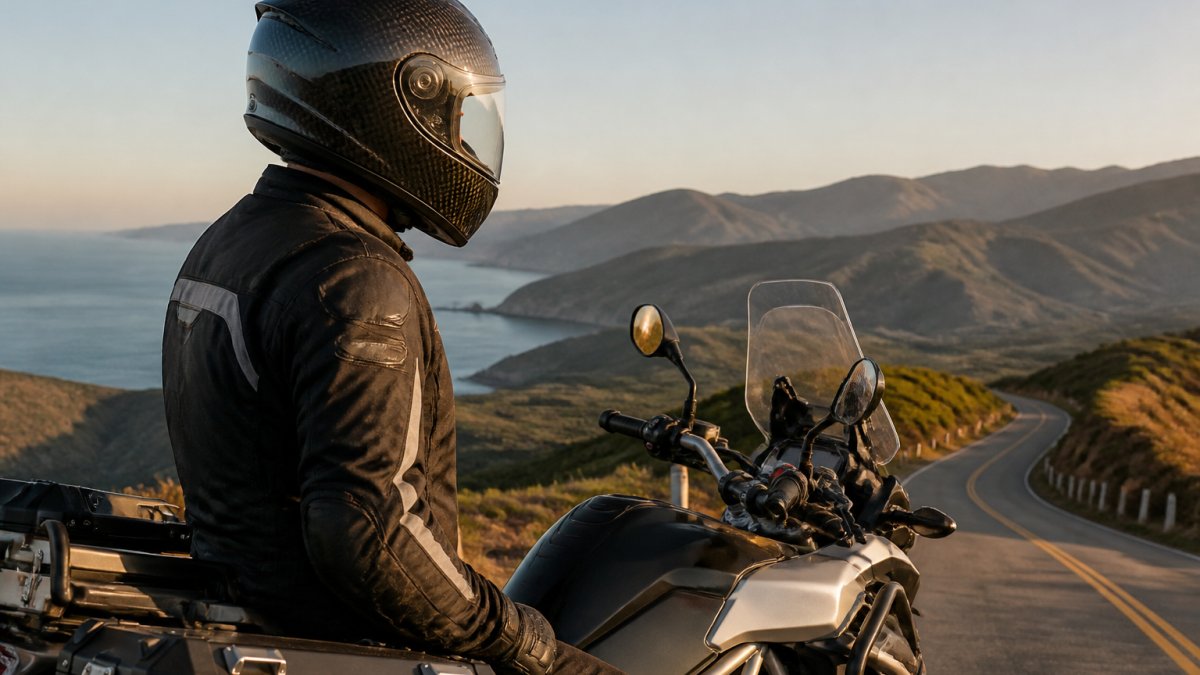
The physics is simple. Your neck holds the helmet up against wind resistance for the entire ride. Every extra gram gets multiplied by hours and miles.
Below are five helmets we stock that earn their place on long touring days, plus the fit and safety details that decide whether a light helmet works for you.
Quick Comparison: Lightweight Motorcycle Helmets for Long Rides
All five picks are DOT and ECE 22.06 certified and built around weight savings rather than feature bloat.
| Model | Type | Shell | Price | Best For |
|---|---|---|---|---|
| HJC RPHA 72 Carbon | Full-face | Carbon fiber | $599.99 | Sport-touring riders who want the lightest RPHA |
| HJC F71 Carbon | Full-face | Carbon over fiberglass | $519.99 | Budget-conscious sport riders |
| HJC F100 Carbon Stan | Modular | Carbon fiber | $529.99 | Adventure and dual-sport touring |
| HJC F100 Modular | Modular | Fiberglass composite | $429.99 | Value-focused adventure riders |
| HJC i91 | Modular | Polycarbonate | $269.99 | Everyday commuting and cruising |
Carbon fiber costs more, but it is the single biggest lever on weight here. If neck fatigue is your complaint, start at the top of that table.

Best Lightweight Full-Face Motorcycle Helmet Picks
Full-face helmets give the most protection of any shell type, and the two carbon HJC models here prove that protection does not have to mean heaviness. Both carry DOT and ECE 22.06 certification and are built for highway-speed riders.
HJC RPHA 72 Carbon: Sport-Touring Full-Face
The HJC RPHA 72 Carbon is our top pick for long rides, and the reason is the shell. HJC built its latest-generation RPHA sport full-face around carbon fiber, the lightest version of the RPHA 72 they make.
The features that matter on hour six: a new chin curtain and SMART HJC cover system that manage airflow and cut noise, an improved ratchet system, and a Dynamic Multi-Step sunshield you can position where you want it. It is also SMART HJC Bluetooth 2nd Gen compatible.
Pros: Lightest RPHA 72 build, included Pinlock insert, strong noise management Cons: Highest price in this group
HJC F71 Carbon: Sport Full-Face Below the RPHA Tier
If the RPHA price gives you pause, the HJC F71 Carbon delivers carbon weight savings at $519.99.

Two details stand out for long rides: the 3D contour design holds a secure fit and works comfortably with glasses, and the two-way pivot ratchet gives a better seal and smoother movement.
Pros: Carbon construction below the RPHA price, glasses-friendly fit, emergency cheek pad release Cons: Fiberglass base adds a little weight versus a full carbon shell
Lightweight Modular Motorcycle Helmet Options for Touring
A lightweight modular motorcycle helmet trades a fixed chin bar for a flip-front design, which is why touring riders gravitate toward them: full-face protection on the highway and an open face at fuel stops without pulling the helmet off. The trade-off is usually weight, since the hinge adds mass, but carbon and careful shell design close that gap.
HJC F100 Carbon Stan: Adventure-Touring Modular
The HJC F100 Carbon Stan is the modular we recommend for riders who split time between pavement and dirt.

The Advanced Channeling Ventilation System runs two intakes and one exhaust, keeping air moving on slow, hot trail sections. The HJ-45 visor is Pinlock ready and blocks 99% of UV-A and UV-B, and the sun shield extends 8 mm for extra coverage.
Pros: Carbon shell, removable peak visor, washable interior Cons: Modular hinge adds weight versus a fixed full-face
HJC i91: Everyday Modular Value
Not every long ride needs a carbon shell. The HJC i91 is built for touring and cruising riders at $269.99, and its polycarbonate shell is designed to be lightweight using CAD technology.
The one-touch chin bar release is glove-friendly, the multi-step sun visor deploys in a single motion, and the 3D contour design fits comfortably even with glasses.
Pros: Lowest price here, glove-friendly release, glasses-friendly fit Cons: Polycarbonate shell is heavier than carbon options
Motorcycle Helmet Fit Guide for Long-Distance Comfort
A motorcycle helmet fit guide starts with one rule: the right size is the one that stays put without pressure points.
HJC F100 Carbon Stan Modular Helmet MC1 →
Start with head shape. Try models with a 3D contour interior, which shapes the padding to the head rather than a generic dome; the HJC F100 and i91 both use that design.
Then check these points before you commit:
- Cheek pads: firm contact, no pinching, and movable on most models
- Forehead: no red line after ten minutes of wear
- Crown: snug but not tight enough to cause a headache
Measure your head circumference above the eyebrows and compare it to the size chart. If you land between sizes, size up and adjust with padding rather than squeezing into a smaller shell.
Motorcycle Helmet Safety Ratings and Certification Explained
Motorcycle helmet safety ratings tell you which standards a helmet has passed, and in the U.S. the baseline is DOT certification under FMVSS 218, administered by the National Highway Traffic Safety Administration. Every helmet we sell meets DOT. Many also carry ECE 22.06, the current European standard, which adds rotation-impact testing and a broader set of anvil and velocity conditions than FMVSS 218 alone.
Here is how to read the labels you will see, and what each one actually tests:
- DOT (FMVSS 218): the legal minimum for road use in the U.S. It sets impact attenuation limits, penetration resistance, and retention-system strength, and it is verified by the manufacturer's own self-certification rather than a pre-market government test.
- ECE 22.06: a stricter independent standard with newer test protocols, including oblique (angled) impact testing that measures rotational acceleration, plus defined coverage zones and a mandatory visor test.
- MIPS: a low-friction layer inside the helmet designed to manage rotational forces in angled impacts. It is a construction feature, not a certification, so it appears alongside DOT or ECE rather than replacing either.
Why lighter does not mean less safe
Weight and safety are not opposites. A shell has to spread a point impact over a wide area and then let the energy-absorbing liner crush in a controlled way.
The trade-off to watch is stiffness versus energy management: a shell that is too stiff can transmit more force to the liner, so the liner has to be tuned to match.
How to compare certifications by market
Certification labels are market-specific, so read the one inside the helmet you are actually buying rather than the marketing copy. A helmet sold in the U.S. must carry DOT; one also sold in Europe may carry ECE 22.06 on a separate label. If a listing claims ECE 22.06, confirm the label is present inside the shell and matches the model.
Ventilation, Noise, and Fatigue on Long Touring Days
Ventilation and noise are the two hidden causes of long-ride fatigue, and they interact with weight in ways that scale numbers do not show. Heat builds inside a closed shell, and constant wind noise drains concentration even when you feel fine. Both get worse the longer you ride, which is why touring helmets prioritize airflow and aerodynamics over aggressive styling.
How ventilation actually moves heat
A channeled system works by creating a pressure difference between the front intakes and the rear exhaust. Air enters at the forehead and chin, travels through channels molded into the liner, and exits at the back, carrying heat and moisture with it. The HJC F100 models run two intakes and one exhaust, moving air through the shell rather than just across the surface.
Why weight distribution matters as much as scale weight
A helmet's scale weight is only part of the neck load. What your neck actually fights is the torque created by the helmet's mass sitting ahead of your spine, multiplied by wind pressure at speed. A lighter helmet balanced over the crown needs fewer corrections in crosswinds than a heavier one with a forward center of mass, which is why a well-shaped 1,500-gram helmet can feel less tiring on hour six than a poorly balanced 1,400-gram one.
Noise: what the numbers mean and how to protect your hearing
Wind noise at highway speed is loud enough to cause long-term damage over years of riding, and the CDC's guidance on noise-induced hearing loss explains why duration matters as much as volume.
Practical guidance: earplugs plus a quieter helmet protects your hearing and reduces end-of-day fatigue. Foam earplugs with a high noise-reduction rating cut the wind roar while still letting you hear a horn or a siren.
Conclusion
The hardest part of a long ride is not the distance. It is the accumulated strain that shows up in your neck, your hearing, and your attention by the final hour. Choosing among lightweight motorcycle helmets for long rides comes down to matching shell material and fit to how you actually ride: carbon for the lightest build, modular for versatility, and a proper fit above all.
At Helmet Shop, we stock the HJC carbon lineup alongside Bluetooth-ready models, with free shipping over $49 and a 30-day return policy so you can confirm the fit. Start with the RPHA 72 Carbon if weight is your priority, or the F100 Carbon Stan if you need a flip-front. Shop the collection and get the helmet that keeps you sharp from the first mile to the last.
Frequently Asked Questions
Are lightweight motorcycle helmets better for long rides?
They can reduce neck strain over a full day in the saddle, because less mass at the end of your neck means less fatigue from wind buffeting and head checks. Carbon fiber shells, like those on the HJC RPHA 72 Carbon and HJC F100 Carbon Stan, cut weight without giving up DOT and ECE 22.06 protection. Weight is only one factor, though. Fit, ventilation, and noise control matter just as much on a 400-mile day.
Is a full-face or modular helmet more comfortable for touring?
Full-face helmets are generally lighter and quieter because the chin bar is a single fixed structure. Modular helmets add convenience: you can flip the chin bar up at fuel stops or to talk without removing the helmet. The HJC F100 Carbon Stan modular weighs more than a pure full-face but adds that flip-front flexibility. If you rarely stop or value quiet, go full-face. If you stop often and want easy access, a lightweight modular motorcycle helmet is the better fit.
How should a motorcycle helmet fit for a long ride?
Use the 2-2-2 rule as a starting point: the liner should touch your forehead and cheeks in two places, you should be able to roll the helmet forward and back about two millimeters, and it should take about two seconds of firm pull to remove. On long rides, pressure points that feel minor in the shop become painful after three hours. Try the helmet on for 20 minutes before you commit, and check that your head shape matches the shell, since long-oval and round heads need different interiors.
What helmet features help reduce fatigue on long motorcycle rides?
Aerodynamic shell shape cuts buffeting, which is the main cause of neck fatigue. A chin curtain and a well-sealed visor reduce wind noise, and noise is a real contributor to tiredness over a long day. Ventilation keeps you cool and alert in summer heat. A Pinlock-ready shield, like the HJ-45 visor on HJC F100 models, prevents fogging in rain and cold. Bluetooth readiness, such as SMART HJC compatibility, lets you take calls and navigation prompts without stopping.
Do lightweight helmets meet the same safety ratings as heavier ones?
Yes. A lighter shell does not mean less protection. The HJC RPHA 72 Carbon, F71 Carbon, and F100 Carbon Stan all carry both DOT and ECE 22.06 certification. Carbon fiber and fiberglass composite shells can be lighter and still absorb impact energy effectively. When you compare motorcycle helmet safety ratings, check that the model carries the certification you need, then weigh that against fit and comfort for your riding style.


