

Table of Contents
- What Are Modular Helmets and Why Riders Choose Them
- Modular vs. Full-Face Helmets: Key Differences
- Modular Helmet Safety Ratings and Certification Standards
- How to Fit a Motorcycle Helmet Correctly
- Bluetooth Modular Helmets for Rider Communication
- Top Modular Helmet Options for Different Riding Styles
- Maintenance, Inspection, and When to Replace Your Modular Helmet
- Frequently Asked Questions
Last Updated: October 18, 2026
What Are Modular Helmets and Why Riders Choose Them
A modular helmet has a flip-up chin bar that rotates upward, letting riders open the front without removing the helmet, full-face protection with open-face convenience, which is why modular helmets are popular with commuters and touring riders.
Modular helmets excel in specific scenarios. Urban commuters can talk at gas stations or toll booths without removing the helmet, touring riders get ventilation flexibility, and adventure riders use the removable peak visor to switch between street and light off-road riding. At Helmet Shop, riders gravitating toward modular helmets prioritize practicality alongside safety, accepting slightly more weight than a full-face in exchange for convenience.
The trade-off is real. Modular helmets weigh more than full-face helmets due to the extra mechanism and hinge hardware, and they're more complex mechanically, so the chin bar latch must stay secure and the hinge system needs regular inspection. Most also generate more wind noise than comparably priced full-face helmets with the chin bar closed, though newer wind-tunnel-engineered designs are narrowing that gap.
Modular vs. Full-Face Helmets: Key Differences
The practical distinction comes down to flexibility versus optimization. A full-face helmet is engineered as a single, sealed unit, with every airflow path, structural reinforcement, and acoustic treatment designed for that configuration. A modular helmet sacrifices some of that optimization to reconfigure mid-ride.
Full-face helmets typically offer superior aerodynamic stability at highway speeds because the chin bar is fixed and integrated into the shell from the ground up.
Modular helmets compensate by offering what full-face helmets cannot: the ability to open the front without removing the helmet. That matters for riders who spend extended time in traffic or on long rides with frequent stops.
The safety profile is roughly equivalent when both meet the same certification standards. Both must pass DOT FMVSS 218 testing in the US, which evaluates impact protection, retention, and field of vision. A modular helmet with the chin bar closed provides the same impact protection as a full-face of the same quality.
At Helmet Shop, we recommend modular helmets for riders whose routine involves frequent stops, varied riding conditions, or long touring days where ventilation flexibility justifies the added weight and complexity. For pure highway commuting or sport riding, a full-face helmet often makes more sense.
Modular Helmet Safety Ratings and Certification Standards
Safety certification tells you a modular helmet has been tested and meets minimum impact protection standards, but not everything about how safe it actually is.
In the US, the relevant standard is DOT FMVSS 218, which evaluates impact absorption, retention system strength, and field of vision. It's a pass/fail standard, not a comparison, so two helmets can both pass DOT and have very different real-world safety profiles depending on shell materials, internal padding, and design details.
Many quality modular helmets also carry ECE 22.06 certification, the European standard, generally considered more rigorous than DOT because it includes additional impact test sites and stricter retention requirements. Dual certification (DOT and ECE 22.06) is a reliable signal of quality.
The chin bar mechanism is a critical safety consideration that often gets overlooked. When closed and locked, it should be part of the integrated safety structure, with impact forces distributed through the chin bar to the shell rather than concentrated at the hinge points. A poorly designed latch can fail under impact, or the hinge can act as a stress concentration point that compromises the shell.
The chin bar should also be rideable open at low speeds, parking, toll booths, slow traffic, but the hinge must be strong enough that opening it doesn't create a stress point that could fail in a crash.
How to Fit a Motorcycle Helmet Correctly
A properly fitted helmet is the foundation of safety. An ill-fitting helmet can shift during a crash, reducing protection exactly when you need it most, and can cause discomfort that leads riders to take it off more often.
Measuring Your Head and Choosing the Right Size
Start by measuring your head circumference with a soft tape measure, wrapped about an inch above your eyebrows and ears, snug but not compressing the skin. Most manufacturers provide a size chart correlating head circumference to XS through 2XL.
The measurement is your starting point, not your final answer. Head shape matters as much as circumference: a helmet that fits a round head perfectly might be loose on the sides for an oval head at the same circumference. That's why trying on helmets, or working with a retailer who understands fit, is so valuable.
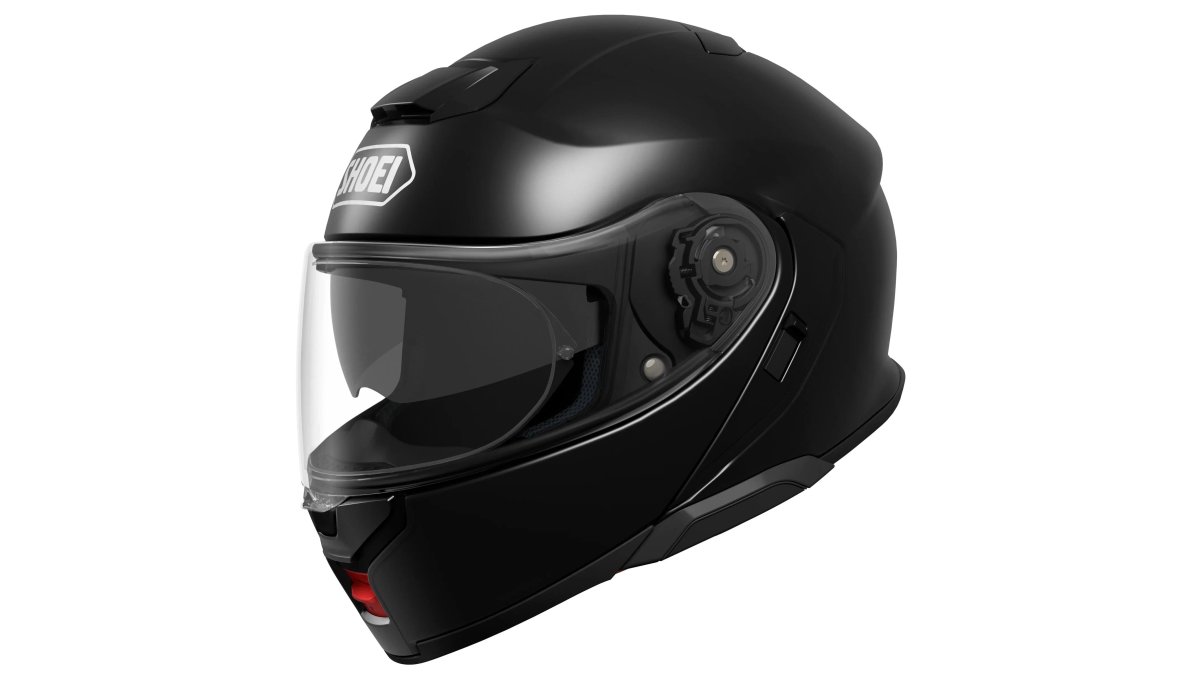
Modular helmets from quality brands like HJC, Shoei, and Daytona use multiple shell sizes to accommodate different head shapes. The HJC F100 uses a fiberglass composite shell designed for the adventure-touring fit profile, while the Shoei Neotec 3 offers two shell sizes (XS-M and L-2XL) so the helmet sits correctly without oversizing.

Testing Fit and Identifying Pressure Points
Once you've narrowed down your size, put the helmet on and check for pressure points. It should feel snug, not painfully tight, and you shouldn't be able to rotate it side to side on your head.
Press gently on the sides near your temples. Sharp pressure or digging means it's too narrow for your head shape, so try the next size up or a brand with a wider fit profile.
Check the chin area. The chin bar should sit comfortably against your chin without pressing hard into the bone. Pressure concentrated at one spot means the interior profile doesn't match your chin shape, so try a different model.
The helmet should cover your forehead down to about an inch above your eyebrows. Too high exposes your forehead in a crash; too low obstructs vision.
The back of your head should feel supported by the interior padding, with no gap between head and shell. A gap means the helmet is too large and will shift forward during hard braking or a crash.
Wear the helmet for at least 15-20 minutes before deciding. Walk around, turn your head side to side, look up and down. It should move with your head as a single unit; if you can rotate it independently, the fit is too loose.
Bluetooth Modular Helmets for Rider Communication
Adding Bluetooth communication to your modular helmet transforms how you ride. You can take calls, hear GPS navigation, or talk to other riders without removing your helmet or taking your hands off the bars.
Most quality modular helmets have recessed speaker pockets where Bluetooth units mount cleanly without protruding. Brands like Shoei engineer their helmets for specific communication systems: the Shoei Neotec 3, for example, integrates seamlessly with the Sena SRL3, with pre-molded speaker pockets and cable management paths that keep wires organized.
SHOEI NEOTEC 3 MODULAR HELMET →
Installing a Bluetooth system is straightforward if the helmet is designed for it. Most systems use adhesive-backed speakers that mount in the pre-molded pockets, a control unit that attaches to your jacket or handlebars, and a microphone near your chin bar or mouth.
The advantage of Bluetooth in a modular helmet is getting all the communication benefits without the bulk of a full system mounted on a full-face helmet. Flip the chin bar up to hear ambient sound while stopped, then close it for highway riding with full communication.
Battery life varies by system. Most Bluetooth helmet communicators run 8-12 hours per charge, enough for most day rides; for multi-day touring, charge overnight or carry a portable battery pack.
Top Modular Helmet Options for Different Riding Styles
The best modular helmet depends on your riding style, head shape, and budget. Here's how we break down the options at Helmet Shop.
For Premium Highway Touring: Shoei Neotec 3
The Shoei Neotec 3 is engineered for riders who spend long hours on the highway. Wind tunnel aerodynamics deliver a tighter seal and reduced buffeting than previous generations. The dual-function flip-up chin bar uses an eccentric rotation axis that prevents shell interference when opening and closing.
For Adventure Touring: HJC F100 Modular Helmet

The HJC F100 combines a flip-front chin bar with a removable peak visor for riders who split time between highway and light off-road terrain. Its DOT and ECE 22.06 certified fiberglass composite shell is lightweight yet impact-resistant, and the Advanced Channeling Ventilation System moves air efficiently on long riding days.
For Value-Conscious Riders: Scorpion EXO EXO-GT930 Transformer Helmet
The Scorpion EXO EXO-GT930 delivers proven quality at an accessible price point. Its DOT-218 and ECE certified advanced polycarbonate shell uses dual density EPS, and aero-tuned ventilation keeps you cool on extended rides. The removable chin bar converts it between modular and open-face configurations.

For Budget-Conscious Dual Certification: Daytona C6 Modular Helmet
The Daytona C6 Modular Helmet meets both DOT FMVSS 218 and ECE 22.06 standards, dual certification at a mid-range price point. Its dual shield system pairs an outer anti-scratch clear shield with an inner retractable smoke shield for all-condition visibility.
| Helmet Model | Best For | Key Features | Price |
|---|---|---|---|
| Shoei Neotec 3 | Premium highway touring | Wind tunnel aerodynamics, dual-function chin bar, sun visor, Sena integration | $949.99 |
| HJC F100 | Adventure touring | Removable peak visor, ventilation, light off-road capability | $429.99 |
| Scorpion EXO GT930 | Value-conscious riders | Removable chin bar, no-fog shield, 5-year warranty | $274.95 |
| Daytona C6 | Budget dual certification | DOT + ECE certified, dual shield, quick-release | $350.95 |
Maintenance, Inspection, and When to Replace Your Modular Helmet
A modular helmet requires more maintenance than a full-face because of the additional moving parts. Regular inspection keeps it safe and extends its lifespan.
Inspect the chin bar latch every few weeks. Open and close it 5-10 times and listen for grinding or clicking.
Check the hinge points for cracks or stress marks, since these areas experience repeated stress every time you open and close the chin bar.
Clean the interior regularly. The Daytona C6, Scorpion EXO, and HJC F100 all feature fully removable, washable interiors.
Inspect the face shield for scratches or crazing (stress fractures in the plastic). A damaged shield reduces visibility and can fail during impact. Replace it if you see significant damage. Most manufacturers sell replacement shields separately.
Check the padding for compression. New padding is firm; over time it compresses and softens.
Helmets have a lifespan. Even if yours looks fine, the foam padding degrades over time from UV exposure, moisture, and repeated impacts. Most manufacturers recommend replacing a helmet every 3-5 years, or immediately after any significant impact.
Store your helmet in a cool, dry place away from direct sunlight, since UV exposure degrades the shell and foam padding.
Choosing the right modular helmet means balancing safety, fit, comfort, and your riding style.
Frequently Asked Questions
Are modular helmets as safe as full-face helmets?
Yes, when properly certified. DOT FMVSS 218 and ECE 22.06 certified modular helmets meet the same safety standards as full-face helmets. The key is the chin bar's locking mechanism, it must lock securely in the closed position. Models like the Shoei Neotec 3 use dual-function flip-up designs with reliable latches. Always verify certification before purchase, and never ride with the chin bar unsecured or partially open.
Can you ride with a modular helmet open?
No. Riding with the chin bar open or unlocked voids safety protection and violates most helmet standards. The chin bar must remain fully closed and locked during riding. You can open it at stops for ventilation or convenience, but secure it before accelerating. Some modular helmets, like the HJC F100, feature removable peak visors for adventure riding flexibility without compromising the chin bar's integrity.
How should a modular motorcycle helmet fit?
A proper fit means the helmet sits level on your head, one finger's width above your eyebrows, with snug contact at the temples and cheeks but no painful pressure points. The chin bar should close smoothly without gaps, and the retention system should hold the helmet firmly when you shake your head side-to-side. Measure your head circumference in centimeters just above your eyebrows, then try multiple sizes, fit varies by brand and shell shape. Daytona offers multiple shell sizes to ensure proportionate fit across the size range.
What should I look for when buying a modular helmet?
Prioritize DOT and ECE certification, chin bar locking reliability, ventilation system, visor quality (Pinlock-ready reduces fogging), and fit across your head shape. Consider weight, lighter shells reduce fatigue on long rides. If you want Bluetooth communication, choose a model with integrated speaker pockets like the Scorpion EXO-GT930 or Daytona C6. Test the quick-release chinstrap mechanism with gloves on. Compare interior liners, removable, washable liners stay fresh longer during touring.


