

Table of Contents
- What CE Ratings Actually Mean on a Jacket Label
- Difference Between CE Level 1 and Level 2 Armor
- CE EN 17092 Standard Explained: AAA, AA, and A Garment Classes
- How to Check Motorcycle Jacket Safety Ratings Before You Buy
- Matching Jacket Safety Levels to Your Riding Style
- Armor Maintenance, Expiration, and Climate Trade-Offs
- Jackets That Meet These Standards
- Frequently Asked Questions
Last Updated: September 30, 2026
What CE Ratings Actually Mean on a Jacket Label
A CE rating on a motorcycle jacket is an independent certification that the garment and its armor have passed standardized European testing for impact protection and abrasion resistance. It is not a marketing claim, and it is not optional for quality gear.
European Committee for Standardization overview of PPE standards
Difference Between CE Level 1 and Level 2 Armor
CE Level 2 armor absorbs more impact energy than Level 1, which is why it is the higher of the two protection tiers. Both levels are certified under EN 1621-1 for limb protectors, but Level 2 must transmit less force to the body during a standardized strike.
How Impact Energy and Kilonewtons Are Measured
Test labs drop a known mass onto the armor and measure how much kinetic energy passes through to a sensor beneath it. The result is expressed in kilonewtons, the unit of force transmission. Lower kilonewtons means less force reaches your body. This standardized testing is what separates certified protectors from foam padding that merely looks protective.
CE EN 17092 Standard Explained: AAA, AA, and A Garment Classes
The EN 17092 standard rates the jacket shell itself, not just the armor, across three main classes: AAA, AA, and A. AAA offers the highest abrasion resistance, AA sits in the middle, and A covers lighter-duty urban riding. A separate Class B exists for garments with impact protection but no abrasion rating.
Abrasion, Tear, and Seam Burst Strength Tests
Each class is verified through three tests. Abrasion resistance measures how long the fabric survives sliding on pavement. Tear strength measures resistance to ripping. Seam burst strength checks whether the stitching holds under force. Higher classes demand more of all three, which is why a Class AAA leather suit feels and costs more than a Class A mesh jacket. Beyond these structural integrity requirements, riders should also consider how high visibility standards contribute to overall road safety by improving detection in low-light conditions.
| Class | Abrasion Resistance | Best For | Typical Build |
|---|---|---|---|
| AAA | Highest | Track, high-speed | Thick leather |
| AA | High | Touring, sport | Leather or heavy textile |
| A | Moderate | Urban commuting | Mesh and textile |
| B | Impact only | Armor-only garments | No abrasion rating |
How to Check Motorcycle Jacket Safety Ratings Before You Buy
Checking a jacket's safety rating takes about 30 seconds once you know where to look. Every certified garment carries a sewn-in label listing its EN 17092 class and the EN 1621 rating of each armor piece. The trick is knowing which pictogram means what, because a jacket can carry two different CE marks and they certify two different things.
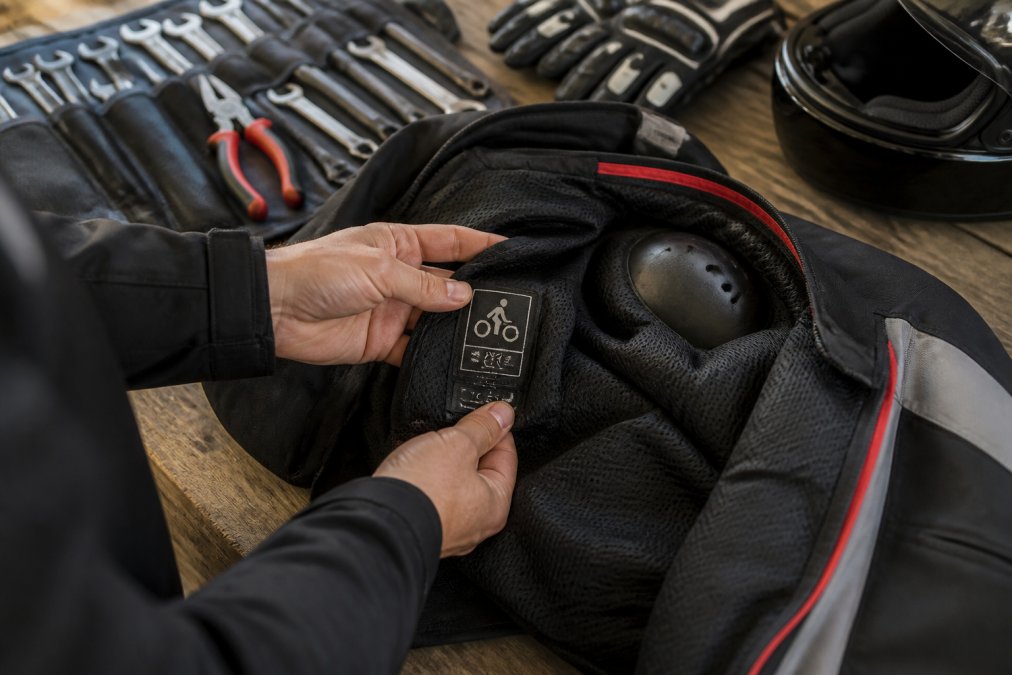
Reading the Label: A Visual Identification Guide
There are two distinct CE pictograms, and confusing them is the single most common mistake riders make in the store.
- The rider-on-motorcycle pictogram appears on the garment label. It signals the jacket itself has been tested to EN 17092 and carries a class letter (AAA, AA, or A). The class letter is usually printed directly beneath or beside the pictogram.
- The armor pictogram appears on the protector insert itself, not the shell. It looks like a shield or a body outline with the impact zone shaded, and it carries the EN 1621 standard number plus the performance level (Level 1 or Level 2).
How to Read the Standard Numbers
The suffix after EN 1621 tells you which body zone the protector was tested for:
- EN 1621-1 covers limb protectors: shoulders, elbows, knees, hips.
- EN 1621-2 covers back protectors.
- EN 1621-3 covers chest protectors.
- EN 1621-4 covers inflatable or airbag-style protectors.
A 30-Second In-Store Checklist
- Find the interior label, usually near the waist or inside the back panel.
- Confirm the rider pictogram and the EN 17092 class letter (AAA, AA, or A).
- Locate each armor insert and read its own tag for the EN 1621 part number.
- Verify the armor level (Level 1 or Level 2) on each insert.
- Confirm the armor is included, not sold separately, and that shoulder, elbow, and back positions are all filled.
Matching Jacket Safety Levels to Your Riding Style
Your riding style should dictate your jacket class, not the other way around. Track day requirements push you toward AAA, while casual riding and short commutes are well served by Class A with Level 1 armor.
Match your gear this way:
- Track and high-speed sport: Class AAA shell with Level 2 armor
- Touring and long-distance: Class AA with Level 2 armor for sustained protection
- Daily urban commuting: Class A with Level 1 armor for airflow and comfort
- Casual short trips: Class A minimum, never plain street clothing
Armor Maintenance, Expiration, and Climate Trade-Offs
Armor does not last forever, and the reasons are physical rather than cosmetic. The foam compounds used in CE protectors are engineered to absorb and dissipate impact energy by deforming and recovering. Over time, heat, sweat, UV exposure, and repeated flexing cause the foam to harden, crack, or lose its rebound. Once that happens, the protector may still look intact while transmitting more force to your body than its original rating promised.
When to Replace Armor
- After any impact. Even a low-speed tip-over can compress the foam past its elastic limit. Replace the insert, not just the shell.
- Annually, as an inspection interval. Most manufacturers recommend checking armor at least once a year, and more often if you ride daily in hot or humid conditions.
- When the foam feels stiff or crumbly. Squeeze the insert. It should compress and spring back. If it stays compressed, feels brittle, or shows visible cracking, it is done.
- When the shell outlives the armor. A quality leather jacket can last a decade; the armor inside it typically will not. Replacement inserts are widely available and far cheaper than a new jacket.
How to Care for Armor
Remove the inserts before cleaning the shell. Never machine-wash armor, never put it in a dryer, and never expose it to direct sunlight for extended periods, because UV degrades the foam. Hand-wash the shell according to the care tag, let it air dry, and reinstall the armor only when the shell is fully dry. Store the jacket on a wide hanger in a cool, dark closet rather than compressed in a bag.
The Climate Versus Safety Trade-Off
This is the honest tension every rider faces, and it is worth stating plainly rather than pretending one jacket solves both problems.
A practical pattern many riders settle into:
- Summer commuting: Class A mesh with Level 1 armor, prioritizing airflow and alertness.
- Three-season riding: Class AA textile with Level 2 armor, balancing abrasion and impact.
- Track and high-speed sport: Class AAA leather with Level 2 armor, accepting the heat penalty for maximum slide protection.
Jackets That Meet These Standards
Several jackets in our catalog carry documented certification rather than vague claims. The Cortech Aero-Tec V2 Jacket uses a 600-denier polyester chassis certified to CE Class A EN 17092-2, with Armanox CE Level 1 armor rated to EN 1621.1 and EN 1621.2 at the shoulders, elbows, and back.

| Product | Garment Class | Armor Level | Best For |
|---|---|---|---|
| Cortech Aero-Flo V2 Jacket | CE Class A | Level 1 | Hot-weather commuting |
| Cortech Aero-Tec V2 Jacket | CE Class A | Level 1 | All-season street riding |
| Scorpion EXO Covert CE Pro II Jeans | CE AA | Level 2 | Casual urban riding |
| Scorpion EXO Covert CE Chino Pant | CE AA | Level 2 | Commuting in plain clothes |
Frequently Asked Questions
What is the best safety rating for a motorcycle jacket?
There is no single best rating because it depends on your riding. CE AAA offers the highest abrasion resistance under EN 17092 and suits track and highway use. CE AA covers most street and touring riders. CE A is the minimum for casual, low-speed riding. Pair any class with CE Level 2 armor at shoulders, elbows, and back for the strongest impact protection.

Is CE AA enough for highway riding?
CE AA is widely considered sufficient for highway and touring use. It passes abrasion, tear, and seam burst strength testing under EN 17092 at higher speeds than CE A. Riders who frequently travel at highway speeds or ride aggressively may prefer AAA. Whichever class you choose, confirm the jacket includes certified protectors rather than foam inserts.
What is the difference between CE Level 1 and Level 2 armor?
The difference between CE Level 1 and Level 2 armor comes down to how much impact energy the protector transmits. Level 1 allows up to 18 kilonewtons through to the body; Level 2 caps it at 9 kilonewtons. Both are tested to EN 1621-1 for limbs and EN 1621-2 for back protectors. Level 2 absorbs more force, which matters most in high-speed impacts.
How do I check motorcycle jacket safety ratings in a store?
Look for a sewn-in label showing the EN 17092 class (AAA, AA, or A) and separate tags for each armor piece listing EN 1621-1 or EN 1621-2 with its level. Reputable jackets carry a declaration of conformity. If a jacket claims protection but has no labeled standard or class, treat the claim as unverified and move on.
Does a higher CE rating always mean a better jacket?
No. A higher class means more abrasion resistance, but fit, armor coverage, and ergonomics matter just as much. A AAA jacket that shifts out of position in a crash protects worse than a well-fitted AA jacket. Climate also plays a role: a heavy AAA jacket in summer heat may push riders to skip gear entirely. Match the rating to your real riding conditions.
How often should motorcycle jacket armor be replaced?
Inspect armor every six months and replace it after any crash impact, even a minor drop. Foam and viscoelastic protectors degrade from UV exposure, sweat, heat, and repeated flexing. Most manufacturers suggest replacing armor every three to five years. If the protector feels stiff, cracked, or compressed, replace it regardless of age.
Understanding jacket safety levels removes the guesswork from a decision that genuinely matters, and most riders only learn the difference after they need it. Helmet Shop stocks certified jackets and riding pants from Cortech and Scorpion EXO, backed by free shipping on orders over $49 and a 30-day return policy, so you can confirm your fit and certification before you commit. Get started with Helmet Shop and ride in gear whose protection you can actually verify.


