

Is a premium Shoei or Arai full face motorcycle helmet actually safer and more comfortable than a mid-range HJC, or are you just paying for a name? You already know that protecting your head is the single most important decision you make before swinging a leg over your bike. However, when you're battling deafening wind noise at highway speeds or struggling with neck fatigue after a long day, it's clear that safety ratings are only one part of the equation. The best helmet isn't just the one with the highest laboratory score. It's the one that minimizes distractions through superior aerodynamics and weight distribution.
We understand that the shift to the new ECE 22.06 standards has made choosing gear feel more complex than it needs to be. This guide cuts through the technical jargon to help you find a helmet that balances elite protection with the performance features you actually need. You'll discover the critical differences between the latest 2026 models from the industry's most trusted brands. We've narrowed down the best options to ensure your next investment provides total confidence and comfort for at least the next five years of riding.
Key Takeaways
- Understand why the structural integrity of a fixed chin bar makes a full face motorcycle helmet the safest choice for high-impact protection.
- Compare the engineering philosophies of Shoei and Arai to see how aerodynamics and "glancing off" shapes manage impact energy differently.
- Explore how brands like HJC and Daytona deliver track-level technology and lightweight materials for everyday street riding budgets.
- Evaluate essential comfort features like ventilation efficiency and weight distribution to eliminate neck fatigue and wind noise.
- Learn how to identify your specific head shape to ensure a perfect fit that maintains safety and performance for years to come.
Full Face vs. Other Styles: Why Maximum Coverage Wins
Choosing a full face motorcycle helmet is a decision rooted in structural physics. A fixed chin bar provides a level of rigidity that modular or open-face designs simply cannot match. In the event of a crash, the helmet shell must absorb and disperse energy across its entire surface. Because a full-face model is constructed as a single, continuous piece, it maintains its shape better under heavy loads. This structural integrity is your first line of defense against traumatic injury.
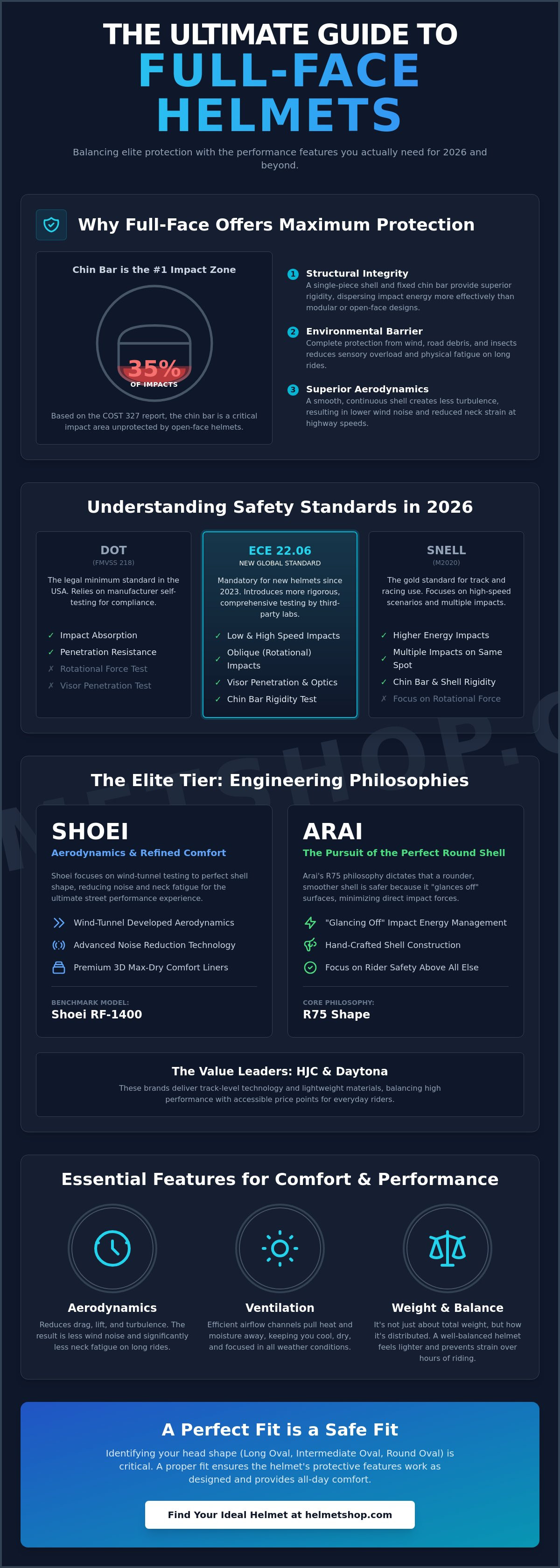
Data from global impact studies, including the COST 327 report, reveals that the chin bar area receives approximately 35% of all impacts in motorcycle accidents. If you wear an open-face helmet, that significant portion of the impact goes directly to your jaw and face. Beyond impact protection, full-face designs act as a total barrier against the environment. They effectively block high-velocity wind, road debris, and insects. This protection reduces sensory overload and prevents the physical fatigue that often sets in during long-distance rides.
To better understand this concept, watch this helpful video:
Comparing Safety Ratings: DOT vs. SNELL vs. ECE 22.06
Understanding Motorcycle helmet safety standards is vital for any rider in 2026. DOT certification is the legal baseline in the United States, but it relies on manufacturer self-testing. For a higher level of assurance, look for the ECE 22.06 standard. This regulation became mandatory for new production in July 2023 and introduces much more rigorous testing. It measures rotational acceleration and visor penetration, which were often overlooked in older tests. SNELL M2020 remains the gold standard for track use, as it tests for multiple impacts on the same spot to simulate high-speed racing scenarios.
The Performance Advantage of Full Face Aerodynamics
Aerodynamics play a massive role in how a full face motorcycle helmet feels at highway speeds. A smooth, continuous shell creates far less turbulence than a modular helmet with external hinges and seams. This lack of disruption significantly lowers wind noise, protecting your hearing and focus. Many premium models now feature integrated spoilers that help stabilize the head and reduce "lift." These components work to minimize the neck strain that usually occurs during long tours. When you choose a full-face design, you're investing in a quieter, more stable ride that lets you stay on the road longer without discomfort.
The Elite Tier: Comparing Shoei and Arai Full Face Engineering
Stepping into the premium market means moving beyond basic safety requirements. Brands like Shoei and Arai don't just meet standards; they redefine how a full face motorcycle helmet should perform over years of daily use. While mid-range options rely on mass-production techniques, these elite manufacturers utilize hand-crafted shell construction and multi-composite materials that provide a superior strength-to-weight ratio. This investment pays off through increased longevity and a significant reduction in rider fatigue.
Shoei: Aerodynamics and Refined Comfort
The Shoei RF-1400 stands as the current benchmark for modern street performance. Every curve of its shell is the result of exhaustive wind-tunnel testing. This process led to the development of vortex generators along the visor edges, which break up air resistance and drastically lower wind noise. Inside, the 3D Max-Dry interior system uses advanced materials to wick away sweat significantly faster than standard liners. If you want to dive deeper into these specific features, see our guide on Shoei Helmets: Why Premium Protection is a Worthy Investment. Their use of multi-density EPS liners ensures that the helmet can manage both high and low-speed impacts with precision.
Arai: The Pursuit of the Perfect Round Shell
Arai follows a strict design philosophy known as the R75 shape. They believe that a full face motorcycle helmet should be as round and smooth as possible. This design allows the helmet to "glance off" obstacles during a slide, which minimizes the rotational energy transferred to the rider’s head. Unlike other brands, Arai refuses to use integrated sun shields or large external spoilers that could snag during an accident. Each shell is hand-laid using their Peripheral Belted Complex Laminate Construction (PB-cLc) for maximum structural integrity. When evaluating these safety philosophies, referring to NHTSA's guide to choosing a helmet can help you understand how these premium features exceed basic legal benchmarks.
One of the biggest advantages of these elite brands is the ability to customize the fit. Arai offers replaceable cheek pads and interior liners in multiple thicknesses. This allows riders to tune the helmet to their specific facial structure. These premium helmets typically come with five-year warranties and are designed to remain comfortable and safe for a full seven-year lifecycle from the date of manufacture. You can browse our full range of high-performance full face helmets to see which engineering style fits your riding goals.
HJC and Daytona: Balancing Performance with Price Points
While Shoei and Arai represent the pinnacle of refinement, many riders find their ideal full face motorcycle helmet within the mid-range segment. Brands like HJC and Daytona have mastered the art of delivering essential safety features without the premium price tag. The primary difference often lies in the shell materials and the complexity of the manufacturing process. According to motorcycle safety statistics, wearing a DOT-compliant helmet significantly reduces the risk of head injury regardless of the brand's prestige. Choosing a mid-range model allows you to allocate funds toward other critical gear like jackets or boots without compromising on fundamental protection.
HJC: The Value-to-Performance Leader
HJC is currently one of the world's largest helmet manufacturers for a reason. Their RPHA series brings track-level technology to the street market at a fraction of the cost of elite rivals. They utilize P.I.M. Plus (Premium Integrated Matrix) shell construction. This blend of carbon fiber, aramid, and fiberglass creates a shell that's both incredibly strong and remarkably light. While it lacks the hand-crafted finish of an Arai, the performance gap is surprisingly narrow. The RPHA line also includes emergency quick-release cheek pads and highly efficient ventilation systems. These features were once exclusive to professional racing helmets but are now standard in HJC's high-performance offerings.
Daytona: Lightweight Simplicity
Daytona helmets cater to riders who prioritize a low-profile look and minimal weight. Their full-face models focus on streamlined designs that excel in urban and cruiser environments. Unlike the feature-heavy Shoei GT-Air series, Daytona often opts for a minimalist approach. This means fewer external vents and a simpler interior liner, which results in a lighter overall package. It's an excellent choice for riders who suffer from neck fatigue but don't require the complex aerodynamic spoilers found on racing helmets. You'll find these helmets offer a straightforward fit that works well for various head shapes.
Understanding shell materials is key to making an informed purchase. Polycarbonate shells are the most affordable but also the heaviest. Fiberglass and composite shells, like those found in HJC models, offer a better balance of weight and impact absorption. Carbon fiber sits at the top of the hierarchy, providing maximum strength with the least amount of mass. If you're a casual weekend rider, a high-quality polycarbonate or composite full face motorcycle helmet from HJC or Daytona provides excellent value. It ensures you stay protected while keeping your investment practical and efficient.
Essential Features: Aerodynamics, Ventilation, and Weight
A high-quality full face motorcycle helmet is defined by more than just its safety rating. While shell integrity is non-negotiable, secondary features determine whether you enjoy your ride or suffer through it. Aerodynamics, climate control, and technology integration transform a protective shell into a performance tool. These elements work together to reduce distractions, allowing you to focus entirely on the road ahead and the environment around you. High-performance models prioritize these details to ensure long-term comfort across varying climates.
Every component of a premium helmet serves a functional purpose. From the shape of the intake vents to the density of the interior foam, these design choices impact how the helmet behaves at highway speeds. When you evaluate these essential features, you're looking for a balance that matches your specific riding conditions, whether that's a daily commute or a cross-country tour. Small refinements in shell shape can drastically reduce wind buffeting and noise.
The Impact of Weight on Rider Fatigue
Don't be fooled by simple weight specs. A balanced 1600g full face motorcycle helmet often feels significantly lighter than a poorly balanced 1400g model. This is due to the center of gravity and the "pendulum effect." If weight is concentrated toward the top, your neck muscles work harder against wind pressure. Proper weight distribution in a helmet is the primary factor in preventing long-distance neck strain and rider exhaustion.
Ventilation and Visor Technology
Effective ventilation requires high air volume and exhaust efficiency. Look for these key features to stay cool:
- Chin bar intakes to prevent visor fogging and provide fresh air.
- Forehead vents that channel air through the EPS liner.
- Rear exhaust ports to pull hot, moist air out of the shell.
For visibility, ensure the helmet is Pinlock-ready to eliminate fogging in cold weather. Photochromic visors are also a great addition, automatically adjusting their tint based on light levels without needing a shield swap.
Communication System Readiness
Integrating technology shouldn't compromise safety. Modern helmets include pre-cut speaker pockets and wire channels to install Bluetooth Motorcycle Headsets without creating pressure points. When adding external units, consider the aerodynamic impact. Premium helmets often feature recessed areas to minimize wind noise and drag. Some manufacturers even offer seamless, integrated systems that maintain the helmet's original profile and balance.
Choosing the right combination of these features ensures your gear supports your riding style rather than hindering it. You can find the latest communication-ready full face helmets in our curated inventory to stay connected on every journey.
Choosing Your Ideal Full Face Helmet at The Helmet Shop
Finding the right full face motorcycle helmet involves more than selecting a graphic or a price point. The most sophisticated safety technology in the world fails if the helmet doesn't fit your head correctly. Proper fitment ensures that the energy-absorbing liners stay in the correct position during an impact. A helmet that is too loose will rotate upon contact, while one that is too tight creates painful distractions that compromise your focus. Achieving a perfect fit requires understanding your specific head geometry and taking precise measurements.
Determining Your Head Shape and Size
Manufacturers design shells around three primary head shapes. Long Oval shapes are longer from front to back and narrower from side to side. Intermediate Oval is the most common shape, featuring a slightly shorter front-to-back measurement. Round Oval shapes are wider in the middle and shorter from front to back. To find your size, use a cloth measuring tape to find the circumference of your head about one inch above your eyebrows. Always refer to the specific brand's sizing chart, as an "Extra Large" in an HJC may fit differently than the same size in an Arai.
Avoid the common mistake of "sizing up" for comfort. A new full face motorcycle helmet should feel snug, almost like a firm handshake. The cheek pads should press against your face, and there should be no gap between your forehead and the interior liner. Use the "Two-Finger" test by attempting to slide two fingers between your forehead and the helmet liner. If they fit easily, the helmet is too large. Check for pressure points by wearing the helmet for 15 to 20 minutes; any localized pain indicates a mismatch in head shape.
The Helmet Shop Advantage
We've carefully curated a selection of Shoei, Arai, and HJC models to ensure every rider finds a shell that matches their anatomy. Our team understands the technical nuances of each brand's internal geometry. This expertise helps you bridge the gap between technical specifications and real-world comfort. Whether you need the racing-derived performance of an HJC RPHA or the handcrafted refinement of an Arai, we provide the expert support necessary to make a confident investment.
Beyond the helmet, we help you build a complete protective kit. You can pair your new headgear with high-quality Tourmaster touring jackets or Cortech performance gear to ensure total body protection. Our national customers enjoy direct access to professional advice, ensuring that your gear arrives ready for the road. We focus on long-term relationships, providing the guidance you need to ensure your equipment remains reliable for the next five years of riding. Visit us to explore our full range of premium full face helmets and experience the difference that expert curation makes.
Secure Your Future on the Road
Choosing a full face motorcycle helmet is the most significant safety commitment you'll make as a rider. You've seen how the latest safety standards and advanced shell materials from Shoei and Arai provide protection that exceeds basic requirements. Whether you choose the handcrafted refinement of an elite brand or the high-performance value of an HJC model, the right gear always begins with a perfect fit. Understanding your specific head shape and ensuring correct weight distribution will keep you comfortable and focused during every tour.
We're here to help you navigate these technical choices with confidence. The Helmet Shop is an authorized dealer for Shoei, Arai, and HJC, offering an expert-curated selection of the safest gear available today. We provide national shipping on all protective apparel to ensure every rider has access to premium equipment. Browse Our Full Collection of Premium Full Face Helmets to find the perfect match for your riding style. Ride safe and enjoy every mile ahead.
Frequently Asked Questions
How long does a full face motorcycle helmet last before it needs replacement?
A full face motorcycle helmet typically lasts between five and seven years from the date of manufacture. Over time, the expanded polystyrene (EPS) liner becomes brittle and loses its ability to absorb impact effectively. You should also replace your gear immediately after any significant impact, as the internal structure is designed for one-time use only.
Is a carbon fiber full face helmet significantly safer than fiberglass?
Carbon fiber is primarily utilized for weight reduction rather than a massive increase in impact safety over fiberglass. While both materials offer excellent protection, carbon fiber reduces the rotational mass, which helps prevent neck fatigue during long rides. Safety ratings like ECE 22.06 ensure that both materials meet the same rigorous impact standards before they reach the market.
Can I install a Bluetooth headset in any full face helmet?
You can install a Bluetooth headset in most modern helmets, provided they have integrated speaker pockets. Premium manufacturers now design shells with recessed channels for wiring and specific mounting points for external units. Always check for these pre-cut pockets before purchasing to ensure the speakers don't create uncomfortable pressure points against your ears.
What is the difference between ECE 22.05 and the new ECE 22.06 rating?
The ECE 22.06 rating is a more stringent standard that replaces the older ECE 22.05 certification. It introduces testing for rotational acceleration and requires visors to withstand higher-velocity impacts. Helmets certified to this new standard undergo tests at a wider range of speeds and impact points, providing a more comprehensive safety profile for the rider.
Should a full face helmet feel tight when I first wear it?
A new helmet should feel quite snug and press firmly against your cheeks when you first wear it. The interior padding will break in and compress by approximately 10% to 15% after several hours of riding. If the helmet is comfortable and loose on day one, it will likely become too large and unsafe once the foam settles.
How much should I expect to spend on a high-quality full face helmet in 2026?
For a high-quality full face motorcycle helmet in 2026, costs vary based on brand and material technology. Premium models from Shoei and Arai often range from $550 to over $1,100 for specialized racing designs. Mid-range options from HJC provide excellent protection and features starting around $175, while carbon fiber models typically sit between $600 and $850.
Are expensive helmets like Arai and Shoei quieter than budget helmets?
Premium helmets are generally quieter because they undergo extensive wind-tunnel testing to refine their shell shapes. Brands like Shoei use high-quality visor seals and thicker neck rolls to block air from entering the bottom of the helmet. Budget models often use thinner liners and less precise visor mechanisms, which allows more wind turbulence to reach the rider's ears.
What should I do if my helmet falls off my bike onto the pavement?
If your helmet falls off your bike onto the pavement while empty, it is likely still safe to use. The EPS liner only compresses when a heavy object, like a head, is inside the shell to provide resistance. However, if the helmet drops from a significant height or shows visible cracks in the outer shell, you should have it inspected or replaced to ensure total protection.


