

Table of Contents
- Why Authentic Shoei Helmets Matter for Rider Safety
- What You'll Need Before You Inspect a Helmet
- Step 1: Check the Shoei Helmet Serial Number and Date Code
- Step 2: Inspect Authentic Shoei Helmet Labels and Certification Marks
- Step 3: Examine Shell Construction, Liner, and Hardware
- Step 4: Compare Graphics, Colorways, and Packaging Details
- Counterfeit Warning Signs vs. Normal Model Variations
- Step 5: Verify Through Authorized Sellers and Manufacturer Support
- What to Do If You Find a Counterfeit
- Frequently Asked Questions
Last Updated: October 15, 2026
Why Authentic Shoei Helmets Matter for Rider Safety
Knowing how to identify authentic Shoei helmets protects more than your wallet. A counterfeit lid can look convincing in photos and still fail when it matters most.
At Helmet Shop, we sell Shoei, Arai, HJC, and other premium brands, so we handle this question often.
This guide walks through seven verification steps. The NHTSA motorcycle helmet safety information explains why certified helmets matter in a crash.
What You'll Need Before You Inspect a Helmet
Gather a few basic tools first. Good light and a steady surface make small details readable.
- A bright flashlight or a well-lit workbench
- A magnifying glass for fine print
- A soft cloth to wipe dust off labels
- Your phone camera for close-up photos
- The helmet's original box and manual, if you have them
- The seller's listing or receipt for reference
Plan on 15 to 20 minutes for a full inspection. Work in this order: serial number and date code first, then labels and certification marks, then shell, liner, and hardware, then graphics and packaging.
One note before you start: normal model differences exist. A European-market helmet and a US-market helmet can carry different labels and still both be genuine Shoei products.
Step 1: Check the Shoei Helmet Serial Number and Date Code
Start here because production markings are the hardest thing for a counterfeiter to reproduce correctly. Shoei applies several identifiers during manufacturing, and they need to agree with each other and with the helmet you were sold.
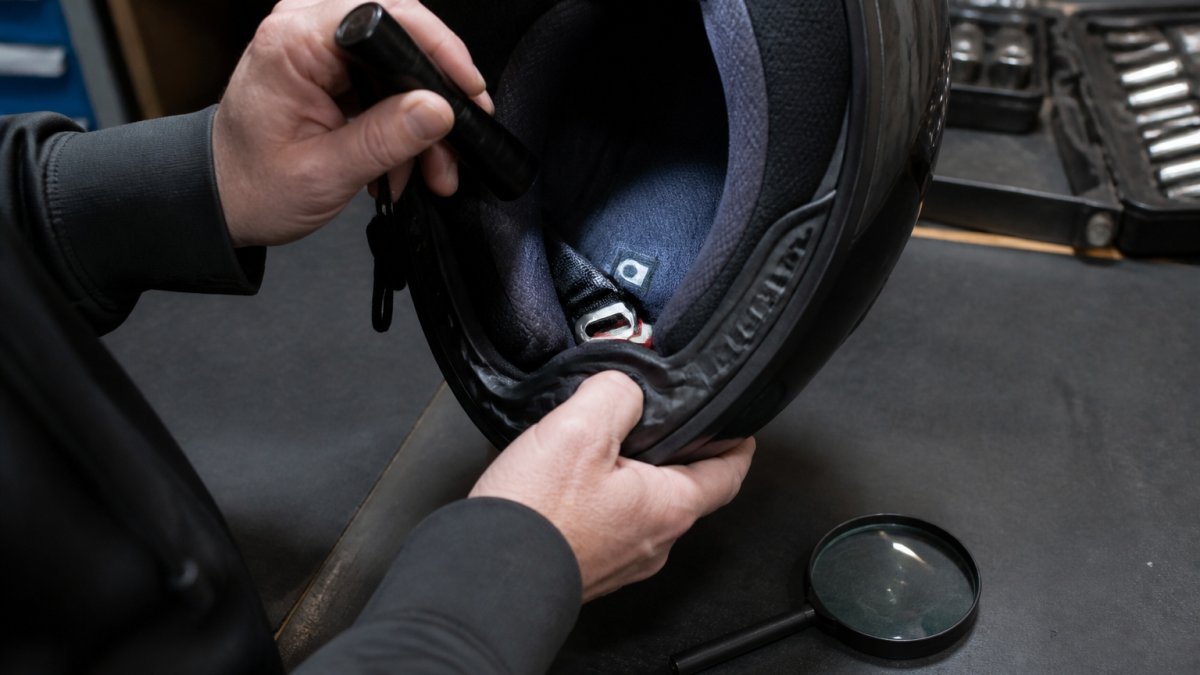
Where Shoei Puts Its Identifiers
On most current Shoei full-face models, you will find production information in three places:
- A shell label under the comfort liner. Peel the liner back gently at the crown or rear. Shoei attaches a printed label to the inner shell that carries the model designation, size, and production information.
- A chin strap tag. A small woven or printed tag is stitched to the strap. It typically shows the model and a production reference.
- A sticker or stamp on the EPS liner or shell edge. Depending on the model and production run, you may find an additional marking here.
Do not force the liner. If a seller will not let you lift the padding to photograph these areas before purchase, treat that as a serious warning sign.
What the Date Code Actually Tells You
The date code records when the shell was produced, not when it was sold. That matters for two reasons. First, helmets have a service life, and a helmet that sat in a warehouse for years before you bought it starts its clock earlier.
A common pattern on counterfeits is a date code that does not match the model generation printed on the shell, or a code format that does not resemble Shoei's own.
Cross-Checking the Serial Number
A serial number is only useful if you can trace it. Here is the sequence that works:
- Photograph the label, the chin strap tag, and the model/size print in one set of clear, well-lit images.
- Confirm the model name on the label matches the model name on the shell and on the box.
- Confirm the size on the label matches the size on the shell and the size you ordered.
- Contact Shoei's customer support with the model, size, and serial information and ask them to confirm the helmet against their records.
Shoei's support team is the authoritative source here. A seller's assurance, a marketplace listing, or a photo of a box is not.
Step 2: Inspect Authentic Shoei Helmet Labels and Certification Marks
Labels are where most riders make a false call. A helmet can carry different certification marks depending on the market it was built for and still be completely genuine. Knowing what each mark means, and where it lives on the helmet, keeps you from flagging a real Shoei as fake.
What Each Certification Mark Means
- DOT: The helmet meets Federal Motor Vehicle Safety Standard 218, the baseline requirement for on-road use in the United States. The mark is typically a sticker on the rear of the shell.
- Snell: The helmet has been tested to the independent Snell Memorial Foundation standard. Snell certification is voluntary and model-specific, and the current motorcycle standard is M2025D. The Snell label is usually placed inside the helmet, often under the liner or on the chin strap.
- ECE 22.06: The helmet meets the European standard used in many international markets. ECE-marked helmets are built for those markets and may not carry a DOT sticker at all.
Shoei builds market-specific versions of many models. A helmet sold in Europe may carry ECE 22.06 and no DOT mark. A helmet sold in the United States will carry DOT, and may also carry Snell depending on the model. Neither situation, on its own, means the helmet is counterfeit.
Where the Labels Sit and What They Should Look Like
Genuine Shoei labels share a few physical traits:
- Print is sharp and legible at close range, including small type
- Spelling and model names are correct
- Stickers are placed straight and consistently, not crooked or bubbled
- The DOT sticker on US-market helmets is a specific format, not a generic printed rectangle
- The Snell label, when present, carries the Snell Memorial Foundation name and the applicable standard
Blurry type, misspellings, a homemade-looking DOT sticker, or a Snell label that does not name the foundation are all worth a closer look.
Matching the Marks to the Model
Shoei models differ in what they carry. Our SHOEI RF-1400 FULL FACE HELMET carries Snell M2025D and DOT-218 approval. The SHOEI X-15 FULL FACE HELMET carries DOT, Snell M2020R, and ECE 22.06.

What is not normal is a helmet claiming every mark at once with no model logic behind it, or a helmet whose marks do not match the model name printed on the shell.
You can check the Snell Memorial Foundation certification program to understand what each standard covers and which models have been certified.
Step 3: Examine Shell Construction, Liner, and Hardware
Build quality is hard to fake at scale. Run your hands over the shell and open every moving part.
SHOEI RF-1400 FULL FACE HELMET →
Real Shoei shells use multi-ply composite construction. Our SHOEI RF-SR Full Face Helmet uses an AIM shell that blends fiberglass and organic fibers. The SHOEI GT-AIR 3 FULL FACE HELMET uses a Multi-Ply Matrix AIM composite shell.

Check these points:
- Shell seams should be smooth, with no rough patches or uneven paint
- The liner should fit snugly and detach cleanly where the model allows
- The chin strap and retention system should feel solid, not flimsy
- Vents should open and close with a firm, even click
- The visor should seat properly, with no gaps or wobble
Cheap hardware is one of the most common giveaways. If a buckle feels thin or a vent sticks, question the helmet.
Step 4: Compare Graphics, Colorways, and Packaging Details
Graphics and packaging are easy to copy badly. Compare the helmet in front of you against official product photos.
Look for these details:
- Decal edges should be crisp, not peeling or misaligned
- Colors should match the official colorway, not a washed-out version
- The model name should be spelled correctly everywhere
- The box should carry the correct model name and size
- The instruction manual should be included and printed clearly
Shoei offers many colorways across its range, so a rare color is not automatically fake. What matters is whether the finish quality and printed details hold up.
Counterfeit Warning Signs vs. Normal Model Variations
Not every difference means fake. This is where most riders get it wrong. They see a different label or a color they don't recognize and assume the worst.
Here is how to separate real problems from normal variation:
| What You See | Counterfeit Sign | Normal Variation |
|---|---|---|
| Missing or altered serial number | Yes | No |
| Blurry or misspelled labels | Yes | No |
| Different certification mark | No | Yes, by market |
| Rare or regional colorway | No | Yes |
| Flimsy hardware and buckles | Yes | No |
| No manual or plain box | Often | Sometimes |
| Discount far below retail | Often | Rare |
The pattern matters more than any single item. One odd detail is weak evidence. Three or four together is a strong signal.
Step 5: Verify Through Authorized Sellers and Manufacturer Support
The safest check is the seller, not the helmet. Authorized dealers buy directly from the manufacturer or its official distributors.
Ask yourself:
- Does the seller list a real business name and contact details?
- Do they offer a return policy and a warranty?
- Is the price in line with other authorized sellers?
- Can they show proof of authorized status?
If a price looks too good, it usually is. Genuine Shoei helmets carry a 5-year warranty, and authorized sellers honor it. A seller who cannot support a warranty claim is not an authorized dealer.
You can also contact Shoei directly with the serial number and model. Their support team can confirm whether a helmet is genuine.
What to Do If You Find a Counterfeit
Stop using the helmet right away. Do not ride in it, and do not resell it. A fake helmet offers no reliable protection.
Then take these steps:
- Report the seller to the platform where you bought it
- Request a refund and keep all photos and messages
- Report the listing to the manufacturer
- File a complaint with the Federal Trade Commission
If you are unsure whether a helmet is real, replace it with one from an authorized seller. Your safety is worth more than the money you save.
Buying a Shoei should give you confidence, not doubt. Counterfeits undercut that trust, and no discount is worth a helmet that may fail in a crash.
Frequently Asked Questions
Where are Shoei helmets manufactured?
Shoei helmets are handmade in Japan. The company operates its own manufacturing facility and has produced helmets there for decades. This matters for authentication because genuine Shoei helmets carry Japanese production markings, and the brand's 5-year warranty applies to helmets bought through authorized channels. If a seller claims a Shoei helmet was made elsewhere, that is a red flag worth investigating before you buy.
Can a Shoei helmet serial number verify that it is genuine?
A serial number is one piece of evidence, not proof on its own. Genuine Shoei helmets carry a serial number and production date code on a manufacturer label inside the shell. You can cross-reference that number with Shoei's customer support or an authorized dealer. Counterfeiters sometimes copy serial numbers from real helmets, so always pair the serial number check with a physical inspection of labels, shell construction, and hardware before concluding a helmet is authentic.
What labels should an authentic Shoei helmet have?
An authentic Shoei helmet sold in the US should carry a DOT FMVSS No. 218 certification label, and many models also carry Snell approval. For example, the Shoei RF-1400 is Snell M2025D and DOT-218 approved, while the Shoei X-15 carries DOT, Snell M2020R, ECE 22.06, and FIM homologation. Look for a manufacturer label with the model name, serial number, and production date, plus a separate certification label. Missing or misprinted labels are a warning sign.
What should I do if I suspect my Shoei helmet is counterfeit?
Stop using the helmet immediately and do not ride in it. Contact Shoei's customer support directly with photos of the serial number, labels, and any packaging. If you bought it from an authorized dealer, reach out to them as well. If you purchased through an online marketplace, file a dispute and report the listing. A counterfeit helmet has not passed the impact testing that a genuine Shoei helmet has, so treating it as protective gear carries a real safety risk.


